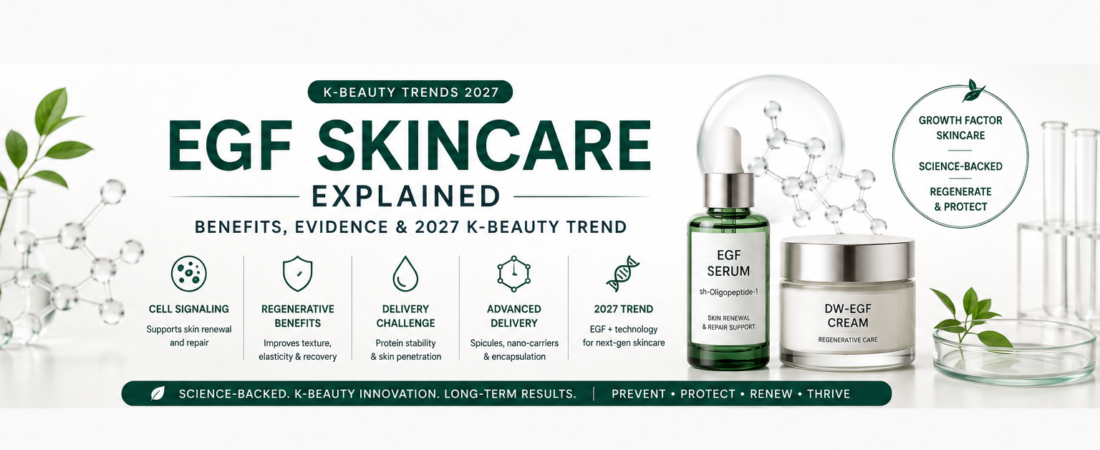
K-beauty loves regenerative ingredients.
PDRN promises recovery.
Exosomes bring biotechnology into skincare.
Spicules create treatment-inspired delivery.
And now another ingredient deserves renewed attention:
EGF skincare.
EGF stands for:
Epidermal Growth Factor.
Unlike many newly viral ingredients, EGF is not new science.
Researchers have studied epidermal growth factor for decades because of its role in epidermal homeostasis and wound-healing processes. EGF can influence cellular survival, proliferation, migration and differentiation through growth-factor signaling.
What is changing is the cosmetic technology surrounding it.
Growth-factor proteins are relatively large and structurally delicate molecules. Reviews of cosmetic growth factors identify poor transdermal delivery, protein instability and formulation interactions as major obstacles to effective topical use.
That creates one of the most interesting questions for 2027:
Can better delivery technology turn EGF from an old regenerative ingredient into a new K-beauty platform?
EGF Skincare: Quick Overview
| Factor | EGF Skincare |
|---|---|
| Full name | Epidermal Growth Factor |
| Common cosmetic INCI | sh-Oligopeptide-1 |
| Main biological role | Cell signaling involved in epidermal repair and homeostasis |
| Typical skincare positioning | Regeneration, elasticity, texture, wrinkles, recovery |
| Major advantage | Strong biological rationale |
| Major challenge | Stability and skin penetration |
| Common formats | Serum, ampoule, cream, eye cream |
| K-beauty example | Easydew / DW-EGF |
| Same as PDRN? | No |
| Same as exosomes? | No |
| 2027 opportunity | EGF + advanced delivery technology |
The European Commission’s CosIng database describes sh-Oligopeptide-1 as a recombinant human peptide produced through fermentation. This is one of the ingredient names consumers may encounter when looking at EGF-containing cosmetics.
What Is EGF?
EGF is a naturally occurring signaling protein.
Its biological importance comes from its ability to bind to the epidermal growth factor receptor, or EGFR, and activate signaling involved in processes such as:
- Cell proliferation
- Migration
- Differentiation
- Tissue homeostasis
- Repair processes
Dermatological research has investigated recombinant human EGF extensively, particularly in wound healing and regenerative applications.
Why Beauty Brands Care
Skin appearance depends partly on the ability of skin cells to maintain normal renewal and repair processes.
That gives EGF an attractive cosmetic story:
support the signals associated with skin renewal rather than simply adding moisture to the surface.
But biological plausibility and finished-cosmetic performance are not the same thing.
That distinction matters throughout this article.
EGF vs sh-Oligopeptide-1: Are They the Same?
Consumers searching for EGF skincare often become confused when the ingredient list does not literally say:
Epidermal Growth Factor.
Instead, they may see:
The European Commission CosIng database identifies sh-Oligopeptide-1 as a single-chain recombinant human peptide manufactured using fermentation.
What This Means for Consumers
If a brand markets:
EGF Serum
and the ingredient list contains:
sh-Oligopeptide-1
that can be part of the product’s EGF positioning.
However, the INCI name alone does not automatically tell you:
- The concentration
- Protein purity
- Biological activity
- Delivery efficiency
- Protein stability after manufacturing
- How much reaches the intended skin layer
Those details can be more important than simply seeing EGF on the front label.
How Does EGF Skincare Work?
The basic idea is cell signaling.
EGF interacts with epidermal growth factor receptors and activates downstream signaling pathways involved in cellular processes.
In dermatological research, EGF has been connected with wound repair and tissue homeostasis.
Cosmetic Interpretation
The cosmetic story is usually translated into benefits such as:
- Smoother texture
- Improved appearance of fine lines
- Elasticity
- Skin recovery
- More youthful-looking skin
Some human cosmetic studies have reported visible improvements following topical use of growth-factor formulations.
For example, a small three-month study involving 29 women using a serum containing bioengineered human-like EGF reported improvements in visible signs of photoaging.
Another review of growth-factor cosmetic products reported improvements in several skin-quality measures across studies, but also emphasized variability in product compositions and study designs.
So the evidence is interesting.
But it is not a reason to assume every EGF serum performs identically.
Potential Benefit 1: Skin Texture
One of the more plausible cosmetic outcomes is improved overall skin appearance and texture.
The 2012 clinical study of a topical barley-derived EGF serum assessed changes after three months of twice-daily use and reported improvements in visible photodamage and aging parameters.
What This Does Not Prove
It does not prove that:
every EGF serum improves texture.
Different products can vary substantially in:
- EGF source
- concentration
- stability
- delivery system
- supporting ingredients
That is why finished-product testing matters.
Potential Benefit 2: Fine Lines and Wrinkles
Growth factors have attracted particular interest in photoaging because skin aging involves changes in cellular signaling and extracellular-matrix maintenance.
Reviews of topical growth-factor skincare have reported improvements in visible wrinkles and other photodamage measures in some studies.
But There Is a Major Limitation
Many EGF studies are:
- Small
- Open-label
- Product-specific
- Combined with other growth factors
- Combined with additional actives
- Conducted after procedures that increase penetration
So we should not make the leap:
EGF exists in this cream → therefore this cream clinically reverses wrinkles.
The evidence should follow the specific formulation.
Potential Benefit 3: Recovery and Regenerative Positioning
This is where EGF naturally connects with current K-beauty.
EGF has a well-established research history in skin repair and wound-related biology.
That makes it commercially compatible with trends such as:
PDRN
exosomes
peptides
spicules
and
skin longevity.
But medical wound-healing evidence should not automatically be transferred to ordinary cosmetic claims.
A cosmetic moisturizer containing an EGF-related ingredient is not equivalent to a medical rhEGF wound treatment.
The Biggest Problem With EGF Skincare: Skin Penetration
This is arguably the most important part of the entire topic.
EGF is a protein.
Proteins generally create formulation challenges because they can be:
- Relatively large
- Structurally sensitive
- Vulnerable to degradation
- Difficult to deliver through the stratum corneum
A review focused specifically on growth factors in skincare identified low transdermal delivery efficiency and protein instability as major barriers to their cosmetic use.
Why This Matters
A beautiful ingredient story means little if:
the active cannot remain stable long enough or reach the relevant environment effectively.
That means the future of EGF skincare may depend less on:
“Who has EGF?”
and more on:
“Who can deliver EGF effectively?”
Why EGF + Delivery Technology Could Be the Real 2027 Trend
This is where the category becomes much more interesting.
A 2026 paper investigated an EGF-loaded FLEXIR-SOME delivery system designed to improve EGF stability and skin penetration.
Researchers reported that the EGF-containing particles had an average size of about 125 nm and showed improved stability and delivery characteristics compared with controls. The associated clinical testing reported improvements in measures related to aging appearance, moisture, skin barrier and hyperpigmentation.
The Important Lesson
The interesting part is not:
EGF was rediscovered.
It is:
EGF delivery is being redesigned.
This follows the same pattern we are seeing across modern K-beauty:
Old/known active + new delivery system = new category opportunity.
EGF + Spicules Already Has Research Behind It
This connection is particularly relevant to Beauty Seller Lab’s existing spicule coverage.
A Korean study evaluated soluble micro-spicules containing EGF for periocular wrinkles.
The study was designed around the idea that micro-needle/spicule technology could improve skin permeability and help deliver EGF more effectively.
That was published years before the current Reedle Shot boom.
Why This Matters Now
Modern consumers are already comfortable with:
- Reedle skincare
- microneedle patches
- ampoule shots
- treatment-inspired boosters
So EGF may benefit from a market that is finally ready to understand the delivery problem.
For more on this technology, read our Spicule Skincare 2027 Guide.
EGF vs PDRN
These ingredients are often grouped together under regenerative skincare.
But their mechanisms are not identical.
| Factor | EGF | PDRN |
|---|---|---|
| Type | Growth-factor protein | DNA-fragment material |
| Main story | Cell signaling | Regeneration / recovery |
| Classic research | Wound healing, tissue signaling | Regenerative medicine |
| Major cosmetic challenge | Protein stability + delivery | Source, concentration + topical evidence |
| Common K-beauty positioning | Recovery / wrinkles / elasticity | Recovery / glow / elasticity |
| 2027 opportunity | Advanced delivery | More transparent formulations |
The Commercial Difference
PDRN has become easier to explain to consumers:
Salmon DNA / vegan PDRN → regeneration.
EGF requires a more technical explanation:
signaling protein → receptor interaction → renewal biology.
That may make EGF more suitable for premium, science-led product positioning.
EGF vs Exosomes
EGF and exosomes are also fundamentally different.
EGF
A specific signaling protein.
Exosomes
Extracellular vesicles that can carry multiple biological materials and signaling molecules.
So:
EGF is one signal.
while the exosome concept is closer to:
a biological communication package.
That does not automatically make exosomes “better.”
It makes the technologies different.
For the broader biotechnology trend, see our Exosomes in Skincare Guide.
EGF vs Peptides
EGF is technically a peptide/protein signaling molecule, but ordinary cosmetic peptides cover a much wider family of compounds.
A product may contain:
- Signal peptides
- Copper peptides
- Carrier peptides
- Neurotransmitter-associated peptides
- Growth-factor-related peptides
EGF is therefore much more specific than simply saying:
peptide serum.
Why This Matters for Marketing
Peptide skincare is already mainstream.
EGF skincare can potentially occupy a more specialized:
high-performance regenerative peptide
position.
Real K-Beauty Signal: Easydew and DW-EGF
Korea already has one of the clearest long-term commercial EGF cases:
Easydew.
The brand currently states that its DW-EGF technology is based on decades of Daewoong Pharmaceutical research and promotes a patented EGF system with 99% purity positioning.
The current Easydew range includes multiple DW-EGF-associated products spanning:
- Essence
- Cream
- Eye cream
- Masks
- Post-treatment positioning
- Pigmentation-focused products
Easydew EGF Golden Elixir
Easydew launched its DW-EGF Golden Elixir 15 ml in December 2025, with a current listed price of KRW 99,000.
That is strategically interesting.
EGF is not being abandoned as an “old” ingredient.
It is still being developed into new premium formats.
Why Easydew Matters for the 2027 Trend
Easydew demonstrates something different from a viral TikTok ingredient.
It shows that EGF already has:
- pharmaceutical heritage
- proprietary technology
- multiple product formats
- premium pricing
- consumer recognition in Korea.
This gives EGF a commercial foundation that many emerging biotechnology ingredients do not have.
Beauty Seller Lab View
The 2027 opportunity is probably not:
EGF suddenly becomes a brand-new ingredient.
It is more likely:
EGF is repositioned inside regenerative, longevity and advanced-delivery skincare.
That’s a much stronger trend thesis.
How EGF Fits Skin Longevity
EGF also fits naturally into the emerging skin longevity category.
Skin longevity focuses on maintaining:
- Resilience
- Recovery capacity
- Cellular function
- Barrier quality
- Healthy aging
EGF’s signaling and regenerative biology creates a natural connection with that framework.
Possible Future Positioning
Instead of:
EGF wrinkle serum
brands could move toward:
Growth Factor Longevity Serum
or:
EGF Cellular Resilience Ampoule
The underlying ingredient may not have changed.
The category architecture has.
For the full framework, see our Skin Longevity in Skincare 2027 Guide.
EGF Skincare Still Has Important Limitations
The ingredient is scientifically interesting.
That does not make every EGF cosmetic exceptional.
1. Stability
Proteins can lose biological activity during manufacturing or storage.
2. Delivery
The skin barrier limits passive penetration of many large molecules.
3. Concentration Transparency
Consumers often cannot easily determine exactly how much active EGF is in a product.
4. Raw-Material vs Finished-Product Evidence
A study on EGF itself does not automatically validate a finished serum.
5. Study Quality
Some cosmetic growth-factor studies are small or lack large randomized controlled designs.
These limitations should be part of the conversation.
Does More EGF Mean a Better Product?
Not necessarily.
This is similar to the concentration problem we identified with PDRN.
A larger number may sound impressive.
But EGF performance also depends on:
- biological activity
- stability
- delivery
- formulation
- finished-product testing.
Better Questions to Ask
Instead of:
How many ppm of EGF?
ask:
What form of EGF is used?
Is it recombinant?
What is the concentration?
What delivery technology is used?
How is protein stability maintained?
Has the final product been clinically tested?
Those questions are much more useful.
Cosmetic Claims Need Careful Wording
This is especially important for global sellers.
In the United States, FDA explains that claims that a product is intended to treat disease or affect the structure or function of the body can move a product into drug territory rather than ordinary cosmetic positioning.
Safer Cosmetic-Style Positioning
Examples include:
Improves the appearance of fine lines.
Helps skin look smoother.
Supports a firmer-looking complexion.
Higher-Risk Language
Claims such as:
repairs damaged tissue
regenerates skin cells
stimulates cell division
heals wounds
can raise much more significant regulatory considerations depending on the market.
For beauty sellers, growth-factor science needs to be translated into cosmetic benefits carefully.
What Should Consumers Look For in EGF Skincare?
1. Clear Ingredient Identity
Look for information such as:
sh-Oligopeptide-1
or clearly disclosed proprietary EGF technology.
2. Delivery Technology
Look for explanations of:
- Liposomes
- Nanocarriers
- Spicules
- Microneedle formats
- Encapsulation
3. Product-Specific Testing
Prioritize evidence from the finished formula.
4. Packaging
Because protein stability matters, packaging and storage conditions can be more relevant than with simple moisturizing ingredients.
5. Realistic Claims
A credible brand should not need to promise:
reverse cellular aging overnight.
Why EGF Could Return as a Major K-Beauty Trend in 2027
Several factors are lining up.
Delivery Technology Is Improving
2026 research continues to focus on increasing EGF stability and skin delivery.
Regenerative Skincare Is Already Popular
Consumers already understand:
- PDRN
- exosomes
- spicules
- peptides
EGF fits naturally into the same ecosystem.
Skin Longevity Is Expanding
Growth-factor signaling provides a more advanced biological story for longevity-focused skincare.
K-Beauty Already Has EGF Heritage
Easydew has an established commercial EGF platform rather than needing to build the category from zero.
Treatment-Inspired Skincare Is Becoming Mainstream
Spicule and microneedle-style products make consumers more receptive to discussions of active delivery.
Taken together, my inference is that EGF has a stronger chance of re-emerging through advanced delivery and regenerative positioning than through a simple “EGF serum” revival.
What Beauty Sellers Can Learn From EGF
The weakest concept would be:
EGF Serum
because another brand can copy that immediately.
A stronger product-development strategy is:
EGF + Delivery
Encapsulated EGF Recovery Ampoule
EGF + Barrier
EGF + Ceramide Resilience Cream
EGF + Longevity
Growth Factor Skin Longevity Serum
EGF + Spicule
Micro-Spicule EGF Booster
EGF + Peptide
Multi-Signal Growth Factor Peptide Serum
The formula story becomes:
- Signal
- Delivery
- Specific skin problem
Measurable cosmetic result.
That is much harder to copy.
What Comes After EGF?
EGF is only one member of a much larger category:
growth factors.
Other factors appearing in research and regenerative skincare discussions include:
- FGF
- TGF
- VEGF
- IGF-related signaling
That makes Growth Factor Skincare a much larger potential cluster than EGF alone.
Our next comparison will examine:
EGF vs Exosomes
because the two represent very different approaches to biological signaling in modern skincare.
The Bottom Line
EGF skincare is not a new trend disguised as new science.
The biology has been studied for decades.
What is changing is the technology surrounding it.
The historical challenge has been clear:
EGF is biologically interesting but difficult to formulate and deliver effectively through topical skincare.
Now the category is moving toward:
encapsulation
nanocarriers
spicule delivery
treatment-inspired formats
and
regenerative / longevity positioning.
A 2026 EGF delivery study demonstrates how active research is continuing around improved stability and skin penetration, while Korean brand Easydew continues expanding its established DW-EGF platform with new premium products.
That creates an interesting 2027 opportunity.
The future probably isn’t:
EGF is back.
It is:
EGF + better delivery + better evidence + clearer positioning.
For consumers, the key question is not simply whether EGF appears on the label.
It is:
Can this specific formula keep the growth factor stable, deliver it effectively and demonstrate a meaningful cosmetic result?
And for beauty sellers, that difference could determine whether EGF becomes another recycled anti-aging claim — or the foundation of a new growth-factor skincare category.
FAQ
What is EGF skincare?
EGF skincare refers to topical cosmetic products positioned around epidermal growth factor or EGF-related recombinant peptides. EGF participates in signaling related to epidermal homeostasis and tissue repair.
What ingredient name should I look for?
One relevant cosmetic INCI is sh-Oligopeptide-1, which the European Commission describes as a recombinant human peptide produced through fermentation.
Does EGF help wrinkles?
Some small human studies and reviews of topical growth-factor products have reported improvements in visible wrinkles and photodamage. Results should not automatically be generalized to every EGF product.
Why is EGF difficult to use in skincare?
Growth-factor proteins face problems including instability, formulation interactions and limited transdermal delivery.
Can spicules deliver EGF?
Spicule-assisted EGF delivery has been studied. A Korean clinical study evaluated soluble micro-spicules containing EGF for periocular wrinkles.
Is EGF the same as PDRN?
No. EGF is a signaling growth factor, whereas PDRN consists of DNA-derived fragments used in regenerative contexts. Their mechanisms and formulation challenges differ.
Is EGF the same as exosomes?
No. EGF is a specific signaling molecule. Exosomes are extracellular vesicles capable of carrying multiple biological materials and signals.
Is EGF skincare a 2027 K-beauty trend?
EGF itself is established rather than new. However, active research into improved EGF delivery, the growth of regenerative skincare and continued Korean commercial development around DW-EGF suggest that advanced-delivery growth-factor skincare is worth watching in 2027. This is a market inference rather than a guaranteed forecast.