Peptides are becoming more specific.
A few years ago, a skincare product could simply say:
“Peptide Serum.”
Today, ingredient-conscious consumers increasingly want to know:
- Which peptide?
- What does it do?
- Is there clinical evidence?
- Is it a signal peptide or carrier peptide?
- Does delivery technology matter?
- Which peptide is better for my skin concern?
Two names appear frequently in this conversation:
Copper peptides and Matrixyl.
Both are associated with firmer, smoother and healthier-looking skin.
But they are not the same technology.
Copper peptides are usually discussed around GHK-Cu, a copper-binding tripeptide associated with tissue remodeling and skin-repair research.
Matrixyl is a proprietary peptide technology developed by Sederma/Croda. The original Matrixyl contains Palmitoyl Pentapeptide-4 and is positioned primarily around visible wrinkles and extracellular-matrix support.
So which is better?
The answer depends on what you are actually looking for.
Table of Contents
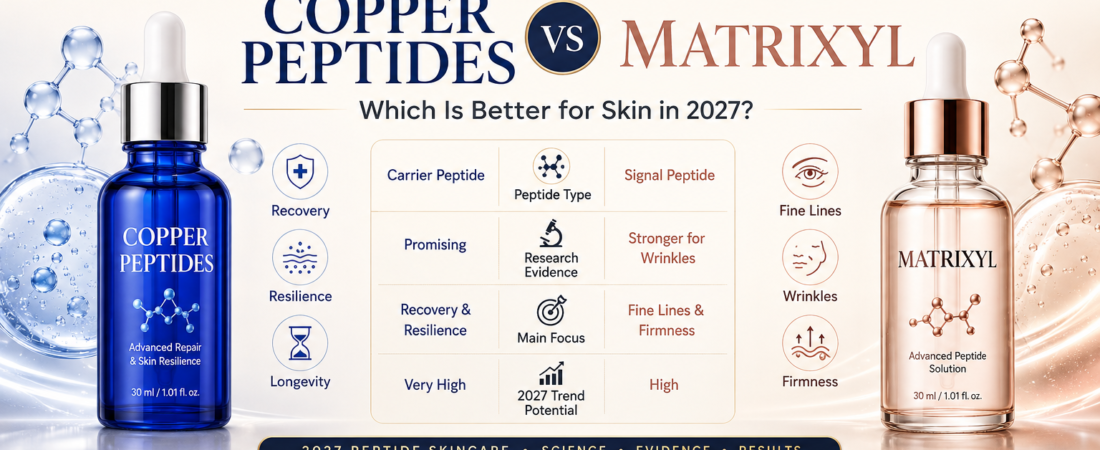
Copper Peptides vs Matrixyl: Quick Comparison
| Factor | Copper Peptides | Matrixyl |
|---|---|---|
| Best-known example | GHK-Cu | Palmitoyl Pentapeptide-4 |
| Peptide type | Copper-binding / carrier peptide | Signal peptide |
| Main positioning | Recovery, resilience, firmness | Fine lines, wrinkles, firmness |
| Research story | Tissue remodeling and regeneration | Wrinkle-focused cosmetic research |
| Direct published topical wrinkle evidence | Promising but limited | Stronger for original Pal-KTTKS |
| Consumer recognition | Growing quickly | Established |
| Visual identity | Often associated with blue formulas | Usually no distinctive color |
| Formula positioning | Regenerative / longevity | Anti-aging / wrinkle care |
| 2027 opportunity | Very high | High, especially with new delivery systems |
| Best for sellers | Strong trend story | Strong established-efficacy story |
The simplest answer is:
Matrixyl has the clearer wrinkle-treatment story.
while:
Copper peptides have the broader regeneration and skin-resilience story.
That distinction matters.
First: What Are Copper Peptides?
Copper peptides are peptides that bind copper ions.
The most famous example in skincare is:
GHK-Cu
or:
Glycyl-L-Histidyl-L-Lysine Copper.
GHK is a naturally occurring tripeptide.
When it forms a complex with copper, it becomes GHK-Cu.
GHK-Cu has been studied in connection with tissue remodeling, wound healing, extracellular-matrix activity and skin regeneration. However, that does not mean every cosmetic copper peptide serum has been clinically proven to produce the same result.
That distinction is important.
A recent scientific review specifically examining topical GHK noted substantial biological interest but also highlighted limitations in published clinical evidence and skin-delivery research.
Why Copper Peptides Became Popular Again
Copper peptides are not new.
Their resurgence comes from the fact that they fit several newer skincare narratives extremely well.
Regenerative Skincare
Consumers are becoming interested in products positioned around:
- Recovery
- Repair
- Resilience
- Skin quality
- Long-term maintenance
Copper peptides naturally fit this language.
Skin Longevity
Traditional anti-aging focuses heavily on wrinkles.
Skin longevity asks a broader question:
How do we maintain healthy-looking and resilient skin over time?
Copper peptides can be positioned within this wider framework.
Biotechnology-Led Beauty
Ingredients such as:
- PDRN
- Growth factors
- Exosomes
- Biomimetic peptides
have increased consumer interest in science-heavy skincare.
Copper peptides feel at home in the same category.
What Is Matrixyl?
Matrixyl is frequently described online as if it were one generic peptide.
It is more accurate to think of Matrixyl as a branded peptide technology family.
The original Matrixyl from Croda Beauty contains:
Palmitoyl Pentapeptide-4
also known in research literature as:
Pal-KTTKS.
Croda positions the ingredient around facial wrinkles, skin repair and smoothing.
This peptide belongs more naturally to the signal peptide category.
Instead of carrying a mineral such as copper, signal peptides are designed to mimic biological signals associated with extracellular-matrix activity.
Matrixyl Is Not the Same as Matrixyl 3000
This is where peptide skincare gets confusing.
You may encounter:
- Matrixyl
- Matrixyl 3000
- Matrixyl Synthe’6
- Other Matrixyl-branded technologies
These should not automatically be treated as identical ingredients.
The original Matrixyl contains Palmitoyl Pentapeptide-4.
Later Matrixyl technologies use different peptide systems.
So when a product says:
“Contains Matrixyl”
it is worth checking which Matrixyl technology is actually in the formula.
For this comparison, we are using the original Matrixyl concept as the reference point while acknowledging that the broader Matrixyl family has continued evolving.
How Does Matrixyl Work?
The original Matrixyl is based on a palmitoylated peptide.
The palmitoyl group helps make the peptide more lipid-friendly, which is relevant because the skin barrier is difficult for many peptide molecules to cross.
The peptide is associated with signaling processes related to extracellular-matrix maintenance.
That gives Matrixyl a very straightforward cosmetic story:
support structural processes associated with smoother-looking skin.
This explains why Matrixyl has historically been marketed around:
- Fine lines
- Wrinkles
- Firmness
- Skin smoothness
How Do Copper Peptides Work?
Copper peptides have a different story.
GHK can bind copper and form GHK-Cu.
Copper is involved in multiple biological processes, while GHK-Cu has been studied for tissue remodeling and repair-related activity.
Research has explored relationships with:
- Collagen
- Elastin
- Glycosaminoglycans
- Fibroblast activity
- Tissue repair
But there is an important caveat.
Strong biological mechanisms do not automatically equal strong topical cosmetic outcomes.
The skin barrier remains a major challenge for peptides.
A 2025 review of topical GHK described GHK-Cu as biologically promising but noted that published information on skin permeability and direct clinical anti-wrinkle performance remains limited.
That is why delivery technology is such an important part of the peptide category.
Round 1: Which Has Better Evidence for Wrinkles?
Winner: Matrixyl
If the question is specifically:
Which has stronger direct published evidence for visible wrinkles?
Matrixyl has an advantage.
A double-blind, placebo-controlled, split-face study evaluated Pal-KTTKS in 93 women aged 35 to 55 over 12 weeks.
The peptide-containing moisturizer produced statistically significant improvements in fine lines and wrinkles compared with the vehicle moisturizer.
That is valuable because it evaluates a topical formulation in human skin rather than relying only on laboratory mechanisms.
Copper peptides have a significant body of biological research, but a recent review noted a surprising shortage of direct clinical anti-wrinkle trials specifically involving topical GHK-Cu.
Beauty Seller Lab Verdict
For a straightforward wrinkle claim: Matrixyl has the cleaner published evidence story.
Round 2: Which Is More Interesting for Skin Recovery?
Winner: Copper Peptides
This is where GHK-Cu becomes more interesting.
Copper peptide research extends beyond wrinkles into areas related to:
- Tissue remodeling
- Recovery
- Repair
- Regenerative processes
This gives copper peptides a broader story.
Matrixyl is easier to explain as:
wrinkle-support peptide.
Copper peptides can be explained as:
skin-quality and recovery peptide technology.
For the current longevity and regenerative-skincare market, that broader narrative is commercially powerful.
Round 3: Which Is Better for Firmness?
Result: Tie
Both technologies can be positioned around firmness.
But they reach that positioning from different directions.
Matrixyl
The story is:
signal → extracellular-matrix support → smoother, firmer appearance
Copper Peptides
The story is:
copper-binding peptide → remodeling and recovery pathways → improved skin-quality positioning
The finished formula matters more than simply choosing one peptide name.
A poorly designed copper peptide serum is not automatically better than a well-formulated Matrixyl product.
And the opposite is also true.
Round 4: Which Is Better for Beginners?
Winner: Matrixyl
For many beginners, Matrixyl is easier.
Why?
The benefit is immediately understandable:
peptide for wrinkles and firmness.
Copper peptides often require more explanation.
Consumers may ask:
- Why is copper in skincare?
- Why is the serum blue?
- Can I use it with retinol?
- Can I combine it with vitamin C?
- Is it suitable for sensitive skin?
That creates more education work.
For experienced skincare users, that complexity can actually increase appeal.
For mainstream consumers, simplicity often wins.
Round 5: Which Has the Stronger 2027 Trend Story?
Winner: Copper Peptides
This is where the result flips.
Copper peptides connect naturally with several trends already expanding across skincare:
skin longevity
regenerative beauty
multi-peptide formulas
PDRN + peptide combinations
advanced delivery systems
That gives copper peptides a stronger “what comes next?” story.
They also appear increasingly in formulas beside other biotechnology-inspired ingredients.
Beauty Seller Lab expects the interesting question for 2027 to be less:
Are peptides trending?
and more:
Which peptide technologies are becoming recognizable categories of their own?
Copper peptides have a strong chance of becoming one of those categories.
But Matrixyl Is Also Evolving
Matrixyl is not standing still.
In April 2026, Croda introduced Matrixyl Neolide, an updated delivery technology built around encapsulation.
Croda says the system is designed to protect the peptide within formulations and provide controlled release after application. The company also reports firming results from its own testing.
This is strategically important.
The future of peptide skincare may not depend only on inventing new peptides.
It may depend on:
delivering existing peptides more effectively.
That could become one of the biggest peptide themes heading into 2027.
Delivery May Matter More Than the Peptide Name
Peptides face a fundamental cosmetic challenge.
Skin is a barrier.
A biologically interesting molecule must still:
- Remain stable in the formula
- Survive storage
- Remain compatible with other ingredients
- Reach the appropriate area of the skin
A copper-peptide study using microneedles demonstrated that GHK-Cu penetration could be enhanced substantially compared with intact skin.
That does not mean consumers should microneedle random peptide serums.
What it demonstrates is a broader principle:
delivery matters.
This is why technologies such as:
- Encapsulation
- Liposomes
- Spicules
- Controlled release
- Microneedle-inspired systems
are becoming increasingly relevant to peptide skincare.
Copper Peptides vs Matrixyl for Fine Lines
If your main concern is:
visible fine lines and wrinkles
Matrixyl has the more straightforward case.
The original Pal-KTTKS peptide has direct topical clinical data supporting visible improvements.
That does not guarantee that every product containing the ingredient will perform equally.
Concentration, formulation and consistency still matter.
But the marketing promise matches the evidence relatively clearly.
Beauty Seller Lab Pick:
Matrixyl
Copper Peptides vs Matrixyl for Skin Recovery
If your main goal is:
recovery, resilience and overall skin-quality positioning
copper peptides become more interesting.
GHK-Cu has a broader biological research story related to tissue remodeling.
Beauty Seller Lab Pick:
Copper peptides
Copper Peptides vs Matrixyl for Skin Longevity
This category is more conceptual.
Neither ingredient literally makes skin “live longer.”
But both can fit into modern skin-longevity routines.
Matrixyl contributes:
- Wrinkle support
- Firmness positioning
- Structural-support messaging
Copper peptides contribute:
- Recovery
- Remodeling
- Resilience
- Regenerative positioning
If skin longevity continues becoming a major beauty concept, copper peptides may have the stronger storytelling advantage.
Can You Use Copper Peptides and Matrixyl Together?
Potentially, yes.
There is no universal rule saying the two peptide categories must always be separated.
In fact, multi-peptide formulas increasingly combine several peptide technologies.
However, consumers should follow the instructions for the specific finished product.
This matters particularly with copper peptide formulations.
For example, The Ordinary currently advises users of its Multi-Peptide + Copper Peptides 1% Serum to avoid combining that specific serum in the same regimen with direct acids, retinoids or strong antioxidants such as direct vitamin C.
That should not automatically be turned into a universal chemistry rule for every copper peptide product.
Product-level formulation guidance matters.
Which Is Better for Sensitive Skin?
Neither ingredient category guarantees sensitive-skin compatibility.
Peptides themselves are often used in relatively gentle anti-aging formulas, but a finished serum may also contain:
- Acids
- Fragrance
- Botanical extracts
- Solvents
- Other active ingredients
If sensitive skin is the priority:
evaluate the whole formula, not only the peptide name.
Copper Peptides vs Matrixyl: Which Is Better With Retinol?
This depends heavily on the formula.
Matrixyl-type peptide products are frequently incorporated into routines alongside other anti-aging ingredients.
Some copper peptide brands, however, recommend separating their copper formulas from retinoids.
The Ordinary, for example, advises alternate use rather than combining its copper peptide serum with its retinoid formulations.
That is a brand-specific compatibility recommendation, not proof that every copper peptide and every retinoid are universally incompatible.
For consumers, the safest practical approach is simple:
follow the manufacturer’s instructions for the product you actually own.
Which One Has Better Marketing Potential?
This is where the answer changes depending on the customer.
Matrixyl
Strong for consumers who want:
- Familiar anti-aging
- Fine-line messaging
- Clinically inspired positioning
- Easy-to-understand benefits
Copper Peptides
Strong for consumers interested in:
- Biotech beauty
- Skin recovery
- Skin longevity
- Regenerative skincare
- More advanced ingredient stories
For retailers and brands, copper peptides currently have more novelty.
Matrixyl has more history.
Why Copper Peptides Could Become a Standalone Category
One of the most important developments in peptide skincare is increasing ingredient specificity.
Consumers once searched for:
peptide serum
Now they increasingly encounter:
copper peptide serum
This is the same pattern we have seen with other skincare categories.
For example:
retinoid → retinol → retinal
or:
vitamin C → L-ascorbic acid
As consumers become more educated, ingredient subcategories become commercially meaningful.
Copper peptides are well positioned for that transition.
Why Matrixyl Still Matters
Trendier does not necessarily mean better.
Matrixyl has something many newer skincare technologies still want:
history.
It has been used in cosmetic formulations for decades.
It also has recognizable peptide-brand equity within ingredient-led skincare.
And Croda’s 2026 launch of Matrixyl Neolide suggests the company is trying to extend that legacy into next-generation delivery technology rather than abandoning it.
That makes Matrixyl particularly interesting from a beauty-industry perspective:
a mature ingredient being modernized.
The Biggest Difference for Beauty Sellers
For consumers, the question is:
Which one should I use?
For beauty sellers, the more useful question is:
Which one is easier to position?
Matrixyl Positioning
“Clinically inspired peptide wrinkle care.”
Very clear.
Copper Peptide Positioning
“Advanced peptide technology for skin recovery, resilience and longevity.”
More sophisticated.
The second story may be more exciting.
The first may be easier to sell.
Copper Peptides vs Matrixyl: Final Score
| Category | Winner |
| Published wrinkle evidence | Matrixyl |
| Fine-line positioning | Matrixyl |
| Consumer simplicity | Matrixyl |
| Skin-recovery story | Copper Peptides |
| Regenerative positioning | Copper Peptides |
| Skin-longevity potential | Copper Peptides |
| 2027 trend appeal | Copper Peptides |
| Established ingredient history | Matrixyl |
| Overall | Depends on the goal |
There is no universal winner.
Beauty Seller Lab View
The most interesting conclusion is not:
Copper peptides beat Matrixyl.
or:
Matrixyl beats copper peptides.
It is that peptide skincare is becoming more specialized.
Consumers are starting to distinguish between:
- Signal peptides
- Carrier peptides
- Copper peptides
- Expression-line peptides
- Multi-peptide systems
- Branded peptide technologies
That creates a much more mature market.
For brands, simply writing:
PEPTIDE COMPLEX
may become less compelling.
The future may require explaining:
which peptide
what mechanism
what concentration
what delivery system
what evidence.
That is why both copper peptides and Matrixyl remain relevant heading toward 2027.
They simply tell different stories.
FAQ
Is Matrixyl a copper peptide?
No.
The original Matrixyl contains Palmitoyl Pentapeptide-4 and is a signal-peptide technology.
Copper peptides such as GHK-Cu bind copper ions and belong to a different peptide category.
Is Matrixyl better than copper peptides?
For direct wrinkle-focused positioning, Matrixyl currently has a clearer published topical clinical evidence story.
Copper peptides have a broader research and marketing narrative around remodeling, recovery and skin resilience.
Is GHK-Cu the same as copper peptide?
GHK-Cu is the best-known copper peptide used in skincare, but “copper peptide” is a broader description.
What does Matrixyl do?
Matrixyl is primarily positioned around smoothing visible wrinkles and supporting extracellular-matrix-related skin processes.
Which is better for fine lines?
Matrixyl has stronger direct published clinical evidence for visible fine-line and wrinkle improvement using Pal-KTTKS.
Which is better for skin recovery?
Copper peptides have the more extensive regeneration and tissue-remodeling research story.
Can I use Matrixyl and copper peptides together?
Potentially, depending on the finished products. Follow the manufacturer’s compatibility and layering instructions.
Are copper peptides better than retinol?
They should not be considered direct replacements.
Retinoids have a different and much larger body of dermatological research. Peptides can instead be viewed as complementary skincare technologies depending on the routine.
What is Matrixyl Neolide?
Matrixyl Neolide is a newer Matrixyl delivery technology introduced by Croda in 2026 using encapsulation designed to protect the peptide and provide controlled release.
Which peptide trend should sellers watch for 2027?
Copper peptides, multi-peptide formulas, peptide + PDRN combinations and improved peptide delivery systems are four areas worth watching.
The Bottom Line
Choose Matrixyl if your priority is a straightforward fine-line and wrinkle peptide story.
Choose copper peptides if you are more interested in skin recovery, regenerative beauty and the emerging skin-longevity category.
But the bigger 2027 trend may not be:
copper peptides vs Matrixyl.
It may be:
better peptide selection + better delivery + better evidence.
And that could push the entire peptide category into its next phase.