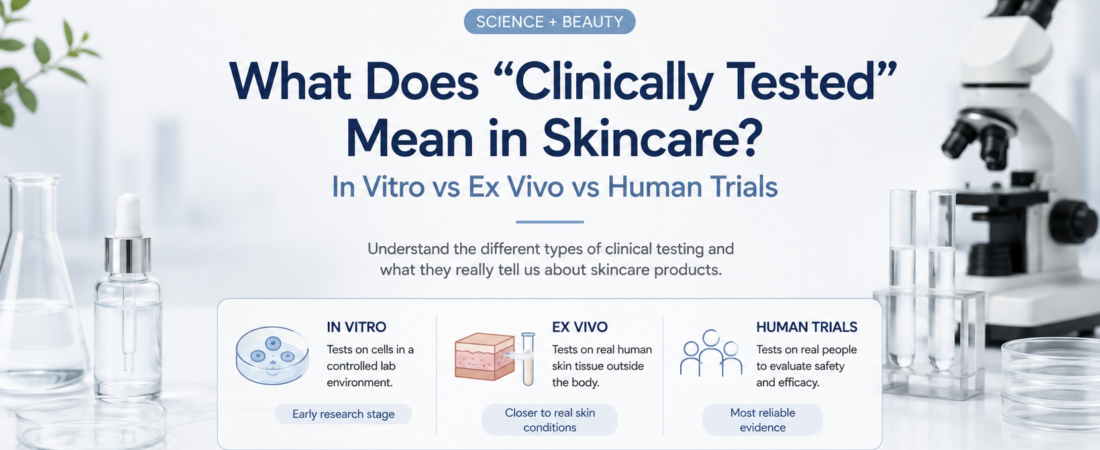
Clinically Tested Skincare sounds reassuring.
A serum may say:
- Clinically tested
- Dermatologist tested
- Clinically proven
- Tested to improve hydration
- Proven to reduce the appearance of wrinkles
- 95% of users saw smoother skin
All of these phrases sound scientific.
But they do not necessarily describe the same level of evidence.
A skincare ingredient may perform well in cultured cells but never have been tested in a finished cosmetic product. Another formula may have been applied to real human skin, but only in 20 volunteers with no control group. A third product may have been evaluated in a randomized, double-blind, vehicle-controlled human study using instrumental measurements.
All three might appear somewhere in marketing as “tested.”
That is why consumers need to understand what kind of test was actually performed.
In the United States, cosmetic claims generally do not receive FDA pre-approval before products reach the market. However, cosmetic labeling must be truthful and not misleading, and claims that move into disease treatment or body structure/function can change how a product is regulated. FDA explains cosmetic labeling claims here.
The Federal Trade Commission also makes an important point: when marketers use objective scientific language such as “clinically proven,” the evidence needs to support the level of proof being advertised. FTC guidance on scientific cosmetic claims.
So what should shoppers actually look for?
Clinically Tested Skincare: Quick Summary
| Evidence Type | What Is Tested? | Humans Involved? | What It Can Tell Us | Main Limitation |
|---|---|---|---|---|
| In vitro | Cells, proteins, reconstructed models | No | Mechanism and biological potential | Does not prove visible results on people |
| Ex vivo | Removed human skin tissue | Tissue only | Skin penetration and tissue response | Not a living whole person |
| Instrumental human test | Finished product on volunteers | Yes | Hydration, TEWL, elasticity, wrinkles, color, etc. | Design quality varies |
| Consumer perception study | Volunteers using product | Yes | How users feel about results | Subjective |
| Controlled clinical study | Product vs control/vehicle/placebo | Yes | Stronger product-specific evidence | May still be small or short |
| Randomized blinded trial | Controlled comparison | Yes | Reduces several types of bias | Less common in cosmetics |
| Independent replication | Result repeated elsewhere | Yes / varies | Strongest confidence | Rare for individual cosmetics |
The key lesson:
“Tested” tells you that something was studied. It does not tell you how strong the study was.
What Does “Clinically Tested” Actually Mean?
The phrase sounds specific.
But on its own, it leaves many questions unanswered.
For example:
How many people were tested?
A study with 15 volunteers and one with 300 volunteers are both human studies.
Was there a comparison group?
If everyone used the product and improved, we still need to know whether some improvement could have occurred from:
- Seasonal changes
- Using moisturizer more consistently
- Stopping irritating products
- Measurement variation
- The base formula itself
Was the finished product tested?
This matters enormously.
A brand may cite research on:
ingredient X
while selling:
serum containing ingredient X.
Those are not automatically equivalent.
FTC guidance specifically warns that a claim about a “clinically tested ingredient” can imply not only that the ingredient was tested but that the finished product delivers the advertised benefit; depending on the claim, experts may require evidence on the actual finished product. Read the FTC Health Products Compliance Guidance.
The Evidence Ladder: Not All Skincare Studies Are Equal
It is useful to think of skincare evidence as a ladder.
Level 1 — Ingredient Theory
At the bottom is a biological hypothesis.
Researchers may know that a molecule participates in:
- Collagen pathways
- Oxidative stress responses
- Inflammation signaling
- Water retention
- Barrier function
This is useful.
But a plausible mechanism is not the same as a proven cosmetic result.
Level 2 — In Vitro Testing
In vitro literally means research performed outside a living organism.
In skincare research, this can involve:
- Keratinocytes
- Fibroblasts
- Melanocytes
- Cell cultures
- Reconstructed epidermis
- 3D skin models
- Isolated enzymes or proteins
Researchers may expose cells to an ingredient and measure changes in:
- Gene expression
- Collagen-related markers
- Cytokines
- Oxidative stress
- Cell viability
- Melanin-related pathways
Modern human-relevant in vitro models can be sophisticated, including reconstructed epidermis and full-thickness skin equivalents. They are valuable for mechanistic research, safety assessment and early product development, but translation to actual clinical outcomes still requires caution.
Example
Imagine a peptide increases a collagen-related marker in cultured fibroblasts.
That supports the statement:
The peptide demonstrated collagen-related biological activity in vitro.
It does not automatically support:
This serum visibly removes wrinkles in humans.
That jump is one of the most common problems in skincare marketing.
Why In Vitro Evidence Still Matters
In vitro studies are not “bad evidence.”
They answer a different question.
They are useful for asking:
Could this ingredient plausibly do something biologically interesting?
They can help researchers:
- Screen ingredients
- Compare concentrations
- Study mechanisms
- Explore toxicity
- Select formulas for later testing
The mistake is not using in vitro studies.
The mistake is pretending they prove more than they do.
A 2025 review of commercially available cosmetic peptides identified 102 peptides and found widely varying levels of in vitro and ex vivo evidence behind their claimed activities. Read the peptide evidence review.
This is directly relevant to our previous discussion of PDRN vs Peptides.
Level 3 — Ex Vivo Testing
Ex vivo studies use tissue removed from a living organism and studied outside the body.
In skincare, one of the most useful models is:
human skin obtained after surgery.
The tissue retains much more of real skin’s architecture than a simple cell culture.
Human skin explants can preserve:
- Epidermis
- Dermis
- Keratinocytes
- Fibroblasts
- Extracellular matrix
- Collagen
- Elastin
This makes ex vivo skin particularly useful for:
- Penetration testing
- Delivery technology
- Barrier studies
- Histology
- Protein-expression analysis
- Short-term biological responses
A review of ex vivo human skin models describes them as promising tools for the efficacy and safety evaluation of topical products because native skin structure is preserved. Read the ex vivo skin review.
Why Ex Vivo Evidence Is Stronger Than a Simple Cell Study
Suppose a PDRN formulation is applied to actual human skin tissue.
Researchers might examine:
- Where the material penetrates
- Whether it remains in the epidermis
- Whether it reaches deeper layers
- Changes in biological markers
- Tissue integrity
That tells us more about topical delivery than placing PDRN directly onto isolated cells.
This is why ex vivo work is especially relevant to our article on PDRN Delivery Technology.
A 2022 study, for example, developed a method for separately evaluating compounds in the epidermal and dermal layers of ex vivo human skin, illustrating how these models can help study topical delivery. See the ex vivo transdermal study.
But Ex Vivo Still Is Not a Human Clinical Trial
This distinction matters.
A skin explant does not experience:
- Blood circulation
- Hormonal changes
- Daily environmental exposure
- Real-life product use
- Long-term metabolism
- Full immune-system interactions
It is biologically valuable.
But it remains a model.
Therefore:
Ex vivo evidence can strengthen a mechanism or delivery claim, but it does not automatically prove visible consumer results.
Level 4 — In Vivo Human Testing
In vivo means the test occurs in a living organism.
For consumer skincare, the most relevant version is:
testing the finished product on real human volunteers.
This is when evidence begins to answer the question consumers usually care about:
Does this actual product produce a measurable result when people use it?
Human cosmetic testing can still vary dramatically in quality.
Instrumental Testing: Measurements Instead of Opinions
Some clinical skincare studies use instruments to measure skin properties.
Common examples include:
Corneometer
Measures changes related to stratum-corneum hydration.
Tewameter
Measures transepidermal water loss, or TEWL.
This can provide information related to barrier function.
Cutometer
Measures skin mechanical properties such as elasticity.
3D Imaging
Can quantify:
- Wrinkle depth
- Surface roughness
- Texture
- Volume
Colorimetry
Can measure changes in:
- Redness
- Pigmentation-related color
- Brightness-related parameters
These methods can provide more objective evidence than simply asking:
“Do you think your skin looks better?”
But instrumental testing is not automatically perfect.
The study still needs good:
- Controls
- Standardized conditions
- Statistical analysis
- Sample selection
- Measurement procedures
Consumer Perception Studies
You’ve probably seen claims like:
97% agreed skin felt smoother.
This usually comes from a consumer-perception or self-assessment study.
Participants may answer questions such as:
- Does your skin feel softer?
- Does your skin look brighter?
- Does your skin feel moisturized?
- Would you continue using this product?
These studies are useful because cosmetic experience matters.
Texture, comfort and perceived improvement influence whether people continue using a product.
But these results are subjective.
Important Difference
“97% of participants agreed their skin felt smoother”
is not the same claim as:
“skin roughness decreased by 97%.”
The first is an opinion rate.
The second sounds like an instrumental measurement of effect size.
Consumers should never treat them as interchangeable.
Level 5 — Controlled Human Studies
A stronger study introduces a comparison.
For example:
Product vs Untreated Skin
One area receives the product.
Another receives nothing.
Product vs Vehicle
The active formula is compared with the same base formula without the active ingredient.
Product vs Placebo
Participants use a control product designed to resemble the tested product.
Split-Face Study
One side of the face uses one formula and the other side uses another.
This can be useful in skincare because each participant acts partly as their own control.
Why the “Vehicle” Matters
Consider a cream containing:
PDRN + glycerin + emollients + occlusives.
If hydration improves, what caused it?
Possibilities include:
- PDRN
- Glycerin
- The emollient system
- Occlusion
- The entire formula
A vehicle-controlled study can help separate:
effect of the base formula
from:
additional effect of the target active.
Without that comparison, ingredient-specific conclusions become much harder.
This is especially important when reading studies behind ingredient-heavy categories such as PDRN skincare, exosomes in skincare and Ectoin in Skincare.
Level 6 — Randomized and Blinded Trials
Two words can significantly improve study quality:
randomized
and:
blinded.
Randomized
Participants or treatment areas are assigned randomly.
This reduces selection bias.
Single-Blind
Usually the participant does not know which treatment they received.
Double-Blind
Both participants and the people assessing outcomes may be blinded to treatment assignment.
Blinding helps reduce expectation bias.
If a participant knows:
“This is the expensive anti-aging serum”
they may perceive results differently.
If an evaluator knows which side received the active formula, that knowledge can also influence subjective scoring.
Does Every Cosmetic Need a Randomized Controlled Trial?
No.
This is where skincare discussions often become too simplistic.
The evidence needed should reflect the claim being made.
For a basic cosmetic statement such as:
“skin feels softer after use”
a huge pharmaceutical-style trial may be unnecessary.
But stronger claims demand stronger evidence.
The FTC explains that the type of substantiation required depends on the nature of the claim, while health-related efficacy or safety representations require competent and reliable scientific evidence.
Similarly, EU Regulation 655/2013 requires cosmetic claims to be supported by adequate and verifiable evidence, and where studies are used, they should be relevant to the product and claim and use valid, reliable and reproducible methodologies. Read EU Regulation 655/2013.
“Clinically Tested” vs “Clinically Proven”
These phrases may look almost identical.
But psychologically they create different expectations.
Clinically Tested
Suggests:
a clinical test was conducted.
It does not tell you:
- Whether the result was positive
- How large the effect was
- Whether there was a control
- Whether the study was blinded
- Whether the finished product was tested
Clinically Proven
Suggests something stronger:
the clinical evidence established the claimed benefit.
That higher implied level of evidence matters.
In a well-known cosmetics enforcement case, the FTC challenged advertising that used “clinically proven” language while making claims that the agency said exceeded the underlying evidence. Read the FTC L’Oréal case.
Beauty Seller Lab Rule
The stronger the marketing phrase, the stronger the evidence you should expect.
“Dermatologist Tested” Is Another Different Claim
Consumers sometimes interpret:
dermatologist tested
as:
dermatologist approved
or even:
clinically proven effective.
These are not necessarily equivalent.
A dermatologist-supervised test may primarily assess:
- Irritation
- Tolerability
- Safety under use conditions
rather than anti-aging effectiveness.
So when you see:
Dermatologist Tested
ask:
Tested for what?
Ingredient Evidence vs Finished-Product Evidence
This may be the single most useful rule in modern skincare.
Suppose a brand says:
“Ingredient X increased collagen markers by 40% in a study.”
Then the serum contains ingredient X.
That does not automatically mean:
“This serum increases human skin collagen by 40%.”
Why?
Because the final result depends on:
- Ingredient concentration
- Molecular form
- Stability
- pH
- Vehicle
- Delivery system
- Interaction with other ingredients
- Penetration
- Use frequency
The EU’s cosmetic-claims criteria explicitly warn that ingredient claims should not imply the finished product has the same properties when it does not, and extrapolating ingredient properties to a finished product requires appropriate evidence.
This is particularly relevant to high-tech ingredients such as:
- PDRN
- Peptides
- Growth factors
- Exosomes
- Ectoin
A Better Evidence Chain
The strongest skincare research often looks something like:
Step 1 — In Vitro
Does the ingredient have a plausible biological effect?
Step 2 — Ex Vivo
Can it interact with or penetrate actual human skin tissue?
Step 3 — Formulation Testing
Is the ingredient stable and available in the finished formula?
Step 4 — Human Study
Does the finished product produce measurable improvements?
Step 5 — Controlled Human Study
Are improvements greater than vehicle, placebo or baseline variation?
This is much stronger than relying on one isolated laboratory result.
A recent 2026 topical-skin study illustrates the translational approach by combining in vitro, ex vivo and clinical investigations rather than treating one model as the entire proof chain. See the integrated 2026 study.
How Large Should a Skincare Study Be?
There is no single magic number.
But sample size matters.
Compare:
Study A
12 participants
Study B
35 participants
Study C
120 participants
All else being equal, larger samples generally provide more confidence that a result was not driven by a few unusual participants.
But:
larger does not automatically mean better.
A poorly controlled study with 500 participants may answer a weaker question than a carefully designed controlled study with 50.
Study quality depends on the entire design.
Study Duration Matters Too
A claim about:
immediate hydration
may reasonably be measured after:
- 30 minutes
- 2 hours
- 8 hours
- 24 hours
A claim about visible:
- Fine lines
- Pigmentation
- Firmness
- Texture
usually needs a longer timeline to be meaningful.
So if you see:
“wrinkles visibly improved”
check whether the study lasted:
- One application?
- Seven days?
- Four weeks?
- Twelve weeks?
Time changes what a result actually means.
What Does “Statistically Significant” Mean?
You may see skincare studies state:
p < 0.05
This usually means the observed result would be relatively unlikely under the statistical null model used in the study.
But statistical significance does not automatically mean:
the result is visually dramatic.
Imagine wrinkle depth changes by:
0.8%.
With a large enough dataset, that might be statistically detectable.
But consumers may not notice it.
That is why we should consider both:
Statistical Significance
Is the change unlikely to be random under the study’s assumptions?
Practical or Clinical Relevance
Is the magnitude meaningful to the user?
The second question is often missing from beauty marketing.
Before-and-After Photos Are Evidence — But Weak Without Standardization
Before-and-after images can be helpful.
But they are extremely sensitive to:
- Lighting
- Camera position
- Facial expression
- Makeup
- Distance
- Lens
- Image processing
A trustworthy study should standardize these variables as much as possible.
Otherwise:
photography technique may become part of the “result.”
This issue also appears in new beauty technologies such as AI Skin Analysis, where lighting, camera quality and positioning can meaningfully affect image-based measurements.
7 Questions to Ask When a Product Says “Clinically Tested”
Here is a practical checklist.
1. Was the Finished Product Tested?
Best:
The exact commercial formula was evaluated.
Weaker:
One ingredient was tested separately.
2. Was It Tested on Humans?
Look for:
- Number of subjects
- Age range
- Skin types
- Inclusion criteria
3. Was There a Control?
Check for:
- Placebo
- Vehicle
- Untreated skin
- Split-face comparison
4. What Was Actually Measured?
Was it:
- Hydration?
- TEWL?
- Wrinkle depth?
- Pigmentation?
- Consumer perception?
Marketing language should match the measured endpoint.
5. How Long Did the Study Last?
Immediate hydration data should not be presented as long-term skin remodeling evidence.
6. Who Conducted the Study?
Possible sources include:
- Brand laboratory
- Contract research organization
- University
- Independent laboratory
Industry-funded research is not automatically invalid.
But funding and conflicts of interest are useful context.
7. Is the Full Study Available?
A product page may show:
+23% firmness
without explaining:
- Baseline
- Sample size
- Control
- Measurement method
- Statistical analysis
The more extraordinary the claim, the more detail we should want.
How to Read a Percentage Claim
Skincare percentages are extremely easy to misunderstand.
Consider:
“100% showed improvement.”
This could mean:
All 20 participants improved by at least some measurable amount.
It does not mean:
the product improved skin by 100%.
Likewise:
“90% agreed skin looked brighter.”
means:
90% gave a favorable questionnaire response.
It does not mean brightness increased by 90%.
Whenever you see a percentage, ask:
Percentage of what?
Why This Matters More in 2027
Skincare marketing is becoming more scientific.
Consumers now regularly encounter terms such as:
- PDRN
- Exosomes
- Growth factors
- Peptides
- Biomimetic
- Nanoliposomes
- Microbiome
- Cellular longevity
Science-based marketing can be useful.
It can also make weak evidence look stronger than it is.
A molecule diagram, laboratory photograph or white coat does not strengthen a study.
Only better evidence does.
This is becoming especially important as emerging technologies and advanced delivery systems enter the same mainstream beauty conversation covered in our 2027 K-Beauty Trends guide.
Beauty Seller Lab Evidence Scale
Here is the framework we recommend when evaluating skincare.
| Rating | Evidence | Interpretation |
|---|---|---|
| 1/5 | Marketing theory | Interesting claim, little direct evidence |
| 2/5 | In vitro evidence | Mechanistically promising |
| 3/5 | In vitro + ex vivo | Better biological relevance |
| 4/5 | Finished-product human study | Useful consumer evidence |
| 5/5 | Controlled human studies + replication | Highest confidence |
This scale is deliberately simplified.
Real evidence does not always move neatly in a straight line.
But it is much more useful than dividing ingredients into:
works
and:
doesn’t work.
Strong Evidence Does Not Guarantee a Strong Product
There is one final complication.
Even if an ingredient has excellent research, a particular product may still be disappointing.
Why?
Because skincare performance depends on:
- Formula
- Packaging
- Stability
- Concentration
- Delivery
- Texture
- Compatibility
- User adherence
This is why our PDRN Delivery Technology 2027 article focuses on delivery rather than simply asking which serum has the largest number printed on the bottle.
The same principle applies broadly:
Ingredient reputation is not finished-product proof.
Weak Evidence Does Not Always Mean a Product Is Useless
The reverse is also true.
Suppose a moisturizer has no published randomized clinical trial.
It may still:
- Feel excellent
- Reduce visible dryness
- Improve comfort
- Help the user maintain a consistent routine
Not every useful cosmetic needs to become a medical research project.
Evidence should be proportional to the claim.
The problem begins when:
modest evidence
is used to support:
extraordinary promises.
Regulatory Reality: Claims Matter
In the United States, FDA distinguishes cosmetics from drugs partly through intended use.
Claims that a product:
- Treats disease
- Prevents disease
- Changes body structure or function
can move the product into drug territory. FDA gives examples such as claims involving hair restoration or cellular effects. See FDA’s cosmetic vs drug explanation.
This is why wording matters.
Compare:
Cosmetic-style claim
Helps reduce the appearance of fine lines.
Much stronger claim
Stimulates collagen production to rebuild damaged dermal tissue.
The second moves much closer to structure/function territory in the U.S. regulatory framework.
Europe Uses a Weight-of-Evidence Approach
EU cosmetic-claims rules provide another useful framework for evaluating marketing even if you are not shopping in Europe.
Regulation 655/2013 includes principles such as:
- Truthfulness
- Evidential support
- Honesty
- Fairness
- Informed decision-making
It states that evidence should match the claim and that study methodology should be valid, reliable and reproducible. It also says the acceptability of a claim should consider the weight of evidence rather than cherry-picking a single favorable result.
That last principle is particularly valuable for consumers.
Do not ask:
Can I find one positive study?
Ask:
What does the total body of evidence suggest?
Beauty Seller Lab View
The phrase Clinically Tested Skincare should be the beginning of your evaluation.
Not the end.
When a product says:
clinically tested
the next question should be:
How?
Then ask:
On what?
Then:
On whom?
Then:
Compared with what?
Then:
What changed, and by how much?
A strong skincare claim should survive those questions.
The best evidence chain is rarely:
ingredient → laboratory result → miracle claim.
It is closer to:
mechanism → skin model → finished formula → human measurement → controlled comparison.
That is especially important for emerging ingredients such as PDRN, exosomes, peptides and ectoin, where research is moving quickly and the marketing often moves even faster.
FAQ
What does clinically tested mean in skincare?
It generally indicates that some form of clinical or human testing has been performed, but the phrase alone does not reveal the study design, sample size, control group or size of the result.
Is clinically tested the same as clinically proven?
No. “Clinically proven” conveys a stronger claim about the evidence. FTC guidance emphasizes that marketers making express claims about scientific proof need evidence that matches the level of substantiation represented.
What is an in vitro skincare study?
An in vitro study tests ingredients or biological effects outside a living person, often using cells, proteins or reconstructed skin systems.
What is an ex vivo skincare study?
Ex vivo research studies removed tissue—often human skin obtained from surgery—under controlled laboratory conditions.
Is ex vivo better than in vitro?
It may better preserve real skin architecture, but each model answers different questions. Neither automatically proves a visible benefit in consumers.
What is an in vivo skincare study?
For cosmetics, this usually refers to testing a product on living human volunteers and measuring outcomes under actual-use or controlled conditions.
Are consumer perception studies clinical studies?
They can be part of human product evaluation, but their outcomes are subjective. A self-reported improvement should not be confused with an objectively measured percentage improvement.
How many people should be in a skincare clinical study?
There is no universal number. Study design, controls, duration and measurement quality are as important as sample size.
Does dermatologist tested mean dermatologist approved?
Not necessarily. It means some form of testing or assessment involved dermatological supervision or expertise, but consumers need additional context about what was evaluated.
Can a brand use ingredient research to support a finished product?
Sometimes, depending on the claim and evidence. But ingredient evidence should not automatically be presented as proof that the finished formula produces the same effect. EU guidance expressly addresses this distinction, and FTC guidance also warns about implied finished-product claims from clinically tested ingredients.
The Bottom Line
Clinically Tested Skincare is not one single level of proof.
Evidence can range from:
cells in a laboratory
to:
human skin tissue
to:
consumer questionnaires
to:
instrumental human measurements
to:
randomized controlled trials.
All of these can contribute useful information.
But they answer different questions.
For consumers, the most important habit is simple:
Do not stop at “clinically tested.” Read one line deeper.
Find out:
what was tested
who was tested
how the result was measured
whether there was a control
and:
whether the evidence belongs to the ingredient or the finished product.
That small change makes skincare marketing much easier to understand.
And in a beauty market becoming increasingly scientific, it may be one of the most useful skincare skills to have.