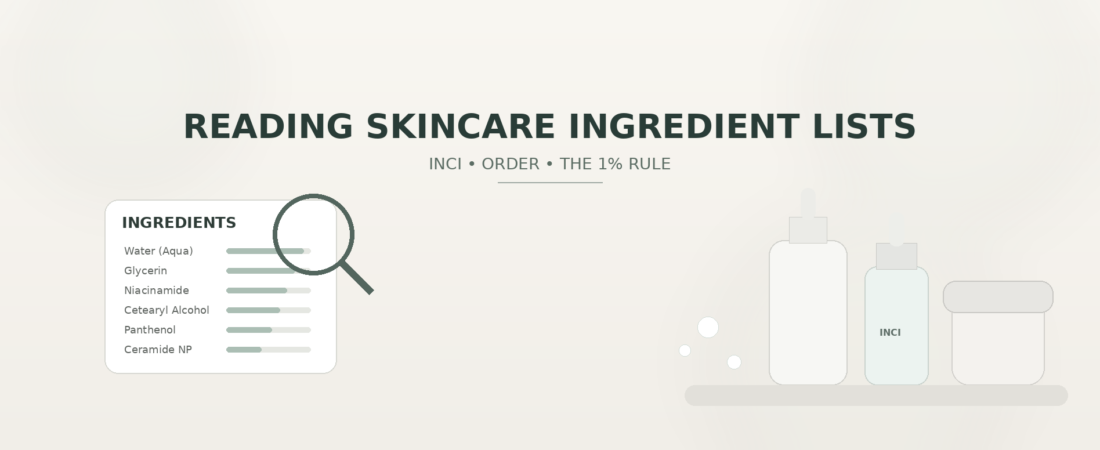
How to read a skincare ingredient list is one of the most useful skills a beauty shopper can learn.
A front label may say:
- 10% niacinamide
- Peptide complex
- PDRN
- Ceramide barrier cream
- Vitamin C
- Hyaluronic acid
- Centella
- Fermented skincare
But the ingredient list on the back tells a different kind of story.
It can help you understand:
- What the formula is mostly made of
- Which ingredients appear relatively high or low
- Whether a marketing ingredient is likely to be present at a major or minor level
- Whether fragrance is included
- Whether multiple humectants, emollients or barrier ingredients are present
- Whether two products marketed very differently may actually have similar formula structures
At the same time, ingredient lists are easy to misread.
One of the biggest misconceptions is:
“If an ingredient is near the bottom, it must be useless.”
Another is:
“I can find the exact 1% line just by looking at the list.”
Neither is reliable.
In the United States, FDA labeling rules generally require cosmetic ingredients present above 1% to be listed in descending order of predominance. Ingredients at 1% or less may then appear in any order after those above 1%.
Read the FDA Cosmetic Labeling Guide
European cosmetic rules use a very similar principle: ingredients are listed in descending order by weight, while ingredients below 1% may appear in any order after those above 1%.
That means the ingredient list is extremely useful.
But it is not a precise concentration chart.
How to Read a Skincare Ingredient List: Quick Guide
| What You See | What It Usually Tells You | What It Does NOT Tell You |
|---|---|---|
| Ingredient near the top | Relatively high amount | Exact percentage |
| Ingredient near the bottom | Lower level or ≤1% region may be possible | That it is ineffective |
| “10% complex” | Amount of a named blend may be disclosed | Amount of each active inside the blend |
| INCI name | Standardized ingredient identity | Safety, quality or approval |
| “Fragrance / Parfum” | Fragrance composition is present | Every individual fragrance material |
| Long ingredient list | Many ingredients | Better or worse formula |
| Short ingredient list | Fewer ingredients | Automatically gentler |
| Hero ingredient on front | Marketing priority | Necessarily the highest-level active |
The best approach is:
Read ingredient lists for structure and context, not as an exact laboratory formula.
What Is an INCI Name?
Skincare ingredient lists often look unnecessarily complicated because brands usually do not write:
Vitamin B3
They write:
Niacinamide
They may not write:
Shea butter
They may use:
Butyrospermum Parkii (Shea) Butter
These standardized ingredient names are commonly referred to as INCI names, short for the International Nomenclature of Cosmetic Ingredients.
The Personal Care Products Council explains that INCI names are standardized names used internationally to identify cosmetic ingredients.
An important detail is often overlooked:
Having an INCI name does not mean an ingredient has been approved or proven safe.
INCI is primarily a naming and identification system.
It does not function as an efficacy score or safety certification.
Why Ingredient Order Matters
Imagine a moisturizer with this simplified ingredient list:
Water, Glycerin, Caprylic/Capric Triglyceride, Niacinamide, Cetearyl Alcohol, Dimethicone, Panthenol, Ceramide NP…
The first few ingredients probably make up a large portion of the formula.
They help define the product’s basic character.
For example:
Water
Usually acts as the main solvent in an aqueous cream or serum.
Glycerin
A common humectant.
Caprylic/Capric Triglyceride
An emollient that can contribute to softness and slip.
Cetearyl Alcohol
A fatty alcohol that may help with texture, emulsion structure and skin feel.
Dimethicone
A silicone ingredient often used for slip, barrier feel and texture.
This gives you more information than simply seeing:
“Ceramide Barrier Cream”
on the front.
The product may indeed contain ceramide.
But the overall formula may rely much more heavily on:
water + humectants + emollients + structural ingredients
to create the actual user experience.
The 1% Rule: What It Really Means
This is one of the most misunderstood skincare topics online.
You may have seen advice such as:
“Find phenoxyethanol and everything after it is under 1%.”
or:
“Everything below fragrance must be less than 1%.”
These shortcuts are unreliable.
Under FDA cosmetic labeling rules, ingredients above 1% generally need to be listed in descending order.
Ingredients at 1% or less may appear in any order after the ingredients above 1%.
EU Regulation 1223/2009 likewise states that ingredients below 1% may appear in any order after ingredients above 1%.
See the EU Cosmetics Regulation
Therefore:
There may be a 1% region, but consumers usually cannot identify its exact starting point from the ingredient list alone.
Why You Cannot Reliably Find the “1% Line”
Suppose the end of a formula looks like:
Panthenol, Tocopherol, Ceramide NP, Xanthan Gum, Adenosine, Disodium EDTA
Which ingredient marks 1%?
You cannot know just by looking.
Perhaps:
- Panthenol = 1.2%
- Tocopherol = 0.5%
- Ceramide NP = 0.1%
Or:
- Panthenol = 0.8%
- Tocopherol = 0.2%
- Ceramide NP = 0.3%
Both can produce similar-looking ingredient lists depending on formulation and labeling rules.
The ingredient list does not disclose enough information to reverse-engineer the formula accurately.
A Low-Listed Ingredient Can Still Matter
This is especially important for skincare actives.
Some ingredients are commonly used at relatively low levels.
Examples may include certain:
- Retinoids
- Peptides
- Ceramides
- Antioxidants
- Preservatives
- Chelating agents
- Thickeners
- Signaling ingredients
So this reasoning is flawed:
“It’s near the bottom, therefore it does nothing.”
A better question is:
Is this ingredient normally expected to work at a low level, and is there evidence for the finished product or formulation?
That connects directly with our guide to Skincare Ingredient Concentration.
The concentration needed for one ingredient cannot automatically be applied to another.
Why 0.1% Can Be Meaningful for One Ingredient and Weak for Another
Skincare ingredients operate at very different concentration ranges.
Consider these hypothetical examples:
Ingredient A
May require several percent to deliver its intended formulation role.
Ingredient B
May be biologically active at a fraction of one percent.
Ingredient C
May be included mainly for formula stability.
Ingredient D
May function primarily as a preservative.
Comparing them by:
which ingredient is present at the highest percentage
makes little scientific sense.
This is one reason the “highest percentage wins” approach can mislead consumers.
Ingredient Lists Do Not Tell You Delivery
Even if two serums contain the same ingredient at the same nominal concentration, they can behave differently.
Formulation can affect:
- Solubility
- Stability
- Release
- Penetration
- Oxidation
- Skin feel
- Irritation
- Compatibility with other ingredients
This is especially relevant for newer skincare technologies.
Our PDRN Delivery Technology 2027 guide explains why delivery systems may sometimes matter more than simply increasing the amount of an active.
An INCI list may tell you what is present.
It usually cannot tell you exactly how well the finished system delivers it.
Ingredient Lists Do Not Tell You Clinical Effectiveness
This is another important limitation.
Suppose two products both contain:
Niacinamide
The ingredient list alone cannot tell you:
- Which one improves skin more
- Which one is better tolerated
- Which one has better stability
- Which formula has been clinically tested
- Whether the product performs better than its vehicle
For that, you need finished-product evidence.
Our guide to Clinically Tested Skincare explains how to distinguish:
- In vitro testing
- Ex vivo testing
- Human instrumental testing
- Consumer perception studies
- Controlled trials
Ingredient lists and clinical evidence answer different questions.
The First Five Ingredients: Useful but Not Magical
Beauty content frequently focuses on:
the first five ingredients.
This can be helpful because high-listed ingredients often reveal the basic formula structure.
But “first five” is not a regulatory threshold.
There is no universal rule that says:
only the first five ingredients matter.
A moisturizer could derive much of its feel from its first five ingredients while relying on a lower-listed active for a specific benefit.
So use the first five ingredients to understand:
formula architecture
not to decide whether every ingredient below them is irrelevant.
How to Read the First Five Ingredients
When looking at the beginning of the list, ask:
Is Water First?
This often suggests an aqueous product.
Are Humectants High?
Common examples include:
- Glycerin
- Propanediol
- Butylene Glycol
- Betaine
- Hyaluronic-acid-related ingredients
This may suggest strong hydration-focused architecture.
Are Oils or Emollients High?
Examples may include:
- Squalane
- Caprylic/Capric Triglyceride
- Esters
- Plant oils
- Silicones
This may suggest a richer texture or stronger emollient component.
Are Fatty Alcohols High?
Ingredients such as:
- Cetearyl Alcohol
- Cetyl Alcohol
- Behenyl Alcohol
can help shape texture and emulsion structure.
They should not automatically be confused with drying alcohols simply because they contain the word “alcohol.”
“Alcohol” Does Not Mean One Ingredient
This is a classic ingredient-list mistake.
Consumers sometimes avoid every ingredient containing:
alcohol
But cosmetic chemistry uses the word across very different substances.
For example:
Alcohol / Alcohol Denat.
These may function as solvents and can contribute to fast-drying textures.
Cetyl Alcohol
A fatty alcohol.
Cetearyl Alcohol
A mixture of fatty alcohols commonly used in creams.
Behenyl Alcohol
Another fatty alcohol used in formulation.
These ingredients do not behave identically.
So ingredient reading requires:
identity before judgment.
Fragrance Is a Special Case
In U.S. cosmetic labeling, fragrance mixtures may be declared generally as:
Fragrance
rather than listing every material in the fragrance composition individually.
FDA specifically notes that some ingredients can be declared collectively as “fragrance” or “perfume.”
Read FDA’s information on cosmetic allergens
Therefore, an ingredient list may not reveal every component of a fragrance mixture.
“Fragrance-Free” Still Requires Context
FDA also notes that there is no federal standard or definition specifically governing terms including:
- Hypoallergenic
- Fragrance-free
- For sensitive skin
in the U.S.
Read FDA’s Allergens in Cosmetics guidance
That does not mean every fragrance-free claim is meaningless.
It means consumers should avoid treating the phrase as an absolute regulatory guarantee.
The most useful approach is:
read the ingredient list and evaluate the finished formula, rather than relying only on front-label language.
“Hypoallergenic” Is Not a Universal Safety Guarantee
This term deserves special attention.
FDA states that there is no federal definition or standard governing “hypoallergenic” cosmetics in the United States.
Read FDA’s Hypoallergenic Cosmetics Q&A
So:
hypoallergenic ≠ guaranteed to cause no allergic reaction.
No cosmetic can realistically guarantee that every consumer will tolerate every ingredient.
Consumers with known allergies should pay more attention to:
- Exact ingredients
- Previous reactions
- Patch testing advice from a healthcare professional where appropriate
than to one marketing word.
Natural Does Not Automatically Mean Safer
Another common ingredient-list shortcut is:
Natural ingredient = gentle
Synthetic ingredient = harsh
FDA warns consumers not to assume that “natural” or “organic” products are automatically safer simply because of ingredient origin.
Read FDA’s cosmetic safety guidance
Natural materials can contain:
- Fragrance compounds
- Potential allergens
- Irritating components
Synthetic ingredients can also be designed for:
- Purity
- Stability
- Consistency
The useful question is not:
natural or synthetic?
It is:
What is the ingredient, at what exposure, in what formula, and for what user?
A Long Ingredient List Is Not Automatically Bad
Another popular online rule says:
“The fewer ingredients, the better.”
Sometimes a short formula is useful.
For example, a person trying to identify a possible trigger may prefer fewer variables.
But a long ingredient list can also represent a thoughtfully engineered formula containing:
- Humectants
- Emollients
- Stabilizers
- Preservatives
- Antioxidants
- Texture modifiers
- Chelators
- Actives
The number of ingredients does not measure quality.
A 25-ingredient formula is not automatically worse than a 10-ingredient formula.
Preservatives Are Not Automatically a Red Flag
Preservatives often appear near the lower part of an ingredient list.
That can make them seem suspicious.
But water-containing cosmetics need adequate protection from microbial contamination.
A formula without an appropriate preservation strategy can create a different safety problem.
So the goal should not be:
preservative-free at any cost.
The more useful question is:
Is the product safely and appropriately preserved for its format and packaging?
Ingredient literacy means understanding function, not simply identifying ingredients that social media labels as “bad.”
How Marketing Can Make an Ingredient Look More Important Than It Is
Consider a hypothetical product called:
Blueberry Ceramide Repair Serum
The front label shows:
- Blueberry
- Ceramide
- Barrier repair imagery
But the actual formula may primarily be:
Water + glycerin + glycols + emollients + polymers
with blueberry extract and ceramide appearing much lower.
Does that mean the product is bad?
No.
The base formula could be excellent.
But the ingredient list helps you separate:
what sells the product
from:
what physically makes up most of the product.
That distinction is valuable.
Extracts Can Make Ingredient Lists Look More Impressive
Botanical skincare may contain:
- Centella Asiatica Extract
- Green Tea Extract
- Licorice Root Extract
- Rice Extract
- Ginseng Extract
- Mugwort Extract
These can be useful formulation components.
But seeing ten extracts does not prove the product is ten times more effective.
Questions still include:
- How are the extracts standardized?
- At what levels are they used?
- What compounds are present?
- Are they stable?
- Is the finished formula tested?
Ingredient count is not evidence strength.
Why “Complex” Percentages Need Extra Attention
A label may say:
10% peptide complex
That can sound like:
10% pure peptides.
But a commercial ingredient complex may itself contain:
- Water
- Solvent
- Stabilizer
- Carrier
- A smaller amount of the actual peptide
So “10% complex” and “10% pure active” are not automatically the same thing.
This is one of the reasons our Skincare Ingredient Concentration Guide recommends asking:
Percentage of what?
before comparing formulas.
Hyaluronic Acid Is Another Good Example
A product may advertise:
1% hyaluronic acid
Another:
2% hyaluronic acid complex
Another:
8 types of hyaluronic acid
The larger number may look better.
But the real formula can differ in:
- Molecular weights
- Sodium hyaluronate vs hydrolyzed forms
- Blend concentration
- Carrier system
- Overall humectant architecture
Therefore:
“8 types” is a formulation description, not automatically an efficacy ranking.
Ceramides: Placement Alone Does Not Tell the Whole Story
Ceramides often appear relatively low in an ingredient list.
This can lead consumers to conclude:
“There isn’t enough ceramide.”
That conclusion may be premature.
Ceramide performance depends on more than simple percentage.
The formula may also contain:
- Cholesterol
- Fatty acids
- Occlusive agents
- Emollients
- Humectants
Barrier products work as systems.
This is consistent with the broader idea explored in our Skin Barrier vs Skin Microbiome guide:
Skin health is rarely explained by one hero ingredient alone.
PDRN Shows Why INCI Reading Has Limits
PDRN products are a useful modern example.
Consumers may encounter terms such as:
- Sodium DNA
- PDRN
- Hydrolyzed DNA
- DNA-related complexes
The exact terminology, molecular characteristics and delivery technologies can vary.
A basic ingredient list may tell you that a DNA-related material is present.
It cannot fully tell you:
- Molecular weight
- Fragment distribution
- Delivery efficiency
- Skin penetration
- Biological availability
This is why ingredient-list analysis should be combined with the evidence discussed in PDRN Skincare 2027 and PDRN Delivery Technology 2027.
The Ingredient List Cannot Tell You Everything
A skincare label usually cannot reveal:
Exact Percentages for Every Ingredient
Unless the brand voluntarily discloses them.
Raw-Material Quality
Two ingredients with the same INCI name may come from different suppliers or manufacturing processes.
Formula Stability
The list does not tell you how the product performs after six months.
Packaging Protection
Light, oxygen and repeated opening can affect certain ingredients.
Manufacturing Process
Order of addition, temperature and processing can matter.
Final Product Performance
Only appropriate product testing can answer that reliably.
A Better 60-Second Ingredient-List Method
Instead of analyzing every ingredient like a chemist, use this practical sequence.
Step 1 — Identify the Formula Base
Look at the first several ingredients.
Ask:
- Water-based?
- Oil-rich?
- Silicone-heavy?
- Humectant-focused?
Step 2 — Find the Hero Ingredient
Look for the ingredient promoted on the front.
Ask:
Is it relatively high, middle or low?
Do not attempt to guess an exact percentage unless disclosed.
Step 3 — Look at Supporting Ingredients
For a barrier product, look for a system such as:
- Humectants
- Emollients
- Ceramides
- Fatty components
- Occlusive support
For a brightening serum:
- Niacinamide
- Vitamin C form
- Licorice-related ingredients
- Tranexamic-acid-related ingredients where applicable
The formula matters more than one star ingredient.
Step 4 — Check Known Personal Triggers
If you already know you react to a specific ingredient, this is where the INCI list becomes especially useful.
FDA recommends reading cosmetic ingredient declarations when trying to avoid substances associated with previous reactions.
Read FDA’s cosmetic allergen guidance
Step 5 — Ignore Fear-Based Ingredient Scoring
Do not automatically reject a product because an app labels one ingredient:
“bad”
Cosmetic safety depends on:
- Substance
- Concentration
- Exposure
- Product type
- Route of use
- Individual susceptibility
A binary green/red score removes too much context.
Step 6 — Look for Finished-Product Evidence
If the product makes major performance claims, check whether the actual formula was tested.
Start with our Clinically Tested Skincare Guide.
Three Ingredient Lists: How to Compare Them
Imagine three moisturizers.
Product A
Water, Glycerin, Squalane, Cetearyl Alcohol, Dimethicone, Panthenol, Ceramide NP…
Likely Story
Balanced humectant + emollient + barrier-focused cream.
Product B
Water, Glycerin, Butylene Glycol, Niacinamide, Propanediol, Carbomer, Panthenol…
Likely Story
Lighter water-based hydration formula with niacinamide.
Product C
Water, Mineral Oil, Petrolatum, Glycerin, Cetearyl Alcohol, Dimethicone…
Likely Story
More strongly occlusive and emollient formula.
Which is best?
The ingredient list cannot answer that universally.
It depends on:
- Skin type
- Climate
- Texture preference
- Barrier condition
- Intended use
Ingredient reading helps you understand differences.
It does not create one universal winner.
U.S. vs EU Ingredient Lists: Similar Core Principle
Both U.S. and EU rules use the same useful basic concept:
higher-level ingredients appear in descending order, while ingredients below approximately the 1% threshold have more flexibility in ordering.
However, detailed labeling requirements differ across jurisdictions.
EU rules additionally specify, among other things, how nanomaterials should be identified and how certain fragrance substances may need separate declaration under applicable conditions.
For international K-beauty sellers, this is a reminder that:
one global ingredient list still needs regulatory review for each target market.
What Beauty Sellers Should Learn From Ingredient Lists
Ingredient literacy is not only useful for consumers.
It can improve product positioning.
A seller should be able to explain:
- Why the base formula makes sense
- What the hero ingredient actually contributes
- Which supporting ingredients reinforce the story
- Whether a percentage refers to a pure ingredient or complex
- What evidence belongs to the ingredient
- What evidence belongs to the finished product
The most credible marketing does not simply say:
“Contains X.”
It explains:
why X is present within this particular formula.
Beauty Seller Lab View
The ingredient list is one of the most valuable pieces of information on a skincare product.
But it is often asked to do more than it can.
It can tell you:
what ingredients are present.
It can help reveal:
the broad architecture of the formula.
It can help you:
spot personal triggers and compare formula styles.
But it cannot reliably tell you:
the exact percentage of every ingredient.
It cannot prove:
clinical effectiveness.
And it cannot tell you:
whether one formula will work better on your skin than another.
The smartest way to read skincare is therefore not:
ingredient list instead of clinical evidence.
It is:
ingredient list + formulation context + concentration + finished-product evidence + personal tolerance.
That combination produces a much better picture.
FAQ
How are skincare ingredients listed?
In the U.S. and EU, ingredients above 1% are generally listed in descending order by weight or predominance. Ingredients at or below/below 1% may have more flexibility in ordering after the higher-level ingredients.
Can I identify the 1% line in an ingredient list?
Usually not with certainty. The rules allow ingredients below the threshold to appear in different orders, so there is normally no visible marker showing exactly where 1% begins.
Does an ingredient near the bottom mean it does not work?
No. Some cosmetic ingredients are designed to be used at relatively low concentrations.
Does a higher ingredient position mean better?
Not automatically. Some formula-support ingredients need to be present at high levels while certain actives may work at much lower levels.
What does INCI mean?
INCI refers to standardized cosmetic ingredient nomenclature used internationally.
Does an INCI name mean an ingredient is FDA approved?
No. The standardized name identifies the ingredient; it does not itself indicate regulatory approval or safety.
Is fragrance always fully disclosed?
Not necessarily. In the U.S., fragrance compositions may generally be declared using terms such as “fragrance” rather than listing every component individually.
Is hypoallergenic regulated by FDA?
FDA states that there is no federal standard or definition governing the term “hypoallergenic” for cosmetics.
Are shorter ingredient lists better?
Not necessarily. Formula quality cannot be determined simply by counting ingredients.
Should I choose skincare based only on the ingredient list?
No. Use ingredient lists alongside formulation information, clinical testing, product format and your own skin tolerance.
The Bottom Line
Knowing how to read a skincare ingredient list can make beauty shopping much easier.
But the goal is not to memorize hundreds of chemical names.
It is to understand what the list can—and cannot—tell you.
Remember:
Top ingredients help reveal the formula base.
The exact 1% line usually cannot be identified.
Low-listed ingredients are not automatically useless.
INCI names identify ingredients but do not prove safety or efficacy.
Fragrance and marketing claims require additional context.
And most importantly:
A skincare formula is a system, not a competition to see which hero ingredient appears highest on the list.
Once you understand that, ingredient lists become much more useful—and much less intimidating.