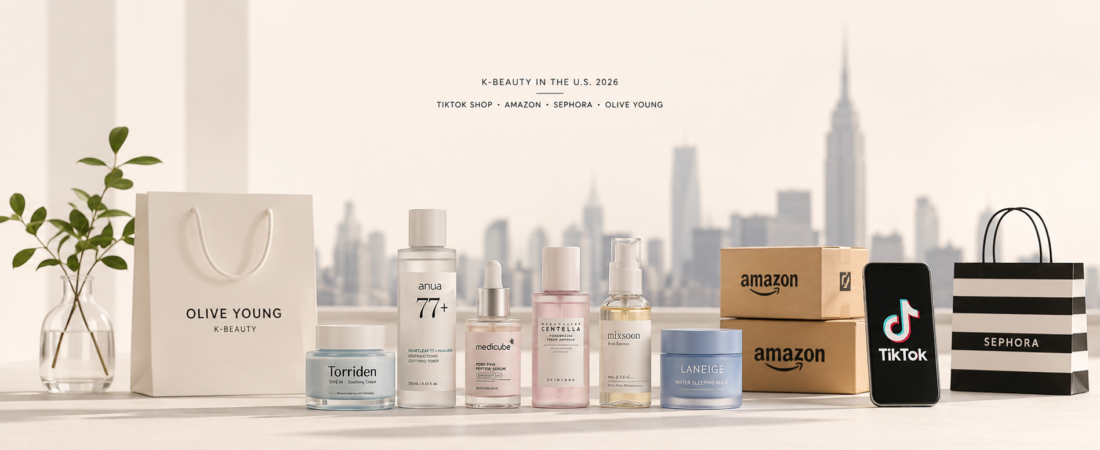
K-Beauty in the US 2026 is no longer a niche category discovered mainly through specialty import stores and online beauty communities.
By 2026, Korean beauty has become part of the mainstream U.S. beauty market.
Consumers can now discover a Korean skincare product through a TikTok creator, search for it on Amazon, compare the ingredients on Reddit or Google, and then see another Korean brand displayed inside a Sephora store.
That change matters.
K-beauty’s U.S. growth is no longer being driven by one retailer or one viral ingredient.
It is increasingly being shaped by an interconnected commerce system involving:
- TikTok Shop
- Amazon
- Sephora
- Specialty retailers
- Creators
- Search
- AI-powered product discovery
According to NielsenIQ, U.S. K-beauty sales reached approximately $2 billion in 2025, representing 37% year-over-year growth.
Read NIQ’s report on K-Beauty’s U.S. growth
In 2026, the momentum became even more visible.
NIQ later reported that global K-beauty value sales increased 53% year over year and 131% over two years.
Read NIQ’s 2026 K-Beauty growth report
The important question is no longer:
Will K-beauty become mainstream in the United States?
A better question is:
How is K-beauty changing the way beauty products are discovered, distributed and purchased in the U.S.?
K-Beauty in the U.S. 2026: Quick Market Snapshot
| Market Signal | 2026 Direction |
|---|---|
| U.S. K-Beauty sales | Strong growth |
| Social commerce | Rapid expansion |
| TikTok Shop | Major discovery + conversion channel |
| Amazon | Search + replenishment + conversion |
| Sephora | Mainstream prestige distribution |
| Ingredient trends | PDRN, spicules, centella, peptides |
| Haircare | Growing adjacent category |
| Consumer journey | Increasingly multi-channel |
| 2027 outlook | Continued mainstream expansion |
The biggest change is not simply higher sales.
It is the way demand travels between platforms.
Why K-Beauty in the US 2026 Is No Longer a Niche Category
For years, K-beauty’s international reputation was built around innovations such as:
- BB creams
- Sheet masks
- Essences
- Snail mucin
- Cushion foundations
- Multi-step skincare
These products helped build consumer awareness.
But the current growth cycle looks different.
K-beauty is now competing through:
- Ingredient innovation
- Fast product development
- Social-first marketing
- Competitive pricing
- Highly visual product demonstrations
- Direct integration between discovery and checkout
NIQ’s 2026 analysis describes K-beauty as an example of regional beauty innovation successfully scaling into global demand.
Global K-beauty value sales were reported to have grown 53% year over year.
That is not the profile of a small beauty subculture.
It is increasingly a mainstream commercial category.
For a broader look at where Korean beauty may move next, see our guide to K-Beauty Trends 2027.
TikTok Shop Changed How K-Beauty Products Are Discovered
Traditional beauty marketing often followed a relatively predictable funnel:
Advertising → awareness → retail store → purchase.
TikTok compresses that process.
A modern beauty journey can look more like:
Creator video → product demonstration → comments → TikTok Shop → checkout.
The entire process can happen in minutes.
NIQ reported that K-beauty value sales through TikTok Shop grew 430% year over year across the U.S., UK, Spain and Germany.
See NIQ’s K-Beauty social commerce data
TikTok Shop is particularly important for beauty because products can be demonstrated visually.
That favors formulas with:
- Interesting textures
- Immediate visual effects
- Distinctive application methods
- Unusual ingredients
- Before-and-after storytelling
Why K-Beauty Works So Well on Short-Form Video
Korean skincare frequently produces products that are easy to explain visually.
Consider:
Spicule Skincare
Consumers can see:
- Treatment-style application
- Skin reaction
- Texture
- Peeling or surface changes
McKinsey highlighted Korean brand Dr. Melaxin as an example of this dynamic. The company reportedly grew from essentially zero share to around 10% of the U.S. TikTok Shop skincare category between 2024 and 2025, generating approximately $57 million in revenue according to the data cited by McKinsey.
Read McKinsey’s 2026 State of Beauty report
For the underlying skincare technology, see our Spicule Skincare 2027 guide.
PDRN Is Another Social-Friendly K-Beauty Story
PDRN has a different advantage.
It offers:
novelty + clinical inspiration + Korean origin story.
That makes it particularly easy to package into short-form educational content.
A creator can explain:
“This ingredient comes from the Korean regenerative-skincare trend.”
That is more memorable than promoting another generic moisturizing serum.
For the science and market context, read our PDRN Skincare 2027 guide.
TikTok Is Becoming a Retailer, Not Just a Marketing Platform
This distinction is increasingly important.
TikTok used to help brands generate awareness.
Consumers then went somewhere else to purchase.
Now TikTok Shop can handle:
- Discovery
- Product education
- Creator endorsement
- Promotions
- Checkout
inside the same ecosystem.
NIQ reports that beauty represents 46% of total FMCG value sales on TikTok Shop, making it the platform’s largest FMCG vertical.
Read NIQ’s TikTok Shop analysis
McKinsey estimates U.S. TikTok beauty sales are on track to reach approximately $4 billion in 2026.
See McKinsey’s beauty channel analysis
That makes TikTok strategically difficult for emerging beauty brands to ignore.
Amazon Plays a Different Role
TikTok may generate excitement.
Amazon frequently captures intent.
A consumer may first see:
“Korean PDRN serum”
on TikTok.
Then search Amazon for:
best PDRN serum
or:
Korean PDRN serum.
That is a different stage of the funnel.
TikTok is often:
discovery-led.
Amazon is often:
intent-led.
This distinction is important for K-beauty brands.
Medicube Shows How TikTok and Amazon Can Work Together
One of the strongest current examples is Medicube.
McKinsey reports that Medicube was the number-one beauty brand on both Amazon and TikTok Shop during Q1 2026.
The report also notes that creators promoting Medicube can direct consumers toward the company’s Amazon storefront.
That creates a cross-platform funnel:
TikTok awareness
↓
Brand search
↓
Amazon
↓
Purchase
This may become one of the defining K-beauty commerce models.
A brand does not necessarily need TikTok and Amazon to compete with each other.
They can perform different jobs.
Amazon Is Becoming More Than a Replenishment Channel
Traditionally, Amazon beauty was strongly associated with:
- Search
- Convenience
- Reviews
- Fast delivery
- Replenishment
But discovery tools are becoming more sophisticated.
McKinsey notes that marketplaces are increasingly integrating:
- Search
- Live shopping
- AI assistance
- Product recommendations
That means Amazon may increasingly participate earlier in the beauty-discovery journey.
For sellers, that makes product information increasingly important.
A strong Amazon listing needs:
- Clear ingredient information
- Benefit hierarchy
- High-quality images
- Reviews
- Competitive pricing
- Search-friendly product naming
Increasingly, it may also need information that AI shopping systems can understand.
Sephora + Olive Young Changes the Offline Story
TikTok and Amazon explain the digital side.
But one of the biggest 2026 developments happened in physical retail.
Beginning August 20, Sephora launched an Olive Young-curated K-beauty assortment across more than 500 U.S. Sephora stores and Sephora.com.
The initial assortment includes 19 Korean beauty brands.
Read Sephora’s official announcement
Brands include:
- Abib
- Arencia
- BANILA CO
- beplain
- BIOHEAL BOH
- Cell Fusion C
- FATION
- FULLY
- HEVEBLUE
- make p:rem
- ma:nyo
- MENOKIN
- REJURAN Cosmetics
- S.NATURE
- SUNGBOON EDITOR
- THOME
- Torriden
- WELLAGE
- WHIPPED
This matters for more than the participating brands.
Olive Young Is Becoming a Global Curator
Olive Young has historically played an important role inside Korea.
It identifies:
- Fast-growing products
- Consumer trends
- Emerging brands
- New ingredients
The Sephora partnership effectively exports part of that merchandising expertise.
Rather than Sephora individually discovering every Korean brand, Olive Young helps provide a curated pipeline.
That creates a new route:
Korean popularity
↓
Olive Young validation
↓
Sephora distribution
↓
U.S. mainstream consumer
This could become an important internationalization model for Korean beauty companies.
Sephora Also Changes Consumer Trust
A consumer encountering an unfamiliar Korean brand through TikTok may wonder:
Is this legitimate?
Seeing the same category inside Sephora reduces that friction.
Major retail distribution can provide:
- Familiar shopping environment
- Easier returns
- Product sampling
- Physical discovery
- Retailer credibility
That is especially valuable for consumers who are interested in K-beauty but unwilling to buy from unfamiliar international websites.
The New K-Beauty Funnel
The most important U.S. market shift may be the disappearance of a single linear sales funnel.
Instead, the consumer journey may look like:
Step 1 — TikTok
A creator introduces the product.
Step 2 — Google / AI / Reddit
The consumer researches:
- Ingredients
- Reviews
- Safety
- Comparisons
Step 3 — Amazon
The shopper checks:
- Price
- Reviews
- Shipping
Step 4 — Sephora
The consumer may:
- See the brand in person
- Test products
- Purchase through a trusted retailer
Step 5 — Repeat Purchase
The customer buys from whichever channel offers:
- Convenience
- Price
- Loyalty benefits
- Availability
The result is:
platform-fluid beauty shopping.
E-Commerce Still Dominates K-Beauty in North America
NIQ reports that e-commerce represents approximately 76% of K-beauty sales in North America.
That is strategically important.
Retail expansion matters.
But Korean beauty remains fundamentally digital-first in North America.
Brands therefore need both:
digital discovery
and:
physical legitimacy.
Why Ingredient-Led K-Beauty Travels So Well
Another reason K-beauty performs internationally is the industry’s ability to turn ingredients into stories.
Examples include:
- Snail mucin
- Centella asiatica
- PDRN
- Spicules
- Peptides
- Exosomes
- Growth factors
Each ingredient provides content.
Brands can explain:
What is it?
Where did it come from?
What does it do?
How is this formula different?
That makes ingredient-led products especially compatible with:
- TikTok
- YouTube
- AI search
The Risk: Ingredient Hype Can Move Faster Than Evidence
There is also a downside.
Social commerce rewards simple messages.
Science is rarely simple.
Claims such as:
“regenerates skin”
“boosts collagen”
“repairs cells”
can easily become stronger than the available evidence.
This is why beauty sellers increasingly need to distinguish:
- Ingredient research
- Finished-product testing
- In vitro evidence
- Ex vivo evidence
- Human clinical results
Our Clinically Tested Skincare guide explains how those evidence levels differ.
K-Beauty Is Expanding Beyond Facial Skincare
The next phase may not be limited to facial serums.
NIQ identifies adjacent opportunities including:
- Haircare
- Wellness
Its earlier U.S. K-beauty analysis also reported that haircare was one of the fastest-growing adjacent categories.
That aligns with the broader scalp skinification trend.
Korean beauty companies increasingly treat the scalp using concepts familiar from skincare:
- Exfoliation
- Barrier care
- Serums
- Peptides
- Hydration
For a deeper look, see our Scalp Skinification 2027 guide.
What U.S. Consumers Are Actually Responding To
K-beauty’s U.S. success is often described as:
Korean innovation.
That is true.
But innovation alone does not explain the growth.
Several commercial qualities work together.
1. Affordable Performance
Many Korean brands occupy a useful middle ground:
higher perceived innovation than mass-market skincare
without prestige-level pricing.
2. Frequent Product Innovation
Korean beauty companies often launch:
- New textures
- New actives
- Ingredient combinations
- Treatment formats
quickly.
This fits social media’s demand for novelty.
3. Visual Products
Products that:
- Foam
- Peel
- Glow
- Change texture
- Use pads or shots
- Create unusual application experiences
are easier to demonstrate.
4. Strong Ingredient Identity
“Centella serum” is easier to communicate quickly than a product without a clear hero story.
5. Creator-Friendly Pricing
Lower price points reduce friction for:
- Trial
- Affiliate promotion
- Impulse purchase
But U.S. Growth Creates New Challenges
Growth does not mean entering the U.S. market becomes easy.
Competition increases as more Korean brands arrive.
The same channels that create opportunities also create pressure.
TikTok Economics Can Be Difficult
McKinsey notes that TikTok Shop growth is supported partly by:
- Promotions
- Affiliate commissions
- Customer-acquisition spending
This means gross sales alone do not tell the full story.
A brand may grow quickly while sacrificing margin.
Beauty sellers therefore need to evaluate:
revenue + contribution margin + repeat purchase
rather than only viral GMV.
Amazon Competition Is Also Increasing
Amazon offers enormous demand.
It also creates:
- Price competition
- Review competition
- Advertising costs
- Copycat listings
- SEO competition
As more Korean brands enter the marketplace, simply being:
Korean skincare
becomes less differentiated.
Brands will need clearer positioning.
Sephora Raises the Standard
Prestige retail offers credibility.
It also demands:
- Brand identity
- Supply reliability
- Merchandising
- Marketing support
- Retail readiness
A product that succeeds through a single viral video may not automatically succeed in a national retail network.
What Korean Beauty Brands Need to Win in the U.S.
Based on the current channel shift, several capabilities may become more important.
1. One Clear Hero Product
Consumers need an easy entry point.
Instead of introducing ten products at once:
one memorable hero SKU
can build awareness first.
2. A Story That Works in Five Seconds
TikTok rewards immediate understanding.
Examples:
PDRN recovery serum
Spicule treatment
Barrier rescue cream
are easier to communicate than vague positioning.
3. Strong Product Evidence
As ingredients become more sophisticated, consumers increasingly ask:
- What percentage?
- What study?
- What form?
- What delivery technology?
The brands that answer these questions clearly may build stronger long-term trust.
4. Multi-Channel Distribution
The 2026 market suggests brands should stop thinking:
TikTok or Amazon or retail.
A more realistic model is:
TikTok + Amazon + retail
with each channel performing a different role.
5. Consistent Pricing
Consumers can compare prices instantly.
Large differences across:
- Amazon
- TikTok
- Brand websites
- Retailers
can damage trust and create channel conflict.
6. U.S.-Ready Compliance
Marketing needs to grow alongside regulatory discipline.
Claims that sound normal in one market may require different wording or evidence in another.
Rapid international growth makes:
regulatory readiness
a competitive advantage.
TikTok vs Amazon vs Sephora
| Channel | Primary Strength | Best Role |
|---|---|---|
| TikTok Shop | Viral discovery | Awareness + impulse conversion |
| Amazon | Search intent | Conversion + replenishment |
| Sephora | Trust + physical retail | Brand credibility + discovery |
| Brand Website | First-party relationship | Data + retention + storytelling |
| Google / AI Search | Research | Education + comparison |
The smartest strategy may not be choosing one winner.
It may be understanding:
where each channel fits in the consumer journey.
Beauty Seller Lab View
The biggest K-beauty story in the U.S. in 2026 is not one viral ingredient.
It is distribution convergence.
TikTok has turned discovery into commerce.
Amazon captures search-driven demand.
Sephora is bringing Olive Young-curated Korean brands into mainstream U.S. retail.
At the same time, consumers move between all three.
That means the next successful Korean beauty brands may need to function simultaneously as:
- Content brands
- Search brands
- Marketplace brands
- Retail brands
This is a much more complex environment than the first wave of international K-beauty.
But it is also a much larger opportunity.
What We Expect in 2027
If the current momentum continues, several developments are worth watching.
More Korean Brands Enter Major U.S. Retail
The Sephora-Olive Young partnership may make Korea-to-global retail pipelines more structured.
Social Commerce Becomes More Competitive
TikTok Shop will likely remain important, but affiliate costs and competition may increase.
Amazon Becomes More Important for Viral Brands
Consumers who discover products on social media will continue searching marketplaces for price, reviews and delivery.
Ingredient Trends Move Faster Across Borders
PDRN and spicules show how quickly a Korean product concept can become globally searchable.
Haircare Becomes a Larger K-Beauty Opportunity
Scalp care and treatment-inspired hair products may become an important adjacent category.
AI Changes Beauty Discovery
Consumers increasingly use AI systems to:
- Research products
- Compare ingredients
- Build routines
making structured, trustworthy product information increasingly valuable.
For the broader outlook, see our K-Beauty Trends 2027 guide.
FAQ
How big is K-beauty in the U.S.?
NIQ reported that U.S. K-beauty sales reached approximately $2 billion in 2025, representing strong year-over-year growth.
Why is K-beauty growing so quickly in the U.S.?
Growth is being supported by product innovation, affordable pricing, ingredient-led marketing, social commerce, creator content and wider retail distribution.
Is TikTok Shop important for K-beauty?
Yes. TikTok Shop has become an important discovery and sales channel, particularly for visually demonstrable skincare products.
Is Amazon important for Korean beauty brands?
Yes. Amazon can capture high-intent search demand and repeat purchases after products gain awareness through social media.
Is Olive Young available through Sephora in the U.S.?
Beginning August 20, 2026, Sephora launched an Olive Young-curated assortment of 19 Korean beauty brands across more than 500 U.S. stores and Sephora.com.
What K-beauty ingredients are trending?
Current high-interest categories include PDRN, centella asiatica, peptides, spicules and other biotech- or clinic-inspired skincare concepts.
Will K-beauty continue growing in 2027?
Current sales, retail expansion and social-commerce data suggest continued momentum, although increased competition and acquisition costs may make execution more difficult.
The Bottom Line
K-beauty in the U.S. has entered a different phase.
The old model was:
discover Korean beauty online and order it from a specialist seller.
The new model is:
discover it on TikTok, research it through search or AI, buy it on Amazon, and see it inside Sephora.
That shift makes K-beauty easier to discover.
It also makes the market far more competitive.
For Korean brands, the next stage of growth will require more than innovative ingredients.
The winners will likely combine:
strong products
clear positioning
credible evidence
creator-friendly content
marketplace execution
and:
mainstream retail readiness.
K-beauty has already proven it can travel.
The next challenge is proving which brands can stay.