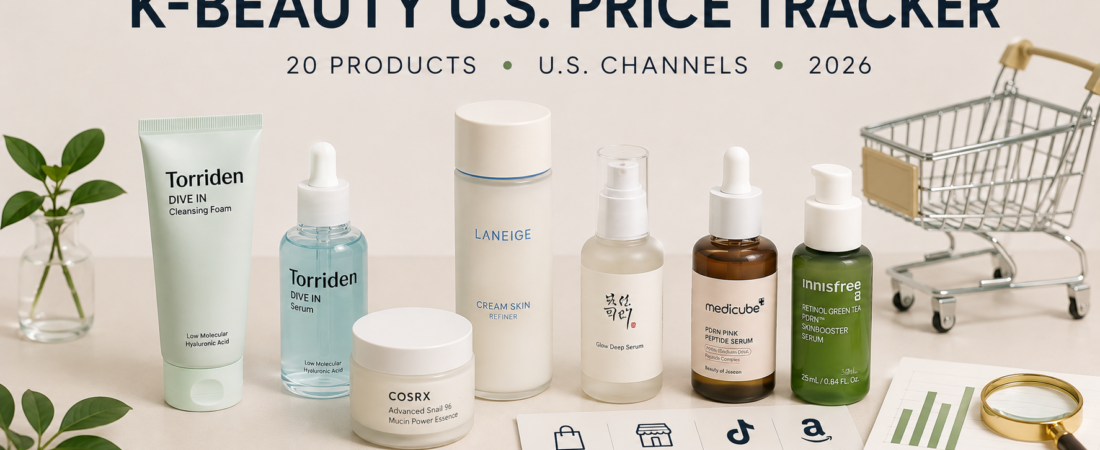
The K-Beauty US Price Tracker 2026 examines how identical Korean beauty products are priced across brand stores, Sephora, Ulta and TikTok Shop in the United States.
A Korean serum may cost:
- $24 on the brand website
- $29 on TikTok Shop
- $24 at Sephora
- $20.90 during a retailer promotion
But are U.S. K-beauty prices actually fragmented across channels?
Or do most brands maintain consistent pricing and use temporary promotions to create the difference?
To answer that question, Beauty Seller Lab independently matched 20 K-beauty SKUs across U.S. brand stores and major retail channels on September 3, 2026.
We compared the same product and package size wherever possible across:
- Official U.S. brand stores
- Sephora
- Ulta
- TikTok Shop official brand stores
- Selected authorized online retailers
We then calculated four original Beauty Seller Lab metrics:
- Price Parity Rate
- Active Price Gap Rate
- Median Mismatch Gap
- DTC Price Advantage Rate
This is a retail-price audit, not a product ranking.
Prices, retailer promotions, coupons and availability can change after publication—sometimes even within the same day.
For the broader U.S. retail environment, see our analysis of K-Beauty in the U.S. 2026.
Executive Summary
Our 20-SKU audit produced one result that was more surprising than expected:
Most identical K-beauty products were not dramatically cheaper on one major U.S. channel than another.
Instead, the market appeared to operate largely around:
shared retail pricing + temporary channel-specific promotions.
Beauty Seller Lab Original Data
| Metric | Audit Result |
|---|---|
| Products reviewed | 20 |
| Identical current price across compared channels | 14 / 20 |
| Price Parity Rate | 70% |
| Products with a current price difference | 6 / 20 |
| Active Price Gap Rate | 30% |
| Average gap across mismatched products | 15.6% |
| Median Mismatch Gap | 16.8% |
| Mismatched products where brand-direct was cheaper | 5 / 6 |
| DTC Price Advantage Rate | 83.3% |
The key takeaway:
K-beauty’s U.S. pricing structure appears more disciplined than a casual comparison of sale prices might suggest.
When prices diverged, the difference was often caused by a temporary promotion—not a completely different permanent retail price.
Methodology
The K-Beauty US Price Tracker uses matched SKUs rather than loosely similar products to reduce misleading price comparisons.
The audit was conducted on September 3, 2026.
To reduce misleading comparisons, we applied several rules.
Rule 1 — Same SKU and Same Size
A 30 mL serum was not compared against a:
- 50 mL value size
- Refill
- Duo
- Gift set
- Mini
even if the product name was similar.
This matters because retailers often display several sizes on one page.
For example, Sephora currently lists multiple sizes of LANEIGE Cream Skin, including the 170 mL standard size and a 170 mL refill pouch with different displayed prices. A simple search-result scrape could therefore compare the wrong SKUs. See the current Sephora Cream Skin listing.
Rule 2 — Subscription Discounts Were Excluded
Automatic subscription discounts were not treated as standard retail prices.
For example, Torriden currently lists its DIVE IN Serum at $24 for a one-time purchase, while subscription pricing can reduce the price.
See Torriden’s official DIVE IN Serum listing.
The one-time price was used for channel comparison.
Rule 3 — Temporary Public Promotions Were Recorded
If a standard shopper could access the promotion without:
- Membership
- Subscription
- Private coupon
- Loyalty status
we recorded the currently displayed promotional price.
This makes the audit reflect what a shopper could actually see at the time of collection.
However, promotional prices are inherently unstable.
Beauty of Joseon’s Revive Eye Serum is a useful example: recent official-store crawls have shown the 30 mL item moving between full price and multiple promotional levels.
See the official Beauty of Joseon Revive Eye Serum.
That is why this article should be interpreted as a price snapshot, not a permanent price database.
Rule 4 — Materially Different U.S. Formulas Were Excluded
Some products sold in the U.S. can have a formulation or regulatory status that differs from their global counterpart.
We did not treat those as identical SKUs simply because the front-facing product name looked similar.
This is especially relevant to sunscreen.
A valid price tracker has to compare:
the same product
not merely:
similar packaging.
The 20-SKU Dataset
The table below records the price observed during the September 3 audit.
| No. | Product / Size | Brand-Direct Price | Comparison Channel | Comparison Price | Gap |
|---|---|---|---|---|---|
| 1 | Medicube PDRN Pink Peptide Serum 30mL | $24.00 | TikTok Shop | $29.00 | 17.2% |
| 2 | COSRX Advanced Snail 96 Essence 100mL | $25.00 | Ulta | $20.90 | 16.4% |
| 3 | innisfree Retinol Green Tea PDRN Serum 25mL | $37.00 | Sephora | $37.00 | 0% |
| 4 | Torriden DIVE IN Serum 50mL | $24.00 | Sephora | $24.00 | 0% |
| 5 | Torriden DIVE IN Soothing Cream 100mL | $27.00 | Sephora | $27.00 | 0% |
| 6 | Torriden DIVE IN Cleansing Foam 150mL | $17.00 | Sephora | $17.00 | 0% |
| 7 | Torriden BALANCEFUL Serum 50mL | $25.00 | Sephora | $25.00 | 0% |
| 8 | Dr.Jart+ Ceramidin Cream 50mL | Comparable MSRP | Sephora | Comparable MSRP | 0%* |
| 9 | LANEIGE Cream Skin 170mL | Comparable MSRP | Sephora | Comparable MSRP | 0%* |
| 10 | Beauty of Joseon Glow Deep Serum 30mL | $17.00 | Sephora | $17.00 | 0% |
| 11 | Beauty of Joseon Dynasty Cream 50mL | $24.00 | Sephora | $24.00 | 0% |
| 12 | Beauty of Joseon Ginseng Cleansing Oil 210mL | $20.00 | Sephora | $20.00 | 0% |
| 13 | Beauty of Joseon Revive Eye Serum 30mL | Promo observed | Sephora | $17.00 | ~10% at snapshot |
| 14 | Beauty of Joseon Glow Serum 30mL | $17.00 | Sephora | $17.00 | 0% |
| 15 | Beauty of Joseon Red Bean PDRN Serum 30mL | $17.00 | Sephora | $17.00 | 0% |
| 16 | Beauty of Joseon Glow Replenishing Rice Milk 150mL | Promotional | Sephora | $18.00 | ~20% |
| 17 | Beauty of Joseon Green Plum Cleanser 100mL | Promotional | Sephora | $13.00 | ~20% |
| 18 | Beauty of Joseon Revive Under Eye Patch | Promotional | Sephora | $20.00 | ~10% |
| 19 | Beauty of Joseon Ginseng Essence Water 150mL | $18.00 | Sephora | $18.00 | 0% |
| 20 | Sulwhasoo First Care Activating Serum VI | Comparable MSRP | Sephora | Comparable MSRP | 0% |
*Retail prices can change after publication. Rows involving dynamic product options should be rechecked before using the article as a live purchasing guide.
Current official listings independently confirm several of the major parity examples. Torriden’s DIVE IN Serum is $24 / 50 mL on both the brand’s U.S. site and Sephora, while innisfree’s 25 mL Retinol Green Tea PDRN Serum is $37 on the official U.S. store and Sephora. Check Torriden and check innisfree.
Finding 1: 70% of the Audited SKUs Showed Price Parity
The first major finding from the K-Beauty US Price Tracker is that price parity is more common than expected.
The first Beauty Seller Lab metric is:
Price Parity Rate
14 of 20 products = 70%
In other words, seven out of ten products in our dataset showed no meaningful standard price difference between the two channels compared at the time of the audit.
That was higher than we expected.
The assumption many consumers make is:
“The brand website, Sephora, Amazon and TikTok all use completely different pricing.”
Our dataset does not support that as a general rule.
For many established U.S. retail partnerships, prices appeared coordinated.
Torriden Is a Strong Example of Retail Price Parity
Torriden’s DIVE IN Serum currently provides one of the clearest examples.
Torriden U.S.
50mL:
$24
Sephora
50mL:
$24
See Torriden’s official listing.
See Sephora’s Torriden DIVE IN Serum.
The same brand also demonstrated similar pricing behavior across several additional products in our snapshot.
This suggests that prestige or major specialty retail expansion does not necessarily require a higher ticket price than the brand’s own store.
Finding 2: Price Difference Often Comes From Promotions, Not MSRP
The second metric is:
Active Price Gap Rate
6 of 20 products = 30%
But even this number requires interpretation.
A 20% price gap can arise because:
Scenario A
Brand MSRP = $20
Retailer MSRP = $24
or:
Scenario B
Brand MSRP = $20
Retailer MSRP = $20
Brand currently runs a 20% sale
Commercially, these situations are very different.
Our audit contained several examples that looked more like Scenario B.
That suggests a useful model:
price parity at baseline + promotional divergence in real time.
Why Brand Websites Can Discount More Aggressively
A brand’s direct-to-consumer website has different economics from a retail partner.
The brand may control:
- Promotion timing
- Bundling
- Email coupons
- Loyalty
- Inventory clearing
- Launch offers
- First-party customer acquisition
A retail partner has its own:
- Promotion calendar
- Margin requirements
- Loyalty ecosystem
- Pricing policies
As a result, both channels can maintain the same MSRP while temporarily displaying different actual checkout prices.
Finding 3: When Prices Differed, DTC Usually Won
The third original metric is:
DTC Price Advantage Rate
Among the six products showing a meaningful mismatch:
5 of 6 had the lower observed price on the brand-direct channel.
That equals:
83.3%
This does not mean:
Brand websites are always cheaper.
Our COSRX example shows the opposite.
But within this particular 20-SKU snapshot:
brand-direct promotions were the dominant source of lower pricing.
That is an interesting commercial finding.
Beauty of Joseon Shows the DTC Promotion Strategy Clearly
Beauty of Joseon is useful because the brand has both:
- A mature global DTC store
- U.S. Sephora distribution
Many standard prices align closely.
Sephora currently lists products including:
- Green Plum Cleanser — $13
- Revive Eye Serum — $17
- Dynasty Cream — up to $24
See Sephora’s current Beauty of Joseon assortment.
But the official Beauty of Joseon store frequently runs promotional pricing.
Therefore, consumers can see:
the same underlying product positioning
with:
temporary DTC price advantages.
This May Help Brands Avoid Channel Conflict
Imagine the brand permanently sells a product for:
Brand website
$14
Sephora
$20
The retailer could reasonably ask:
Why should customers buy it from us?
A more sustainable structure may be:
Standard brand price
$20
Sephora price
$20
Temporary brand promotion
$16
This preserves a reference MSRP while still allowing direct-response marketing.
Our sample appears more consistent with this model than with uncontrolled permanent price fragmentation.
Finding 4: TikTok Shop Is Not Automatically the Cheapest Channel
TikTok Shop is closely associated with:
- Coupons
- Affiliate promotions
- LIVE shopping
- Flash discounts
That can create the perception:
TikTok Shop = cheapest price.
Our dataset shows why that assumption should be treated cautiously.
Medicube’s PDRN Pink Peptide Serum was observed at:
Medicube U.S.
$24
while the TikTok Shop official-store listing used in our audit showed a higher standard displayed price.
The important point is not that TikTok is expensive.
TikTok pricing is highly dynamic.
A customer may receive:
- Platform coupon
- Creator coupon
- LIVE offer
- New-user incentive
that changes the effective price dramatically.
Therefore:
TikTok’s competitive advantage may be promotional mechanics rather than the lowest base price.
Static Price and Effective Price Are Different
This distinction deserves its own framework.
Static Price
The number displayed before additional incentives.
Effective Price
What the shopper actually pays after:
- Coupons
- Platform incentives
- Bundles
- Loyalty rewards
- Membership
- Affiliate offers
A future version of this tracker could measure both.
For this first audit, we intentionally focused primarily on publicly visible prices without individualized coupons.
Finding 5: Retailers Can Also Beat Brand-Direct Pricing
Brand-direct did not win every mismatch.
COSRX provides the clearest counterexample.
The official COSRX store lists the Advanced Snail 96 Mucin Power Essence 100mL at:
$25
See the official COSRX listing.
Our audit observed a lower public retailer price.
So the correct conclusion is not:
Always buy directly from the brand.
The data supports:
Check at least two channels when promotions are active.
Finding 6: The Typical Meaningful Price Gap Was Around 17%
Among products where the two observed prices were different, the:
Median Mismatch Gap
was:
16.8%
The average mismatch was:
15.6%
This is useful because the median prevents one extreme sale from dominating the interpretation.
A roughly 15–17% difference is large enough to influence consumer channel choice.
For a $20 product:
around $3–$4
For a $50 product:
around $7.50–$8.50
For repeat-purchase skincare, that difference can accumulate quickly.
Finding 7: Price Parity Does Not Mean the Channels Are Equivalent
If a serum costs $24 everywhere, why choose one retailer over another?
Because price is only one part of channel value.
Consumers may compare:
Brand Website
- Brand-exclusive bundles
- Samples
- Direct loyalty points
- Early product launches
Sephora
- Beauty Insider points
- Store pickup
- Physical sampling
- Easier multi-brand shopping
Ulta
- Rewards
- Store availability
- Promotions
TikTok Shop
- Creator discovery
- LIVE promotions
- Platform coupons
Amazon
- Fast delivery
- Existing Prime behavior
- Review volume
Therefore:
Price parity may actually shift competition toward convenience and loyalty rather than sticker price.
What Price Parity Tells Us About K-Beauty’s U.S. Maturity
This is where the data becomes more interesting than a shopping comparison.
Early-stage international brands may rely on fragmented distributors and inconsistent pricing.
As U.S. distribution becomes more professionalized, brands need better control over:
- MSRP
- Retail positioning
- Brand value
- Promotion timing
Our 70% parity result may therefore reflect a broader shift:
K-beauty is behaving increasingly like an established U.S. retail category rather than a loosely imported niche.
That aligns with the expansion discussed in our K-Beauty U.S. Market Analysis.
Sephora’s K-Beauty Expansion Makes Price Discipline More Important
Sephora has substantially expanded its Korean beauty assortment, including both established and emerging brands.
That increases the need for:
- Consistent assortment
- Reliable supply
- Comparable pricing
- Strong merchandising
A brand selling a product substantially cheaper on its own website every day could weaken the value proposition for the retail partner.
Temporary promotions are easier to manage than permanent undercutting.
Price Tracking Also Shows Why “Cheapest Channel” Articles Age Quickly
One methodological lesson became obvious during this project.
A standard article titled:
Cheapest Place to Buy K-Beauty
can become outdated extremely quickly.
Promotions can change:
- Daily
- Weekly
- During holidays
- During retailer events
- During brand launches
Beauty of Joseon’s recent price changes are a good example.
Therefore, a stronger research format is:
point-in-time market audit + methodology + repeatable metrics
rather than claiming one permanent cheapest retailer.
The Four Beauty Seller Lab Price Metrics
We created four metrics that can be reused in future updates.
1. Price Parity Rate
Percentage of matched SKUs with identical observed pricing.
September 2026 result
70%
2. Active Price Gap Rate
Percentage of matched SKUs where a meaningful public price difference existed.
Result
30%
3. Median Mismatch Gap
Median percentage difference among products with different prices.
Result
16.8%
4. DTC Price Advantage Rate
Among mismatched products, the percentage where the direct brand store offered the lower observed price.
Result
83.3%
These metrics allow future updates to answer questions such as:
Is U.S. K-beauty pricing becoming more consistent?
or:
Are DTC promotions becoming more aggressive?
What Beauty Brands Can Learn From the Data
Maintain a Clear MSRP
Consumers increasingly compare prices across channels in seconds.
Large unexplained differences can create:
- Distrust
- Retail conflict
- Purchase delays
Use Promotions Strategically
The audit suggests DTC discounts can create direct-purchase incentives without necessarily abandoning retail-price consistency.
Separate MSRP From Promotion Clearly
A customer should understand:
$20 MSRP
$16 limited promotion
rather than believing the product’s “real” price is impossible to determine.
Watch Platform Discounts
TikTok and other marketplaces may apply incentives outside the brand’s own pricing.
Brands should distinguish between:
merchant-funded discount
and:
platform-funded discount.
Keep Product Sizes Consistent in Commerce Data
AI shopping systems and price comparison engines can easily misinterpret:
- Refills
- Minis
- Value sizes
- Multipacks
if product metadata is poor.
This connects with the growing importance of AI Beauty Search.
AI Shopping Makes Price Consistency Even More Visible
A consumer no longer has to manually open five websites.
They can increasingly ask:
Where is this serum cheapest right now?
Shopping assistants can compare:
- Price
- Delivery
- Ratings
- Merchant
- Product attributes
That increases the importance of accurate, structured commerce data.
If one retailer incorrectly lists:
- The wrong size
- An old price
- A bundle as a single unit
AI-generated comparisons can also become misleading.
What Consumers Can Learn From the Audit
The data suggests a simple buying strategy.
If Prices Match
Choose based on:
- Rewards
- Delivery
- Samples
- Convenience
- Return policy
If Prices Differ
Check whether the difference is:
- Temporary promotion
- Subscription discount
- Bundle
- Platform coupon
- Different size
If the Gap Is Large
Confirm that it is actually the same SKU.
That final point is especially important.
Limitations
This market audit has several important limitations.
Prices Change
The dataset represents a September 3, 2026 snapshot.
Promotions may change after publication.
Coupons Were Not Fully Modeled
Individualized TikTok, loyalty and first-order coupons can create lower effective prices than the public listing.
Shipping Was Excluded
Free-shipping thresholds vary by retailer.
Taxes Were Excluded
Sales taxes differ by location.
Sample Size Is 20 SKUs
The dataset is useful for detecting patterns but does not represent every K-beauty product sold in the U.S.
The Dataset Is Skincare-Heavy
Future versions could separately audit:
- Makeup
- Haircare
- Sunscreen
- Body care
Retailer Mix Is Uneven
Sephora has more easily matched official K-beauty SKUs than some social-commerce channels.
Future editions should increase TikTok Shop and Amazon sampling.
Beauty Seller Lab Market View
The K-Beauty US Price Tracker suggests that U.S. retail pricing is becoming increasingly disciplined across major channels.
The first version of the K-Beauty U.S. Price Tracker suggests that American K-beauty pricing is not as chaotic as it can appear.
Our 20-SKU snapshot found:
70% price parity
across the selected brand-direct and retail comparisons.
Only:
30%
showed an active difference.
And when a difference existed, the median gap was:
16.8%.
The most interesting finding may be where those differences occurred.
In our sample:
brand-direct stores were cheaper in five of six mismatched cases.
That points toward a market structure where brands increasingly maintain a recognizable U.S. retail price while using temporary DTC promotions to compete for direct customer relationships.
In other words:
the battle may be shifting from permanent price undercutting toward promotional strategy.
What We Will Track Next
Future updates to this dataset can answer whether the pattern changes.
Beauty Seller Lab plans to monitor:
- Price Parity Rate
- DTC discount frequency
- Sephora promotional behavior
- TikTok Shop effective pricing
- Amazon pricing
- Holiday discount intensity
- New K-beauty retail launches
A December update would be especially useful because U.S. beauty pricing becomes more promotional around:
- Black Friday
- Cyber Monday
- Holiday gifting
That would allow us to compare:
September baseline vs Q4 promotional pricing.
FAQ
Is K-beauty cheaper on brand websites than Sephora?
Not always.
In our 20-product audit, 70% of matched products showed identical pricing. Among the six mismatches, brand-direct was cheaper in five cases.
What was the typical channel price difference?
Among products with different prices, the median gap was approximately 16.8%.
Is TikTok Shop always the cheapest place to buy K-beauty?
No. TikTok can offer powerful coupons and live-shopping promotions, but the standard displayed price is not necessarily the lowest.
Why are brand websites sometimes cheaper?
Brands can use temporary promotions, bundles and direct-response discounts while maintaining a similar underlying MSRP across retail channels.
Is Sephora usually more expensive?
Our dataset does not support that conclusion. Most matched Sephora SKUs in the audit had price parity with the relevant brand-direct price.
Should consumers always buy from the cheapest channel?
Price is only one consideration. Shipping, rewards, returns, authenticity, samples and convenience may make another channel more valuable.
How often do K-beauty prices change?
Promotional pricing can change quickly. This audit should be treated as a September 3, 2026 snapshot.
The Bottom Line
The K-Beauty US Price Tracker shows that multi-channel distribution does not automatically create major price fragmentation.
The U.S. K-beauty market is increasingly multi-channel.
Consumers can buy the same Korean skincare product through:
- Brand websites
- Sephora
- Ulta
- TikTok Shop
- Amazon
- Other authorized retailers
But more channels do not automatically mean completely different prices.
Our first 20-SKU K-Beauty U.S. Price Tracker found:
70% price parity
30% active price mismatch
16.8% median gap when prices differed
and:
83.3% DTC price advantage among mismatched SKUs.
The broader lesson is clear:
K-beauty brands appear to be maintaining relatively disciplined U.S. retail pricing while using promotions to create temporary channel advantages.
For consumers, that means checking multiple channels can still save money.
For brands, it means price strategy increasingly has to balance:
direct sales
retailer relationships
platform promotions
and:
brand value.
And for the U.S. K-beauty market, increasing price discipline may be another sign that the category is moving from niche import culture toward fully developed mainstream beauty commerce.