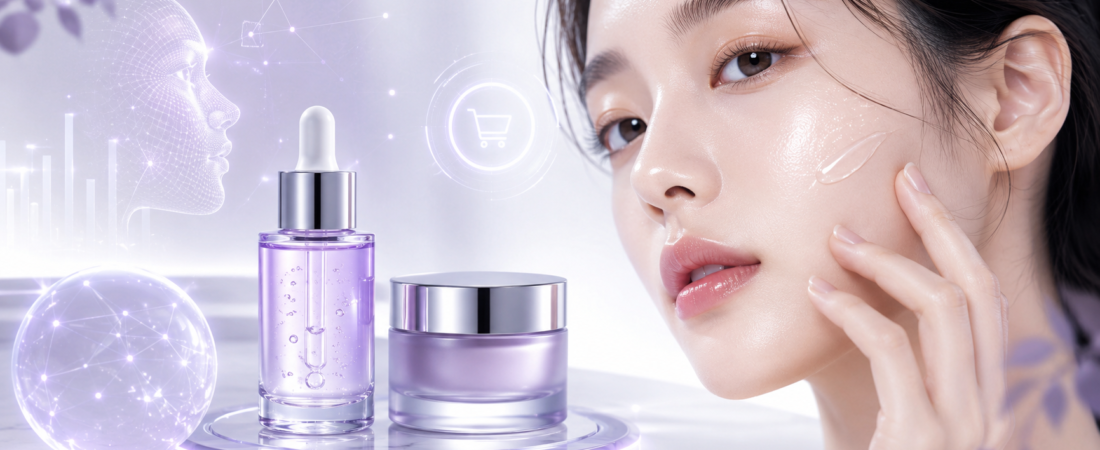
K-Beauty Trends 2027 are pointing toward a new phase for Korean beauty. The market is moving beyond simple “glass skin” trends toward skin longevity, regenerative ingredients, AI-powered shopping, social commerce, and more science-driven beauty routines. In 2026, PDRN, exosomes, spicules, slow aging, scalp care, and advanced peptides all gained momentum, while AI shopping and social commerce continued to reshape how beauty products are discovered and purchased. These signals suggest that 2027 will be defined by smarter formulations, stronger clinical credibility, and new ways for consumers to find and buy beauty products.
In this guide, we break down the 15 K-Beauty and beauty commerce trends most likely to shape 2027.
1. PDRN Goes Mainstream
PDRN (polydeoxyribonucleotide) is moving from Korean dermatology clinics into mainstream skincare. In 2026, the ingredient gained wider visibility across serums, creams, masks, and post-treatment skincare, while both salmon-derived and plant-based versions began attracting more attention. Major beauty publications have already identified PDRN as one of the defining K-Beauty ingredients of 2026.
The science behind PDRN is linked to tissue repair and regenerative pathways, and recent dermatology reviews describe potential benefits related to wound healing, inflammation control, and skin recovery. However, the evidence for topical cosmetic PDRN is still developing, and results should not be treated as equivalent to injectable clinical treatments.
For 2027, the bigger opportunity may be the expansion of PDRN beyond a single “hero ingredient.” We expect brands to combine it with peptides, ceramides, growth-factor-inspired ingredients, and barrier-care formulas, while also competing on PDRN source, concentration, molecular size, and clinical evidence. This could turn PDRN from a viral K-Beauty trend into a broader regenerative skincare category.
What to watch in 2027
- Plant-derived and vegan PDRN
- PDRN + peptide combinations
- PDRN barrier creams and recovery products
- Clearer concentration and sourcing claims
- More clinical testing for topical formulas
2. Peptides Become More Advanced
Peptides are no longer being treated as one simple anti-aging ingredient. In 2026, skincare brands increasingly began differentiating between biomimetic peptides, signal peptides, carrier peptides, and multi-peptide complexes designed to support collagen, hydration, barrier function, and skin recovery. K-Beauty in particular is moving toward more biotech-driven formulas that combine peptides with ingredients such as PDRN, ceramides, antioxidants, and regenerative actives.
Scientific evidence is also becoming more nuanced. A 2026 systematic review and meta-analysis covering 19 randomized controlled trials found that peptide-based interventions showed meaningful improvements in hydration and brightness, while wrinkle reduction was more modest and effects on elasticity and skin density were less consistent. This suggests that brands will increasingly need to support peptide claims with clearer formulation data and clinical evidence rather than relying on the word “peptide” alone.
For 2027, the opportunity is likely to shift toward next-generation peptide systems rather than single-peptide products. We expect more multi-peptide blends, biomimetic peptides, copper peptides, peptide + PDRN combinations, and formulas positioned around skin longevity and resilience instead of traditional anti-aging alone. This also creates room for brands to compete through peptide type, concentration, delivery system, and clinical testing.
What to watch in 2027
- Biomimetic peptides
- Multi-peptide complexes
- Copper peptide formulas
- Peptide + PDRN combinations
- Peptide + ceramide barrier products
- More clinical evidence and concentration disclosure
3. Skin Longevity Replaces Traditional Anti-Aging
Traditional anti-aging skincare has long focused on reducing visible signs of aging such as wrinkles, fine lines, and pigmentation. In 2026, however, the conversation increasingly shifted toward skin longevity — maintaining healthy skin function, resilience, hydration, and barrier strength over a longer period of time rather than simply trying to erase signs of aging.
This change is especially visible in K-Beauty’s “slow aging” philosophy. Instead of aggressive short-term treatments, slow aging emphasizes consistent sunscreen use, barrier support, hydration, gentle actives, and long-term maintenance. Ingredients such as ceramides, peptides, niacinamide, antioxidants, and regenerative actives are increasingly positioned around resilience and recovery rather than only wrinkle correction.
For 2027, we expect more brands to adopt skin healthspan, resilience, recovery, and longevity language across product development and marketing. However, brands will also need to be careful with scientific claims. The concept of “extending skin longevity” is still difficult to measure directly, and many products marketed under the longevity trend still rely on familiar skincare ingredients rather than entirely new technologies.
What to watch in 2027
- Skin longevity and skin healthspan claims
- Slow-aging skincare routines
- Barrier resilience positioning
- Peptide + ceramide combinations
- Regenerative ingredients such as PDRN
- More emphasis on prevention and long-term maintenance
- Stronger demand for clinical evidence
4. Barrier Repair Evolves Into Skin Resilience
Skin barrier care is evolving beyond simply repairing dry or irritated skin after damage occurs. In 2026, skincare increasingly focused on skin resilience — helping the skin maintain hydration, tolerate environmental and cosmetic stress, and recover more effectively when its barrier is challenged. This reflects a broader shift toward long-term skin health rather than short-term correction.
Ceramides remain one of the most important ingredients in this category because they are key components of the skin barrier and help reduce moisture loss. However, newer barrier-focused formulas are increasingly combining ceramides with cholesterol, fatty acids, panthenol, cica, beta-glucan, ectoin, peptides, and other supportive ingredients rather than relying on a single hero ingredient.
For 2027, we expect barrier products to move from simple “repair creams” toward formulas positioned around resilience, recovery, and prevention. Products may increasingly emphasize multi-lipid systems, stress recovery, compatibility with retinoids and acids, and clinical measurements such as hydration and transepidermal water loss (TEWL).
What to watch in 2027
- Multi-ceramide and multi-lipid systems
- Ceramide + peptide combinations
- Panthenol, cica, beta-glucan, and ectoin
- Barrier care designed for active-heavy routines
- Skin resilience and recovery claims
- Hydration and TEWL testing
- Lightweight barrier products for daily use
5. Spicule Skincare Moves Into the Mainstream
Spicule skincare is moving from a niche K-Beauty concept into a more recognizable global category. Spicules are microscopic, needle-like structures—often derived from marine sponges—that can create temporary microchannels in the skin and improve the delivery of topical ingredients. Research has shown that natural siliceous spicules can increase skin penetration of certain compounds, which helps explain why they are increasingly being used in serums, creams, and treatment-style products.
Consumer awareness has also grown quickly. In 2026, mainstream beauty coverage increasingly described spicules as a “liquid microneedling” or at-home treatment trend, while K-Beauty products such as Reedle Shot helped bring the concept into wider international awareness.
For 2027, we expect spicule skincare to become more sophisticated. Rather than relying only on the tingling sensation as a marketing hook, brands may increasingly differentiate products by spicule concentration, particle size, delivery system, and the active ingredients paired with them. PDRN, peptides, exosome-inspired ingredients, cica, and barrier-supporting ingredients are likely combination candidates.
At the same time, brands will need to communicate usage instructions carefully. Because spicules physically interact with the skin barrier, stronger formulas may not be suitable for every skin type, and consumers may need clearer guidance about frequency, irritation, and combinations with other potent actives. Research into cosmetic spicule delivery is promising, but consumer products should not be presented as equivalent to professional microneedling procedures.
What to watch in 2027
- Spicule + PDRN combinations
- Spicule + peptide formulas
- Different spicule strength levels
- Barrier-supporting post-spicule products
- Better usage and irritation guidance
- More clinical testing
- Expansion beyond facial serums into creams, masks, and scalp products
6. Exosomes and Regenerative Beauty Expand
Exosomes are becoming one of the most talked-about ingredients in regenerative skincare. They are tiny extracellular vesicles involved in cell-to-cell communication, carrying proteins, lipids, and signaling molecules. In 2026, exosomes gained more attention across K-Beauty, professional aesthetic treatments, and at-home skincare, especially in products positioned around recovery, hydration, texture, and skin rejuvenation.
Interest is growing, but the science is still developing. A 2026 systematic review of 21 studies found that exosome- and extracellular-vesicle-based treatments showed promising improvements in elasticity, hydration, wrinkle depth, and pigmentation. However, topical skincare presents an additional challenge because penetration through the skin barrier can be limited, and products marketed as “exosome skincare” may differ greatly depending on whether they use human-derived, plant-derived, lab-engineered, or exosome-inspired materials.
For 2027, we expect the category to become more sophisticated and more regulated. Brands may compete on source, purification, stabilization, delivery technology, and clinical evidence rather than simply putting the word “exosome” on the label. K-Beauty is also likely to combine exosome-related technologies with PDRN, peptides, growth factors, spicules, and barrier-repair ingredients as part of the broader move toward regenerative and longevity-focused skincare.
What to watch in 2027
- Plant-derived and lab-engineered exosome technologies
- Exosome + PDRN combinations
- Exosome + peptide and growth-factor formulas
- Better stabilization and delivery systems
- More clinical testing for topical products
- Clearer disclosure of exosome source and processing
- Increased regulatory scrutiny around regenerative claims
7. Growth Factors and EGF Gain Attention
Growth factors are becoming more visible in advanced skincare, particularly as brands move toward regenerative and longevity-focused positioning. Epidermal Growth Factor (EGF) is one of the best-known examples. EGF is a signaling protein involved in cell communication, wound healing, and tissue homeostasis, and recombinant EGF has been studied for skin repair and rejuvenation applications.
In 2026, growth factors are also appearing more frequently alongside peptides and regenerative technologies. Beauty coverage has highlighted smarter, more targeted peptides and growth factors as part of the broader move toward clinically backed skincare, while K-Beauty continues to push biotech-inspired ingredients into more mainstream formats.
Research into topical EGF remains promising but still relatively limited compared with long-established actives such as retinoids. A 2026 formulation study reported improvements in hydration, elasticity, barrier function, pigmentation, and visible signs of aging with an EGF-loaded cosmetic formulation, while earlier reviews have also found potential benefits for facial rejuvenation and wound repair. However, formulation stability, delivery through the skin barrier, concentration, and the source of the growth factor can all influence performance.
For 2027, we expect growth-factor skincare to become more differentiated. Instead of simply promoting “EGF” on the front of a package, brands may increasingly compete on recombinant technology, delivery systems, peptide-growth-factor combinations, post-procedure recovery positioning, and stronger clinical evidence.
What to watch in 2027
- Recombinant EGF formulations
- Growth factor + peptide combinations
- EGF + PDRN products
- Post-procedure recovery skincare
- Improved delivery and stabilization technology
- Clearer sourcing and concentration information
- More controlled clinical studies
8. Scalp Care Becomes an Extension of Skincare
Scalp care is increasingly being treated as an extension of skincare rather than a separate haircare step. In 2026, Korean scalp routines gained wider international attention, with more emphasis on exfoliation, hydration, microbiome balance, and lightweight scalp serums and tonics. This “skinification” of the scalp reflects a broader shift from simply styling hair to maintaining a healthier scalp environment.
Skincare-inspired ingredients are also moving into scalp products. Salicylic acid, niacinamide, peptides, antioxidants, hyaluronic acid, and soothing botanical ingredients are increasingly appearing in scalp treatments designed to address buildup, dryness, oiliness, irritation, and overall scalp condition. Korean scalp spas have helped popularize routines built around scalp analysis, exfoliation, targeted ampoules, and hydration.
For 2027, we expect scalp care to become even more specialized. Brands may increasingly segment products by scalp type, combine skincare-style active ingredients with hair-density positioning, and develop more sophisticated leave-on treatments. However, consumers should be cautious with exaggerated “detox” or hair-growth claims, since cleansing buildup and supporting scalp health are not the same as medically treating hair loss.
What to watch in 2027
- Scalp serums and ampoules
- Peptide and niacinamide scalp formulas
- Scalp microbiome positioning
- Gentle scalp exfoliation
- Personalized products by scalp type
- Scalp analysis and diagnostic devices
- Growth-support positioning with stronger clinical evidence
- Expansion of Korean scalp-care brands globally
9. Glass Hair and High-Gloss Haircare Grow
“Glass hair” is becoming the haircare equivalent of glass skin: smooth, reflective, healthy-looking hair with a mirror-like shine. In 2026, the trend moved further into the mainstream, with beauty publications highlighting gloss treatments, smoothing serums, masks, and cuticle-focused products designed to create a polished finish.
The important shift is that glass hair is no longer only about styling. More brands are combining shine with repair, hydration, bond care, and scalp health, so the glossy finish becomes a visual signal of healthier-looking hair rather than a temporary cosmetic effect. Korean haircare brands are also gaining more visibility in global retail, helping K-Beauty principles expand beyond skincare into hair and scalp routines.
For 2027, we expect high-gloss haircare to become more treatment-driven. At-home hair glosses, protein treatments, bond-repair ampoules, lightweight oils, and leave-in serums may increasingly compete on both shine and long-term hair condition. The strongest products will likely combine an immediate glossy result with claims around damage repair, softness, frizz control, and cuticle smoothing.
What to watch in 2027
- At-home hair gloss treatments
- Bond repair + gloss combinations
- Protein and keratin treatments
- Lightweight shine serums
- Cuticle-smoothing technology
- Heat and humidity protection
- Scalp-to-hair routines
- K-Beauty haircare expansion in global retail
10. Overnight Treatments Become More Sophisticated
Overnight skincare is moving beyond the traditional sleeping mask. In 2026, K-Beauty brands pushed the category toward long-wear hydrogel masks, collagen wrapping masks, barrier-focused sleeping treatments, and overnight products designed to deliver a visible “morning-after” result. Beauty publications also continued to highlight overnight masks as a growing part of Korean skincare routines.
Collagen masks have been especially visible. Vogue reported rising interest in collagen face masks, while products such as overnight hydrogel masks have gained attention for combining collagen with peptides, niacinamide, hyaluronic acid, ceramides, and other hydrating ingredients. However, topical collagen should mainly be understood as a moisturizing and film-forming ingredient rather than as a way to directly replace collagen deep inside the skin.
For 2027, overnight treatments are likely to become more targeted. Instead of one generic sleeping mask, we expect brands to create products for barrier recovery, elasticity, hydration, calming, pigmentation, and post-active recovery, while also experimenting with hydrogel, wrapping-film, cream-mask, and leave-on serum formats.
The strongest products will likely compete on comfort, overnight wearability, ingredient delivery, and visible results the next morning rather than simply claiming that “more hours on the skin” automatically means better performance.
What to watch in 2027
- Overnight hydrogel masks
- Collagen wrapping masks
- Peptide + collagen combinations
- Ceramide and barrier-recovery sleeping masks
- PDRN overnight treatments
- Multi-hour and overnight wear formats
- Less sticky, pillow-friendly textures
- Stronger clinical testing for hydration and elasticity
11. Metabolic Beauty Connects Beauty and Wellness
Beauty is increasingly moving beyond what happens on the surface of the skin. Mintel named “Metabolic Beauty” its number-one global Beauty & Personal Care prediction for 2026, describing a shift toward beauty where health, technology, personalization, and holistic wellness increasingly overlap.
This trend connects skincare with broader lifestyle factors such as sleep, stress, nutrition, exercise, gut health, and overall wellbeing. At the same time, consumers are showing more interest in supplements, diagnostic tools, wearables, and personalized routines that attempt to connect internal health signals with visible beauty outcomes. The broader 2026 wellness market is also showing stronger interest in inner beauty, preventative care, and technology-enabled health tracking.
For 2027, we expect the beauty-and-wellness boundary to become even less distinct. Skincare brands may increasingly pair topical products with supplements, diagnostic tools, personalized recommendations, and lifestyle guidance. AI-supported skincare analysis may also help brands build routines around factors such as environmental exposure, stress, sleep, and individual skin conditions.
However, this category will require careful communication. Claims that a cosmetic product can alter metabolism, treat medical conditions, or directly improve systemic health require much stronger evidence and may fall outside ordinary cosmetic positioning. The strongest beauty brands will likely focus on measurable skin outcomes while treating wellness factors as supportive context rather than making unsupported medical promises.
What to watch in 2027
- Beauty + wellness product ecosystems
- Inner beauty and beauty supplements
- Personalized skin diagnostics
- AI-supported beauty recommendations
- Wearables and beauty-related health data
- Sleep and stress-aware skincare routines
- Skin longevity + holistic wellness positioning
- More demand for measurable, science-backed outcomes
12. Clinical Proof Becomes a Bigger Selling Point
Beauty consumers are becoming more skeptical of vague promises. As professional aesthetic treatments become more familiar, skincare products are increasingly being compared with clinical-level results. In 2026, Mintel identified this shift as a major force in skincare innovation, with consumers placing greater expectations on measurable performance and more sophisticated active ingredients.
This means claims such as “improves hydration,” “supports the skin barrier,” or “reduces the appearance of wrinkles” are becoming more persuasive when brands can show how the result was measured, how many people participated, how long the test lasted, and what percentage improvement was recorded. Large-scale beauty testing programs are also increasingly combining instrumental measurements, clinical data, and real consumer testing rather than relying only on subjective product impressions.
The trend is especially relevant to K-Beauty. As ingredients such as PDRN, exosomes, peptides, spicules, and growth factors move into mainstream skincare, consumers and retailers are likely to demand stronger evidence behind increasingly technical claims. Current 2026 K-Beauty coverage already points to growing demand for clinical credibility, scientific validation, and expert-backed positioning.
For 2027, proof itself may become part of the product’s marketing language. Instead of simply placing an ingredient name on the front of a package, brands may increasingly highlight results such as hydration improvement, TEWL reduction, elasticity measurements, irritation testing, or dermatologist-supervised consumer studies. The strongest brands will make these results easy to understand while avoiding claims that go beyond what the study actually demonstrates.
What to watch in 2027
- More before-and-after clinical data
- Hydration and TEWL measurements
- Elasticity and wrinkle-depth testing
- Sensitive-skin and irritation testing
- Clear study duration and participant numbers
- Dermatologist-supervised evaluations
- QR codes linking to test results
- More cautious and specific efficacy claims
- Clinical evidence used directly in packaging and product pages
13. Personalized and AI-Assisted Beauty Expands
Personalized beauty is becoming more sophisticated as AI moves beyond simple product quizzes. In 2026, beauty brands increasingly used AI-powered skin analysis, virtual consultations, and recommendation engines to evaluate factors such as skin tone, texture, visible concerns, environment, and personal preferences. Major beauty companies are also using AI internally to accelerate formulation and product development.
K-Beauty is particularly well positioned for this shift because Korean beauty companies have already experimented with AI-driven shade matching and customized cosmetics. Amorepacific, for example, has used AI systems to analyze skin tone and recommend personalized foundation and lip colors, showing how beauty personalization can extend beyond skincare into makeup and product manufacturing.
For 2027, personalization is likely to become more dynamic. Instead of recommending one routine based on a single questionnaire, AI systems may increasingly adjust recommendations using changing skin conditions, climate, season, lifestyle, and purchasing behavior. Personalized skincare may also become more closely connected to smart mirrors, diagnostic devices, wearables, and AI shopping assistants. Vogue has already identified personalized, AI-supported skincare as part of the broader 2026 shift toward precision and science-backed beauty.
The biggest challenge will be trust. Brands will need to clearly explain what data is being collected, how recommendations are generated, and whether AI-based skin assessments have been independently validated. Personalization will be most valuable when it helps consumers simplify their routines rather than encouraging unnecessary product consumption.
What to watch in 2027
- AI-powered skin analysis
- Personalized skincare routines
- Dynamic recommendations based on climate and season
- Smart mirrors and connected beauty devices
- AI shade matching for makeup
- Personalized product formulations
- AI + wearable health data
- Privacy and transparency around beauty data
- AI shopping assistants recommending skincare products
14. AI Shopping Changes Beauty Product Discovery
Beauty product discovery is moving beyond traditional search results and marketplace rankings. In 2026, Google expanded its agentic commerce strategy through the Universal Commerce Protocol (UCP), an open standard designed to let AI systems connect product discovery, cart building, and checkout across services such as Google Search AI Mode and Gemini.
Google also introduced the Universal Cart in 2026, allowing shoppers to collect products discovered through AI-powered experiences and move more smoothly toward purchase. UCP can access real-time product information such as pricing and inventory, while newer integrations support checkout, promotions, loyalty information, and other commerce functions.
For beauty brands, this could significantly change how products compete for visibility. Instead of optimizing only for a traditional Google ranking or Amazon search result, brands may increasingly need to provide AI systems with accurate product titles, structured attributes, pricing, availability, return policies, customer-support information, and detailed product data. Google’s current UCP documentation already requires merchants to prepare product feeds, return policies, support information, and checkout-related attributes for participating commerce experiences.
For 2027, we expect beauty discovery to become increasingly AI-mediated. A shopper may ask an AI assistant to find a Korean barrier cream for sensitive skin under a certain price, compare ingredients, evaluate options, add selected products to a cart, and potentially proceed toward checkout without following the traditional search → website → product page journey. Google has explicitly described agentic commerce as moving shopping from discovery through decision and purchase.
This means beauty brands will need to think beyond conventional SEO. Product information must be clear enough for both humans and AI systems to understand exactly what the product is, who it is for, what ingredients it contains, how much it costs, and why it is different from competing products.
What to watch in 2027
- AI shopping assistants
- Agentic commerce
- Google Universal Commerce Protocol
- AI Mode and Gemini product discovery
- AI-powered product comparisons
- Better structured product data
- Real-time price and inventory information
- AI-readable ingredient and benefit descriptions
- Product-feed optimization for AI shopping
- AI-assisted cart building and checkout
15. TikTok Shop and Social Commerce Keep Reshaping K-Beauty
Social commerce is becoming one of the most important growth channels for beauty. McKinsey estimates that U.S. social commerce sales across consumer categories will reach about $100 billion in 2026, while beauty sales on TikTok have grown at roughly 260% annually since 2023. That makes TikTok more than a marketing channel—it is increasingly becoming a place where product discovery, creator content, live demonstrations, and checkout happen in one ecosystem.
K-Beauty is particularly well suited to this environment. Products with visible textures, unusual formats, strong before-and-after demonstrations, or distinctive ingredients can spread quickly through short-form video. Vogue’s 2026 K-Beauty coverage specifically noted that TikTok is accelerating the movement of Korean beauty brands into mainstream retail, while industry experts say Amazon and TikTok Shop are now among the key channels driving K-Beauty sales in the U.S.
TikTok Shop also integrates creators directly into the sales process. Sellers can work with creators who feature products in shoppable videos and LIVE streams, while commissions can be paid on resulting sales. TikTok Shop currently describes itself as a discovery-driven commerce ecosystem where brands can sell through videos, LIVE, and creator partnerships.
Beauty brands are already treating TikTok Shop as a serious retail channel. In 2026, MAC Cosmetics launched on TikTok Shop with live broadcasts, creator affiliates, tutorials, and product bundles, showing that even established global beauty brands are adapting to social-first commerce.
For 2027, the strongest beauty brands may no longer separate content, influencer marketing, and ecommerce into different activities. A single creator video could introduce a product, explain the ingredients, demonstrate the texture, answer questions, and generate a sale within minutes. For K-Beauty brands, success will increasingly depend on creating products and stories that are easy to understand visually and easy for creators to explain.
What to watch in 2027
- TikTok Shop expansion into more markets
- Creator affiliate programs
- Shoppable short-form videos
- LIVE beauty demonstrations
- Viral ingredient-led product launches
- UGC designed specifically for conversion
- Creator seeding tied directly to sales data
- Social-commerce-exclusive product bundles
- Faster movement from TikTok virality to mainstream retail
- Greater integration of content, creators, and checkout
What Will Define K-Beauty in 2027?
These K-Beauty Trends 2027 show that the market is unlikely to be defined by one viral ingredient or one skincare aesthetic. Instead, the market appears to be moving toward a combination of biotechnology, skin longevity, stronger clinical evidence, personalization, and new digital commerce models.
The strongest signals already visible in 2026 include regenerative ingredients such as PDRN and exosomes, slow-aging and barrier-focused routines, scalp-first haircare, and increasingly multifunctional products. At the same time, beauty discovery is changing as social commerce and AI-powered shopping become more influential in how consumers research, compare, and purchase products.
Google’s expansion into agentic commerce through the Universal Commerce Protocol also suggests that product information itself may become increasingly important. Beauty brands may need to optimize not only for traditional search engines and marketplaces, but also for AI systems that compare products, prices, availability, and attributes on behalf of shoppers.
2027 K-Beauty Trend Summary
| Trend | 2027 Signal | What Brands Should Watch |
|---|---|---|
| PDRN | Very High | Source, concentration, combinations |
| Advanced Peptides | High | Multi-peptide and biomimetic systems |
| Skin Longevity | Very High | Prevention, resilience, long-term skin health |
| Barrier Resilience | High | Ceramides, lipids, recovery formulas |
| Spicule Skincare | High | Strength levels, safety, delivery systems |
| Exosomes | High | Source, stabilization, clinical evidence |
| Growth Factors / EGF | Emerging | Delivery technology and credibility |
| Scalp Care | Very High | Skincare-inspired scalp treatments |
| Glass Hair | High | Repair + shine combinations |
| Overnight Treatments | High | Targeted long-wear formats |
| Metabolic Beauty | Emerging | Beauty + wellness positioning |
| Clinical Proof | Very High | Instrumental and consumer testing |
| Personalized Beauty | High | AI skin analysis and recommendations |
| AI Shopping | Very High | Structured product information |
| TikTok & Social Commerce | Very High | Creators, UGC, LIVE and checkout |
The Bigger Opportunity
For beauty brands, the biggest opportunity may come from combining several of these trends rather than chasing them individually.
Examples could include:
- PDRN + peptide barrier creams
- Skin longevity products supported by clinical testing
- Scalp treatments using skincare-inspired ingredients
- Spicule products paired with recovery-focused formulas
- AI-friendly product pages with detailed ingredient and benefit information
- TikTok-first launches supported by creator affiliates
- Korean OEM products designed specifically for global social commerce
The brands that perform well in 2027 may not simply be those that launch the newest ingredient. They are more likely to be the ones that combine credible formulation, clear product positioning, measurable evidence, and strong digital distribution.
Get the Free 2027 Beauty Commerce Checklist
Want a practical version of these trends that you can use for product planning, market research, and ecommerce strategy?
Download the free 2027 K-Beauty & Beauty Commerce Trend Checklist.
It covers:
- Emerging K-Beauty ingredients
- Product development opportunities
- AI commerce
- TikTok and social commerce
- Korean OEM and ODM
- Global selling
- U.S. and EU regulatory signals
- A practical 90-day action checklist
Enter your email below to get the free checklist.