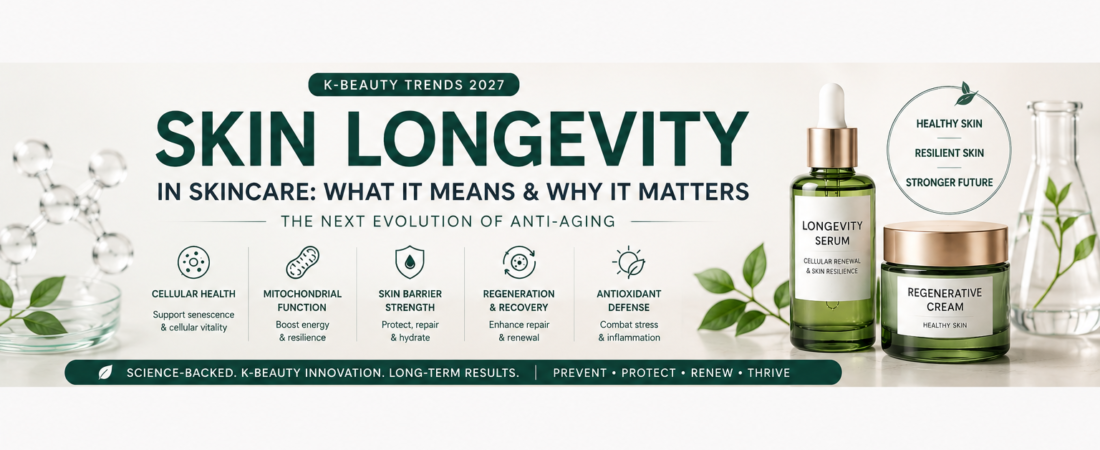
For decades, anti-aging skincare has focused on what consumers can see.
Wrinkles.
Fine lines.
Sagging.
Dark spots.
Loss of firmness.
But a newer skincare concept is beginning to change the question.
Instead of asking:
How do we make skin look younger?
the beauty industry is increasingly asking:
How do we help skin stay functional, resilient and healthy for longer?
That idea is being described as:
skin longevity.
The concept is closely related to the emerging scientific idea of skinspan — maintaining skin health and function throughout the aging process rather than focusing only on the visible signs of age. Recent academic frameworks describe skin aging as the result of interconnected biological processes including cellular senescence, mitochondrial dysfunction, chronic inflammation, DNA damage, stem-cell changes and environmental stress.
K-beauty is beginning to translate that science into products and marketing.
Amorepacific has held a dedicated Skin Longevity Symposium, Sulwhasoo is already using the phrase “Skin Longevity Powered by Ginseng,” and AESTURA presented research in 2026 exploring the relationship between skin-barrier damage and aging.
That makes skin longevity one of the most important skincare concepts to watch going into 2027.
But what does it actually mean?
And how different is it from ordinary anti-aging?
Skin Longevity: Quick Overview
| Factor | Skin Longevity |
|---|---|
| Main goal | Preserve healthy skin function for longer |
| Traditional comparison | Anti-aging / wrinkle correction |
| Key biological themes | Senescence, mitochondria, inflammation, autophagy, barrier health |
| Consumer benefit story | Resilience, recovery, firmness, hydration, healthy aging |
| Typical ingredient directions | Retinoids, peptides, antioxidants, barrier lipids, ginseng and emerging biotech |
| K-beauty relevance | Rapidly increasing |
| Same as “reverse aging”? | No |
| Scientific maturity | Growing, but still emerging as a cosmetic framework |
| 2027 commercial potential | High |
The most important distinction is simple:
Skin longevity is not about making skin immortal.
It is about maintaining the healthspan of the skin — its ability to protect, repair, communicate and recover as efficiently as possible over time.
What Does Skin Longevity Actually Mean?
The term is closely related to the broader concept of healthspan.
Healthspan does not simply ask how long someone lives.
It asks:
How long can the body remain healthy and functional?
Skin longevity applies a similar idea to skin.
A 2025 scientific framework called Skinspan proposed evaluating skin aging through long-term preservation of function and resilience rather than cosmetic appearance alone. The authors connected skin health to intrinsic aging mechanisms and environmental exposures such as ultraviolet radiation, pollution and lifestyle factors.
Traditional Anti-Aging
Traditional anti-aging marketing often begins with a visible problem:
- Wrinkles
- Sagging
- Fine lines
- Pigmentation
and asks:
How can we reduce this sign?
Skin Longevity
Skin longevity begins further upstream:
Why is the skin becoming less resilient in the first place?
This shifts attention toward:
- Cellular health
- Barrier integrity
- Oxidative stress
- Chronic inflammation
- DNA damage
- Mitochondrial function
- Cellular senescence
- Tissue repair
That difference could reshape how anti-aging skincare is marketed over the next several years.
Why Is Skin Aging More Complicated Than Wrinkles?
Visible aging is the end result of many biological processes occurring at the same time.
A major 2025 review of intrinsic skin aging identifies cellular senescence, telomere shortening, oxidative stress, hormonal changes, immune decline and metabolic changes among the important internal contributors to aging. UV exposure, pollution, smoking, nutrition and other external factors add additional stress.
At the broader biological level, modern aging research describes twelve interconnected “hallmarks of aging,” including:
- Genomic instability
- Telomere attrition
- Epigenetic alterations
- Loss of proteostasis
- Disabled macroautophagy
- Deregulated nutrient sensing
- Mitochondrial dysfunction
- Cellular senescence
- Stem-cell exhaustion
- Altered intercellular communication
- Chronic inflammation
- Dysbiosis
Not every one of these mechanisms can realistically be changed by a cosmetic product.
But the framework gives beauty companies a much broader scientific map than simply:
wrinkles = less collagen.
1. Cellular Senescence Could Become a Major Beauty Keyword
What Are Senescent Cells?
Cells do not divide forever.
Stress, DNA damage and aging can push cells into a state known as cellular senescence.
Senescent cells stop dividing but can remain metabolically active and release signaling molecules collectively associated with the senescence-associated secretory phenotype, or SASP. Research increasingly connects the accumulation of senescent cells with age-related tissue changes, including in human skin.
Dermal fibroblasts are especially important because they contribute to the extracellular matrix that supports skin structure.
Recent research continues to investigate how fibroblast senescence interacts with collagen degradation, inflammation and extracellular-matrix remodeling.
Why This Matters for Skincare
Traditional skincare says:
Boost collagen.
Longevity skincare may increasingly say:
Help maintain healthier fibroblast function.
That is a much broader story.
We may therefore see more cosmetic marketing using terms such as:
cellular vitality
cellular renewal
senescence support
skin resilience
and
healthy aging.
But brands will need to be careful.
Research into senolytics and other interventions targeting senescent cells is scientifically interesting, but that does not mean an ordinary cosmetic cream has been proven to remove senescent cells from human skin.
2. Mitochondrial Health Is Moving Into Skincare
Mitochondria generate much of the energy required for cellular function.
With aging, mitochondrial dysfunction can contribute to oxidative stress, altered metabolism and impaired cellular performance.
Mitochondrial dysfunction is now recognized as one of the major hallmarks of biological aging, while newer research is exploring the relationship between mitochondrial quality control, autophagy and skin aging.
The New Marketing Story
Traditional skincare:
Gives skin energy.
Skin-longevity skincare:
Supports cellular energy and mitochondrial resilience.
The second sounds much more sophisticated.
But consumers should distinguish between:
a plausible biological mechanism
and
finished-product clinical proof.
A product containing an antioxidant does not automatically mean that the product has been clinically demonstrated to “reverse mitochondrial aging.”
3. Autophagy Could Become the Next Technical Skincare Term
What Is Autophagy?
Autophagy is one of the cellular systems involved in clearing damaged proteins, molecules and organelles.
In simplified terms, it acts as part of a cellular recycling and quality-control process.
Modern aging frameworks include impaired macroautophagy among the hallmarks associated with biological aging.
Skin research is also exploring how autophagy interacts with cellular senescence and age-related changes.
Why Beauty Brands May Like This Concept
It provides a compelling narrative:
Healthy skin does not simply need more ingredients.
It also needs effective cellular maintenance.
That makes autophagy-supporting skincare a plausible next marketing category.
However, this is also exactly the type of scientific language that could easily be exaggerated.
Product-specific evidence will matter.
4. Skin Barrier Health May Become Part of Anti-Aging
For years, barrier skincare and anti-aging skincare were marketed almost like separate categories.
Barrier products focused on:
ceramides
dryness
sensitivity
and
moisturization.
Anti-aging products focused on:
retinol
wrinkles
firmness
and
collagen.
That separation may be disappearing.
In June 2026, AESTURA presented research at a dermatology conference specifically examining the relationship between skin-barrier damage and aging. The company described aging-related changes in connection with barrier deterioration and discussed the role of barrier-focused derma care.
Why This Makes Sense
The skin barrier plays a fundamental protective role.
When barrier function becomes impaired, the skin can experience increased moisture loss and greater sensitivity to environmental stress.
AESTURA’s current Atobarrier365 Cream, for example, is positioned around high-density ceramide capsules, barrier strengthening and prolonged moisturization.
That does not automatically make every ceramide moisturizer a longevity treatment.
But it changes the category narrative:
Barrier care may become preventive aging care.
This could be particularly important for K-beauty because Korean skincare already has strong consumer recognition around ceramides, panthenol, cica and barrier repair.
5. Prevention May Become More Important Than Correction
This may be the biggest conceptual change.
Traditional anti-aging often begins after visible changes appear.
Skin longevity emphasizes preventing or slowing the conditions that contribute to those changes.
Amorepacific’s 2026 Holistic Longevity research vision explicitly divides its strategy into two pillars:
Preventive Care
Protect skin against stresses associated with:
- Environmental exposure
- Lifestyle factors
Active Care
Support restoration of cellular function.
That positioning is significant.
It suggests that future premium skincare may increasingly combine:
protection + repair
rather than simply promising:
wrinkle reduction.
6. Regenerative Skincare Fits Naturally Into Skin Longevity
This is where Beauty Seller Lab’s existing PDRN, exosome and spicule coverage connects with the new category.
PDRN is marketed around repair and regeneration.
Exosome-positioned products emphasize biological communication.
Spicule skincare emphasizes delivery and stimulation.
Skin longevity can act as the umbrella concept connecting all three.
For example:
PDRN → recovery
Exosomes → communication
Spicules → delivery
Skin Longevity → long-term resilience
That is commercially powerful.
Instead of selling consumers another isolated hero ingredient, brands can tell a larger story about keeping skin functional and resilient over time.
For our broader coverage of regenerative ingredients, see our PDRN Skincare in 2027 Guide and Exosomes in Skincare Guide.
7. Ginseng Is Already Being Repositioned as a Longevity Ingredient
One of the clearest examples is Sulwhasoo.
The brand has studied Korean ginseng for decades, but its newest communication is moving beyond conventional “anti-aging.”
In 2025, Sulwhasoo launched a global campaign around:
Skin Longevity Powered by Ginseng
for its Concentrated Ginseng Rejuvenating Cream.
The official product currently positions Korean Ginseng Actives and Ginseng Peptide™ around skin self-rejuvenation, firmness, wrinkles and resilience.
Why This Is Strategically Important
Ginseng is not a new ingredient.
The framing is new.
Old message:
Ginseng anti-aging cream.
New message:
Ginseng-powered skin longevity.
This demonstrates an important point.
The skin-longevity trend does not necessarily require completely new ingredients.
Existing ingredients can be repositioned around:
resilience
preventive aging
cellular health
and
long-term function.
Skin Longevity vs Anti-Aging
The two ideas overlap, but they are not exactly the same.
| Traditional Anti-Aging | Skin Longevity |
|---|---|
| Reduce visible signs | Maintain function and resilience |
| Wrinkle focused | Multi-mechanism focused |
| Corrective | Preventive + corrective |
| Often ingredient-led | Biology/system-led |
| “Look younger” | “Age healthier” |
| Shorter-term cosmetic outcome | Longer-term skin-health narrative |
| Collagen / retinol | Barrier + cells + inflammation + mitochondria + more |
Anti-aging is not disappearing.
Instead, skin longevity may become the next layer above it.
A brand can still sell wrinkle improvement.
But the larger story becomes:
We are not only treating your wrinkle.
We are supporting the systems that help your skin remain resilient over time.
Our next dedicated guide will compare Skin Longevity vs Anti-Aging in more detail.
Which Ingredients Fit the Skin Longevity Trend?
There is no officially approved list of “skin longevity ingredients.”
The concept is broader than any single active.
However, several categories fit naturally into the current scientific and commercial narrative.
Retinoids
Retinoids remain among the most established topical approaches for visible photoaging and collagen-related changes.
In longevity positioning, their story may evolve from:
wrinkle treatment
toward:
long-term cellular renewal.
Peptides
Peptides are increasingly researched for signaling, collagen synthesis, inflammation and other skin-aging pathways. A 2025 review described peptides as emerging candidates for preventing and managing skin aging through several biological mechanisms.
Antioxidants
Oxidative stress is strongly connected with both intrinsic and environmentally accelerated skin aging.
Antioxidants therefore remain a logical component of longevity-focused formulas.
Ceramides and Barrier Lipids
These ingredients support one of the most fundamental skin functions:
barrier integrity.
As barrier health becomes increasingly linked with healthy aging, this category may gain a stronger longevity story.
PDRN
PDRN fits the regenerative side of longevity positioning.
It already carries consumer associations with repair and recovery.
Ginseng
Sulwhasoo is demonstrating how a traditional botanical can be repositioned through modern longevity science and premium skincare storytelling.
What About “Senolytic Skincare”?
This is a term worth watching carefully.
Senolytic Means Something Specific
In aging research, senolytic approaches aim to selectively remove senescent cells.
That is a much stronger biological claim than:
supports healthy-looking skin.
Scientific reviews are investigating senolytic strategies in skin aging, but this remains an emerging therapeutic field.
Cosmetics Should Not Overstate the Evidence
A serum containing a botanical antioxidant should not automatically be called:
clinically proven senolytic skincare
without relevant evidence.
This is likely to become an important credibility issue as longevity marketing grows.
Brands that explain:
what was actually measured
will probably be more credible than brands that simply borrow biomedical terminology.
What Should Consumers Look For in Skin Longevity Products?
Instead of searching for one magical longevity ingredient, look at the product in layers.
1. Prevention
Does the routine address major environmental stressors?
The strongest example remains:
daily sun protection.
UV radiation is one of the major drivers of extrinsic skin aging, so any “longevity routine” that ignores photoprotection has a major conceptual gap.
2. Barrier Support
Look for:
- Ceramides
- Humectants
- Barrier lipids
- Gentle formulation
3. Evidence-Based Actives
Look for active ingredients with a reasonable evidence base for the intended benefit.
4. Recovery
This may include:
- PDRN
- Peptides
- soothing systems
- regenerative-positioned actives
depending on the formula.
5. Product-Specific Evidence
The biggest question should increasingly become:
What did this finished product actually demonstrate?
Not:
Does one ingredient have an interesting laboratory study?
Real K-Beauty Signal #1: Amorepacific Skin Longevity Symposium
In October 2025, Amorepacific’s New Beauty Research Initiative held a dedicated Skin Longevity Symposium in New York City.
The company presented research involving proprietary ingredients including Ginsenomics™, Lymphanax™ and RE.D Flavonoid™ and discussed their potential roles in skin longevity.
This matters because it shows skin longevity is not simply appearing in consumer-facing advertising.
Major Korean beauty companies are building research frameworks around the concept.
Real K-Beauty Signal #2: Sulwhasoo
Sulwhasoo represents the luxury side of the trend.
The brand’s current Concentrated Ginseng Rejuvenating Cream is positioned around skin’s self-rejuvenating abilities, resilience and long-term anti-aging care.
And the brand has explicitly adopted:
Skin Longevity Powered by Ginseng
as a global communication theme.
That makes Sulwhasoo one of the clearest current examples of longevity language entering mainstream K-beauty.
Real K-Beauty Signal #3: AESTURA and the Skin Barrier
AESTURA represents a second route into longevity.
Rather than beginning with cellular regeneration, its current scientific positioning increasingly connects:
with
aging.
In 2026, the brand presented research specifically on the link between skin-barrier damage and aging at an international dermatology meeting.
This suggests that K-beauty’s already strong barrier-care category could become one of the foundations of future longevity skincare.
Skin Longevity May Change Product Development
For beauty sellers, the biggest opportunity is not necessarily launching a product named:
Longevity Serum
That phrase alone will quickly become copyable.
A stronger strategy is:
Longevity Mechanism + Consumer Problem + Hero Ingredient
For example:
Barrier Longevity
Ceramide + Panthenol + Antioxidant
Target:
Chronically dry, stressed skin.
Cellular Recovery
PDRN + Peptide + Niacinamide
Target:
Loss of resilience and recovery.
Environmental Longevity
Antioxidants + Barrier Lipids + UV-supportive routine
Target:
Urban environmental stress.
Regenerative Longevity
PDRN + Exosome-positioned technology + delivery system
Target:
Premium biotech skincare.
This creates something consumers can actually understand.
The Biggest Marketing Risk
Skin longevity could become an extremely powerful category.
It could also become meaningless very quickly.
If every brand launches:
Longevity Cream
without explaining what the product actually does, the phrase may become another vague synonym for anti-aging.
The strongest brands will likely define:
What mechanism?
Barrier resilience?
Oxidative stress?
Cellular senescence?
Mitochondrial function?
Inflammation?
What ingredient?
Peptide?
Ginseng?
Ceramide?
PDRN?
What measurement?
Hydration?
Elasticity?
Barrier recovery?
Wrinkles?
Biomarkers?
The more specific the explanation, the stronger the credibility.
Why Skin Longevity Could Be Bigger Than PDRN
PDRN is an ingredient category.
Skin longevity is potentially a platform category.
That distinction matters.
PDRN can sit inside:
Skin Longevity.
So can:
- Exosomes
- Peptides
- Ceramides
- Retinoids
- Antioxidants
- Ginseng
- Spicule delivery
- Microbiome approaches
That gives brands enormous flexibility.
It also makes the concept more durable than any single viral ingredient.
Why Skin Longevity Could Become a Major 2027 K-Beauty Trend
Several signals are now converging.
Scientific Momentum
Academic reviews published in 2025 are explicitly discussing skinspan, skin health and longevity-oriented cosmeceuticals rather than only traditional anti-aging.
Korean Industry Investment
Amorepacific has held a Skin Longevity Symposium and publicly announced a Holistic Longevity research vision.
Consumer-Friendly Translation
Sulwhasoo has already translated the concept into:
Skin Longevity Powered by Ginseng.
Existing K-Beauty Strengths
K-beauty already performs strongly in categories that naturally fit longevity:
- Barrier repair
- Prevention
- Layered skincare
- Regenerative ingredients
- Fermentation
- Botanicals
- Delivery technologies
That makes longevity an unusually natural next step for the industry.
What Beauty Sellers Should Watch in 2027
Watch for these phrases appearing more frequently:
Skin Longevity
Skinspan
Cellular Vitality
Healthy Aging
Cellular Senescence
Mitochondrial Health
Autophagy
Resilience
Self-Rejuvenation
Preventive Aging
Regenerative Skincare
The important signal will not be the terminology alone.
The real test is whether brands begin building:
multiple products
around those ideas.
That is how we will know longevity has become a category rather than a campaign.
The Bottom Line
Skin longevity could represent the next major evolution of anti-aging skincare.
Traditional anti-aging asks:
How can we reduce wrinkles?
Skin longevity asks:
How can we help skin remain healthier, more functional and more resilient as it ages?
That creates a much larger scientific and commercial framework.
Cellular senescence, mitochondrial health, autophagy, inflammation, barrier integrity and regenerative processes are all increasingly discussed within modern skin-aging research.
At the same time, K-beauty companies are already commercializing the concept.
Amorepacific has established a dedicated longevity research direction.
Sulwhasoo is positioning ginseng around skin longevity.
AESTURA is connecting barrier science with aging.
That does not mean every product using the word “longevity” will be scientifically advanced.
It means the language of anti-aging is changing.
The winning question may no longer be:
How young can this cream make me look?
It may become:
How well can this formula help my skin maintain its resilience over time?
For consumers, that means focusing more on prevention, barrier health, evidence and long-term routine quality.
For beauty sellers, it creates an entirely new product-development framework.
And for K-beauty, skin longevity may be one of the most important category-building opportunities of 2027.
FAQ
What is skin longevity?
Skin longevity describes the idea of preserving skin health, function and resilience for as long as possible rather than focusing only on correcting visible signs of aging. Recent scientific frameworks increasingly use concepts such as skinspan to describe healthy skin aging.
Is skin longevity the same as anti-aging?
Not exactly. Anti-aging traditionally emphasizes visible signs such as wrinkles and firmness, while skin longevity uses a broader framework that includes prevention, cellular function, barrier integrity, inflammation and resilience.
What causes skin aging?
Skin aging is influenced by intrinsic processes including cellular senescence, oxidative stress, telomere changes, immune and metabolic changes, as well as extrinsic factors such as ultraviolet radiation, pollution and lifestyle.
What are senescent skin cells?
Senescent cells are cells that have entered a stable state in which they stop dividing while remaining biologically active. Accumulation of senescent cells and their signaling activity is being studied as one contributor to skin aging.
What ingredients are associated with skin longevity?
There is no official list. Current longevity-relevant categories can include retinoids, peptides, antioxidants, ceramides, PDRN and botanicals such as ginseng, depending on the mechanism and formulation.
Is ginseng a skin longevity ingredient?
Sulwhasoo is currently positioning its ginseng research and Concentrated Ginseng Rejuvenating Cream under the theme “Skin Longevity Powered by Ginseng.” This is a brand-specific longevity positioning rather than proof that every ginseng cosmetic extends skin lifespan.
Does skin barrier health affect skin aging?
Barrier integrity is increasingly being studied in connection with aging. AESTURA presented research in 2026 specifically examining the relationship between skin-barrier damage and aging.
Will skin longevity be a major K-beauty trend in 2027?
It cannot be guaranteed, but recent scientific publications, dedicated Amorepacific longevity research, Sulwhasoo’s global longevity campaign and barrier-aging research from AESTURA provide strong evidence that the concept is gaining momentum.