If you followed K-beauty in 2025 or 2026, you probably saw one ingredient everywhere:
PDRN.
PDRN skincare has quickly become one of the most talked-about categories in Korean beauty.
Originally associated with regenerative medical and aesthetic treatments in Korea, PDRN has rapidly moved into mainstream skincare — appearing in serums, creams, toner pads, masks and even scalp products.
By 2026, major beauty publications including Vogue, Allure and Byrdie were identifying PDRN as one of the ingredients defining the next generation of Korean skincare.
PDRN is part of a broader shift toward biotech-inspired Korean skincare. For a wider market overview, read our 2027 K-Beauty Trends Guide.
But there is an important question behind the hype:
Does topical PDRN skincare actually work — and will consumers still care about it in 2027?
Let’s look at the market, the science and the commercial opportunity.
Table of Contents
What Is PDRN?
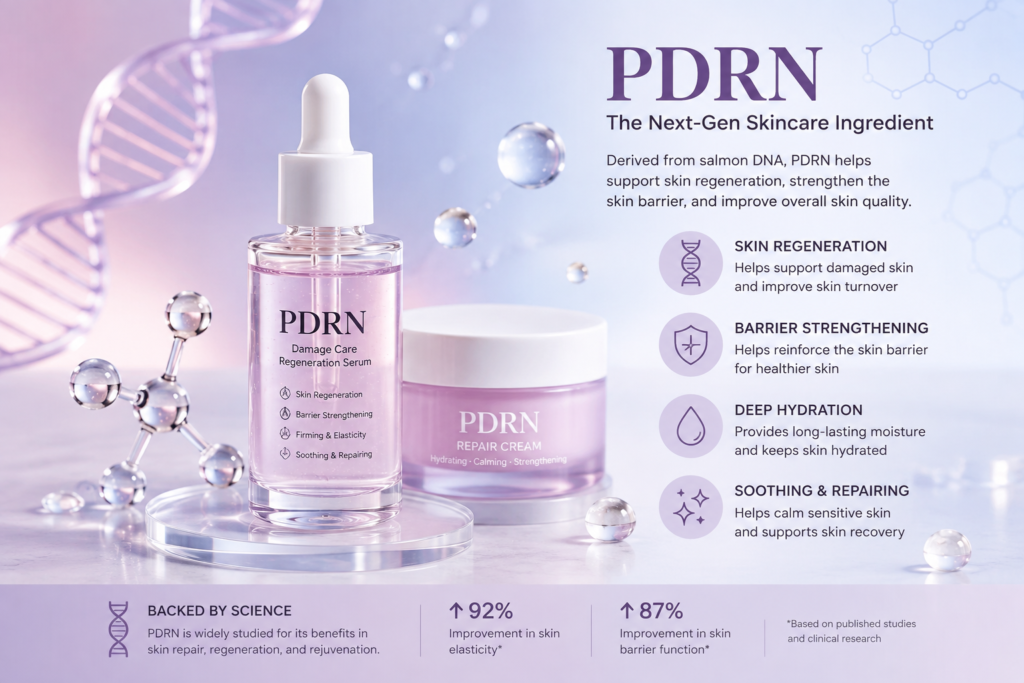
PDRN stands for polydeoxyribonucleotide.
It consists of DNA fragments and has been studied in regenerative medicine for its potential role in tissue repair, inflammation regulation and wound healing. Research has explored mechanisms involving adenosine A2A receptor signaling and cellular repair processes.
Traditionally, many PDRN materials have been derived from salmon or trout DNA.
That origin explains one of the most memorable phrases associated with the trend:
“Salmon DNA skincare.”
However, newer cosmetic formulations are increasingly experimenting with alternative sources, including plant-derived PDRN. Research has examined PDRN obtained from plants such as Panax ginseng, while brands are also commercializing products marketed with rose-derived alternatives.
Why Did PDRN Become So Popular?
PDRN sits at the intersection of several powerful beauty trends.
1. Consumers Want “Regenerative” Skincare
The traditional anti-aging message focused heavily on wrinkles.
The new language is broader:
- skin recovery
- barrier support
- elasticity
- longevity
- collagen
- regeneration
- healthy aging
Beauty publications covering 2026 K-beauty increasingly describe the market as moving toward slow aging, skin longevity and biotech-inspired skincare.
PDRN fits almost perfectly into that narrative.
2. Clinic-Inspired Beauty Is Moving Into the Bathroom
Korean beauty has become increasingly good at translating professional treatment concepts into consumer-friendly cosmetics.
Examples include:
Microneedling → spicule skincare
Skin boosters → PDRN serums
Professional masks → overnight hydrogel masks
Regenerative treatments → exosome-inspired skincare
Spicule products in particular have helped normalize the idea of treatment-inspired home skincare, although dermatology experts emphasize that topical spicules should not be considered equivalent to professional microneedling.
PDRN benefits from the same consumer psychology.
The product feels more technologically advanced than a conventional moisturizing serum.
PDRN Skincare vs. PDRN Treatments: An Important Difference
This is where consumers — and sometimes marketers — can get confused.
Scientific research on PDRN includes studies involving medical applications, injections, wound healing and regenerative treatment. Reviews of the literature report promising biological effects related to tissue regeneration and inflammation.
That does not automatically mean a cosmetic serum applied to the surface of the skin produces the same effects as an injected treatment.
Topical cosmetic delivery involves different concentrations, molecular sizes, formulations and penetration conditions.
Research on topical formulations is developing. For example, studies have investigated plant-derived and lower-molecular-weight PDRN for skin barrier and anti-aging applications, with promising early findings.
For consumers and sellers, the safest interpretation is:
PDRN is scientifically interesting, but cosmetic PDRN should not be marketed as though it is identical to medical PDRN treatment.
That distinction may become increasingly important as regulators and consumers become more skeptical of exaggerated skincare claims.
The PDRN Formula Is Changing
One of the clearest developments in the market is that brands are rarely selling PDRN alone.
Instead, they are building ingredient stacks.
Common combinations now include:
PDRN + Hyaluronic Acid
Hydration and plumping positioning.
PDRN + Collagen
Elasticity and firm-looking skin positioning.
PDRN + Peptides
Healthy-aging and firmness positioning.
PDRN + Niacinamide
Glow and uneven-tone positioning.
PDRN + Panthenol
Barrier and soothing positioning.
Current products from Medicube, Anua and COSRX already demonstrate several of these combinations.
This matters commercially.
Consumers rarely buy an ingredient because they understand its biochemical pathway.
They buy a clear result.
So:
PDRN + Peptides = Firmness
is easier to sell than:
Contains Polydeoxyribonucleotide.
What Does PDRN Skincare Cost?
As of August 2026, several major Korean skincare brands are positioning PDRN in the accessible-premium mass skincare range.
| Brand | Example Product | Listed US Price* |
|---|---|---|
| COSRX | 5 PDRN Collagen Intense Vitalizing Serum | From $14 |
| Medicube | PDRN Pink Peptide Serum | $26 |
| Anua | PDRN Hyaluronic Acid Capsule 100 Serum | $30 |
| Centellian24 | Expert Madeca Cream Active Renew PDRN 50ml | $36.10 |
*Prices observed on official US/global brand stores in August 2026 and may change.
COSRX currently lists its PDRN collagen serum from $14, while Medicube lists its PDRN Pink Peptide Serum at $26. Anua’s PDRN Hyaluronic Acid Capsule 100 Serum is listed at $30, and Centellian24 lists its Expert Madeca Cream Active Renew PDRN at $36.10.
The rapid expansion of PDRN skincare also shows how quickly Korean brands can turn clinical-inspired ingredients into mainstream products.
This creates an interesting price position.
PDRN sounds like a highly advanced ingredient, but Korean brands are making it available at roughly mainstream serum prices rather than luxury skincare prices.
That combination — advanced story + accessible price — is one reason K-beauty can scale ingredient trends quickly.
PDRN Is Becoming More Than a Serum Trend
Another important signal is product expansion.
PDRN is already moving beyond the original serum format.
COSRX now lists PDRN products across serums, toner, hydrogel masks and other formats. Medicube has extended the concept into multiple facial products and even hair and scalp care.
Anua has similarly expanded PDRN into serum sprays, creams and bundled routines.
This suggests the ingredient may be transitioning from:
Hero ingredient
↓
Hero product
↓
Complete product line
That is usually a more meaningful commercial signal than one viral serum.
Salmon PDRN vs. Vegan PDRN Could Become a Bigger Story
The next stage of the PDRN trend may not simply be:
“Does this product contain PDRN?”
Instead, consumers may begin asking:
“What kind of PDRN does it contain?”
Medicube, for example, currently offers its PDRN Pink Peptide Serum in both Salmon DNA PDRN and Rose PDRN (Vegan) options.
Scientific research has also explored plant-derived PDRN materials, including Panax sources.
That opens a new marketing layer:
source transparency.
By 2027, brands may increasingly differentiate products through:
- salmon-derived PDRN
- plant-derived PDRN
- vegan PDRN
- molecular size
- concentration
- delivery technology
- complementary active ingredients
In other words, simply writing “PDRN” on the package may eventually stop being enough.
What Beauty Sellers Should Watch in 2027
For retailers, distributors, Amazon sellers and beauty brands, PDRN still looks commercially relevant.
But the opportunity is changing.
For beauty sellers, PDRN skincare may remain especially attractive when combined with a clear skin concern and complementary ingredients.
Stage 1 — Ingredient Discovery
Consumers ask:
“What is PDRN?”
Stage 2 — Product Discovery
Consumers search:
“Best PDRN serum.”
Stage 3 — Comparison
Consumers begin asking:
“Medicube vs Anua PDRN.”
“PDRN vs peptides.”
“PDRN vs retinol.”
“Salmon PDRN vs vegan PDRN.”
Stage 4 — Specialization
The market splits into more specific benefits:
PDRN for glow
PDRN for dry skin
PDRN for mature skin
PDRN + peptides
PDRN barrier cream
PDRN toner pads
PDRN scalp care
We are already seeing evidence of this category expansion across major Korean brands.
For sellers, that means the next opportunity may not be launching another generic PDRN Serum.
It may be finding the strongest PDRN + problem + format combination.
What Could Replace PDRN?
Every skincare ingredient eventually faces competition from the next trend.
And several candidates are already appearing.
Current K-beauty coverage highlights ingredients and technologies including:
- biomimetic peptides
- exosomes
- spicules
- EGF
- NAD/NMN-inspired longevity ingredients
- advanced fermentation
But that does not necessarily mean PDRN disappears.
More likely, PDRN becomes part of a larger skin longevity ecosystem.
Instead of:
PDRN vs Peptides
we may increasingly see:
PDRN + Peptides + Collagen + Delivery Technology
That is already visible in products reaching the market today.
Is PDRN Just Hype?
Partly hype. Partly science. And definitely a real market trend.
There is legitimate scientific research around PDRN and tissue regeneration.
There is also growing research into cosmetic and topical applications.
But consumers should be cautious when brands imply that a topical cosmetic serum produces the same effects as professional injectable treatments.
The strongest PDRN products of the next few years will probably not rely on the ingredient name alone.
They will combine:
credible formulation + complementary ingredients + clear consumer benefit + transparent claims.
The Bottom Line
PDRN helped define the transition of K-beauty from “gentle hydration” toward biotech-inspired skin optimization.
And going into 2027, the trend appears to be evolving rather than disappearing.
The future of PDRN skincare will likely depend on formulation quality, transparency and clear consumer benefits.
The biggest change may be this:
2025–2026:
“Contains PDRN.”
2027:
“What type of PDRN, how much, combined with what, and for which skin problem?”
For consumers, that means more choice.
For sellers and brands, it means the easy stage of simply putting a trending ingredient on the label is ending.
The next winners will need to explain why their version is different.
FAQ
What does PDRN stand for?
PDRN stands for polydeoxyribonucleotide, a mixture of DNA fragments studied for regenerative and tissue-repair applications.
Is PDRN made from salmon?
Many traditional PDRN materials are derived from salmonid DNA, but plant-derived alternatives are also being researched and commercialized.
Is PDRN serum the same as a PDRN injection?
No. Topical cosmetics and injectable medical or aesthetic treatments involve different delivery methods and should not be assumed to produce equivalent effects.
What ingredients are commonly combined with PDRN?
Current Korean products commonly combine PDRN with ingredients such as collagen, hyaluronic acid, peptides, niacinamide and panthenol.
Will PDRN still be popular in 2027?
No one can know for certain, but current product expansion across serums, creams, masks, toners and scalp care suggests that PDRN is developing into a broader ingredient category rather than remaining a single-product trend.
Next in the Beauty Seller Lab series:
PDRN vs Peptides: Which Skincare Trend Has More Potential in 2027?