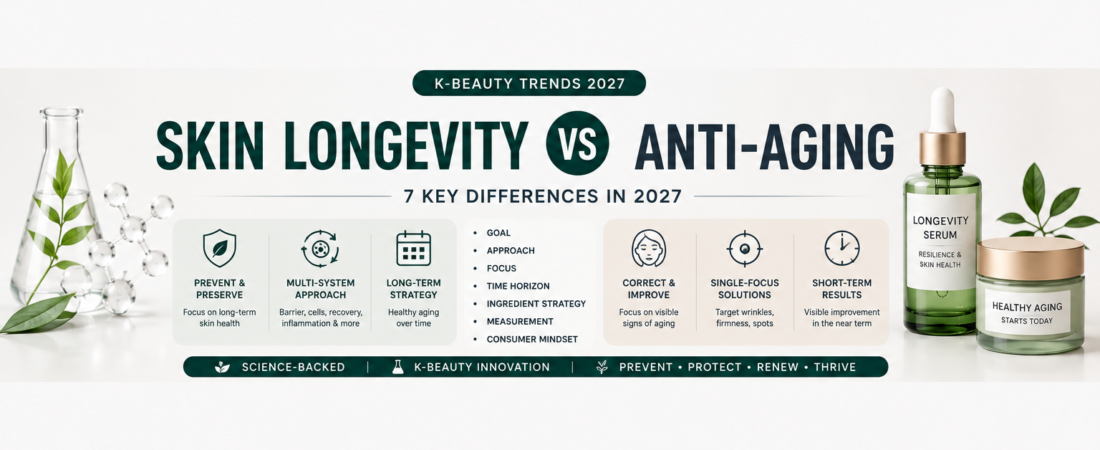
For decades, the beauty industry has used one phrase to describe almost every product targeting older skin:
anti-aging.
Wrinkle creams.
Firming serums.
Retinoids.
Collagen boosters.
Brightening treatments.
But a newer term is rapidly entering skincare research and premium beauty marketing:
skin longevity.
At first, the two concepts sound almost identical.
Both are interested in what happens as skin ages.
Both may use familiar ingredients such as peptides, antioxidants, retinoids, ceramides and regenerative actives.
But the difference between skin longevity vs anti-aging is becoming increasingly important.
Traditional anti-aging generally focuses on reducing or preventing visible signs of aging.
Skin longevity asks a broader question:
How can skin maintain healthy function, resilience and recovery capacity for as long as possible?
A 2025 scientific framework called Skinspan proposed evaluating skin aging through long-term preservation of skin health and function, connecting intrinsic aging processes with environmental factors such as ultraviolet exposure, pollution and lifestyle.
That difference could reshape how skincare is developed and marketed going into 2027.
For a full introduction to the concept first, read our Skin Longevity in Skincare 2027 Guide.
Skin Longevity vs Anti-Aging: Quick Comparison
| Factor | Traditional Anti-Aging | Skin Longevity |
|---|---|---|
| Main goal | Reduce visible signs of aging | Preserve function and resilience |
| Core question | How can skin look younger? | How can skin age healthier? |
| Time horizon | Often corrective | Long-term preventive + corrective |
| Main concerns | Wrinkles, firmness, pigmentation | Barrier, recovery, cellular function, inflammation, aging signs |
| Product story | Visible improvement | Long-term skin health |
| Typical actives | Retinoids, peptides, antioxidants | Same actives + barrier and regenerative systems |
| Science framing | Symptom / pathway based | Multi-system aging biology |
| Consumer language | Anti-wrinkle, lifting, firming | Resilience, vitality, skinspan, healthy aging |
| K-beauty opportunity | Established | Rapidly emerging |
| Does one replace the other? | No | Likely expands the framework |
The key point is:
Skin longevity does not make anti-aging obsolete.
It changes the reason behind the routine.
What Does Traditional Anti-Aging Skincare Mean?
Anti-aging skincare has historically focused on preventing or improving visible changes associated with chronological aging and photoaging.
Common targets include:
- Fine lines
- Wrinkles
- Uneven pigmentation
- Reduced firmness
- Rough texture
- Loss of elasticity
Scientific reviews of skin aging describe both intrinsic biological aging and external factors such as ultraviolet radiation as contributors to these changes. Treatments therefore range from prevention through sunscreen to topical interventions such as retinoids and procedures designed to address existing damage.
Anti-Aging Is Not Just Marketing
Some traditional anti-aging strategies have substantial evidence.
For example, a randomized trial following participants for 4.5 years found that daily sunscreen use was associated with less detectable skin aging than discretionary sunscreen use. Retinoids also have a long scientific history related to keratinocyte activity, collagen-related changes and photoaging.
So the move toward longevity should not be interpreted as:
Everything we used to call anti-aging was wrong.
Many established anti-aging practices are likely to become components of longevity skincare.
What Does Skin Longevity Mean?
Skin longevity shifts attention from isolated visible symptoms toward maintaining a healthy skin system over time.
The emerging Skinspan framework connects healthy skin aging with factors including:
- Cellular senescence
- Mitochondrial dysfunction
- DNA damage
- Chronic inflammation
- Barrier health
- Environmental exposure
- Lifestyle
- Long-term preventive care
The Simplest Difference
Traditional anti-aging:
Reduce the wrinkle.
Skin longevity:
Maintain the biological environment that helps skin remain resilient as it ages.
The wrinkle still matters.
It just becomes one visible outcome inside a much larger system.
Difference 1: Correcting Aging Signs vs Preserving Skin Function
This is the biggest conceptual difference in skin longevity vs anti-aging.
Traditional Anti-Aging
A traditional product often starts with a visible concern:
I have wrinkles.
Then it provides a benefit:
This product improves the appearance of wrinkles.
That is easy for consumers to understand and easy to measure clinically.
Skin Longevity
Longevity starts further upstream.
Instead of asking only:
How deep is the wrinkle?
it may ask:
How well is the skin barrier functioning?
How efficiently is the tissue recovering?
What is happening to fibroblast function?
Is chronic cellular stress increasing?
How resilient is the skin to environmental damage?
Modern research links skin aging to multiple interacting biological processes rather than one isolated pathway.
The Result
Anti-aging → visible outcome
Longevity → function + visible outcome
Difference 2: Correction vs Prevention
Traditional anti-aging marketing often becomes most relevant after consumers notice aging signs.
Skin longevity fits naturally with a preventive mindset.
Anti-Aging Example
Fine lines are visible → use wrinkle serum.
Longevity Example
Maintain UV protection, barrier integrity, hydration, antioxidant protection and appropriate actives before major functional decline occurs.
The Skinspan framework specifically emphasizes long-term prevention, including sun protection and maintaining a resilient skin environment.
This is one reason K-beauty may fit the concept unusually well.
Korean skincare already emphasizes:
- Daily sunscreen
- Hydration
- Barrier care
- Layered routines
- Gentle maintenance
- Preventive skincare
Longevity gives those behaviors a larger scientific narrative.
Difference 3: One Aging Sign vs Multiple Aging Mechanisms
Traditional anti-aging products often organize themselves around a single problem.
Common Anti-Aging Positioning
Retinol → wrinkles
Vitamin C → pigmentation
Peptide → firmness
Eye cream → crow’s feet
This is commercially simple.
Longevity is more complicated.
Skin Longevity Looks at Connected Systems
Modern aging biology recognizes interconnected mechanisms including mitochondrial dysfunction, cellular senescence, impaired autophagy, genomic instability, chronic inflammation and altered cellular communication.
A 2025 review specifically examining longevity cosmeceuticals argues that future skincare evaluation may increasingly require biomarkers and clinical trial designs capable of measuring broader biological aging processes rather than only appearance.
That could shift product development toward:
multi-pathway formulations
rather than
one ingredient = one wrinkle claim.
Difference 4: The Ingredients May Be Similar — the Story Is Different
This part is important.
Skin longevity does not necessarily require completely new ingredients.
Many longevity formulas may use ingredients consumers already know.
Retinoids
In traditional anti-aging:
Reduce the appearance of wrinkles.
In longevity positioning:
Support long-term cellular renewal and skin quality.
Antioxidants
Traditional:
Brightening and environmental protection.
Longevity:
Help reduce oxidative stress associated with environmental aging.
Peptides
Traditional:
Firming and collagen support.
Longevity:
Signaling and structural resilience.
Ceramides
Traditional:
Dry-skin moisturizer.
Longevity:
Maintain barrier function and resilience.
Ceramides are fundamental components of the stratum corneum lipid system, and recent research continues to examine topical physiological lipids for restoring ceramide balance and strengthening barrier function.
PDRN and Regenerative Ingredients
Traditional anti-aging may simply present these as:
new wrinkle ingredients.
Longevity can place them within a broader:
recovery + regeneration + resilience
story.
For more on this category, see our PDRN Skincare in 2027 Guide.
Difference 5: Wrinkle Care vs Barrier Resilience
One of the most commercially important changes could be the merging of:
barrier skincare
and
anti-aging skincare.
Historically these were different shelves.
Anti-Aging Shelf
- Retinol
- Collagen
- Peptides
- Firming cream
Barrier Shelf
- Ceramides
- Panthenol
- Moisturizer
- Sensitive-skin cream
Longevity makes that separation less logical.
The skin barrier is part of the skin’s core protective system, and ceramides play a major structural role in maintaining water-permeability barrier function.
So a future longevity product could reasonably combine:
ceramide + peptide + antioxidant + regenerative active
rather than forcing consumers to choose between:
barrier care
and
anti-aging.
That is particularly interesting for K-beauty because barrier-focused products are already one of the market’s strongest categories.
Difference 6: Product Claims May Need to Become More Sophisticated
Traditional anti-aging claims are relatively easy to understand.
Traditional Metrics
- Wrinkle depth
- Elasticity
- Firmness
- Hydration
- Pigmentation
Longevity creates a measurement problem.
How exactly does a brand prove:
This cream extends skin longevity?
That claim is much harder.
The emerging longevity-cosmeceutical literature explicitly highlights the need for better biomarkers and clinical methodologies to evaluate skinspan-related outcomes.
This Creates a Credibility Test
Weak longevity marketing:
AGE REVERSAL LONGEVITY COMPLEX
with no explanation.
Stronger longevity marketing:
Supports barrier recovery, improves elasticity and reduces oxidative-stress markers after X weeks.
The second still uses measurable endpoints.
For sellers, this could become a competitive advantage.
The more scientific the marketing language becomes, the more important finished-product evidence will become.
Difference 7: “Look Younger” vs “Age Better”
The emotional language is changing too.
Traditional Anti-Aging
The classic message is:
Fight aging.
Reverse aging.
Erase wrinkles.
Look younger.
Skin Longevity
The emerging message is more like:
Maintain resilience.
Protect future skin quality.
Support healthy aging.
Preserve skin function.
Improve skinspan.
This may appeal to consumers who do not necessarily want to “fight” aging but still want effective skincare.
It also gives brands permission to reach younger audiences without saying:
You need an anti-wrinkle cream at 25.
Instead:
Start protecting your skin’s long-term resilience now.
That can dramatically expand the potential consumer base.
Do Sunscreen and Retinol Still Matter in Skin Longevity?
Absolutely.
A longevity framework does not mean abandoning proven skincare.
Sunscreen
UV radiation is one of the major external contributors to visible skin aging. A long-term randomized trial found less skin-aging progression among participants assigned to daily sunscreen use.
If a longevity routine ignores photoprotection while emphasizing exotic biotechnology, the strategy is conceptually incomplete.
Retinoids
Retinoids remain among the most established ingredient families in anti-aging skincare and influence epidermal differentiation and collagen-related pathways.
Longevity does not replace retinoids.
It simply places them inside a larger system.
Real K-Beauty Example: Sulwhasoo Shows Both Concepts Can Coexist
Sulwhasoo may be the clearest example of where this market is heading.
The Product Still Uses Anti-Aging Language
The official U.S. page describes the Concentrated Ginseng Rejuvenating Cream as a ginseng anti-aging cream targeting wrinkles, firmness and resilience.
The Brand Story Uses Longevity
At the same time, Sulwhasoo’s 2025 global campaign was built around:
Skin Longevity Powered by Ginseng.
The campaign expanded across multiple global markets and positioned long-term skin self-renewal and ginseng science within a longevity narrative.
This is extremely important strategically.
Sulwhasoo did not stop selling anti-aging.
It placed anti-aging outcomes inside a larger longevity story.
That may become the dominant model.
Real K-Beauty Example: Amorepacific Is Building a Longevity Research Platform
The shift extends beyond one brand campaign.
In October 2025, Amorepacific’s New Beauty Research Initiative hosted a dedicated Skin Longevity Symposium in New York, presenting research on proprietary ingredients and their potential roles in skin longevity.
In February 2026, the company went further by unveiling a broader Holistic Longevity Solution technology vision at IMCAS World Congress.
Why This Matters
This suggests longevity is being developed as:
research platform
→ ingredient technology
→ brand communication
→ consumer products
rather than only as a marketing slogan.
For the broader market context, see our 2027 K-Beauty Trends Guide.
Where Do PDRN, Exosomes and Spicules Fit?
These trends do not compete directly with skin longevity.
They can sit underneath it.
PDRN
Recovery / regenerative positioning
Exosomes
Biological communication / biotech positioning
Spicules
Delivery / stimulation positioning
Skin Longevity
The umbrella goal
A future premium formula might therefore combine:
PDRN + peptide + ceramide + spicule delivery
and sell the entire system around:
long-term skin resilience.
For the biotech side of this trend, see our Exosomes in Skincare Guide.
Skin Longevity Does Not Mean “Reverse Biological Age”
This distinction will become increasingly important.
Scientific aging research is exploring:
- Senolytics
- Cellular reprogramming
- Epigenetic aging
- Mitochondrial restoration
- Regenerative technologies
But ordinary cosmetic products should not automatically be assumed to produce those same biological outcomes.
Research on skin longevity is expanding, but many advanced interventions remain experimental or therapeutic rather than established topical-cosmetic effects.
A More Credible Cosmetic Claim
Instead of:
This cream reverses cellular aging.
a more defensible longevity product might demonstrate:
- Improved barrier recovery
- Increased hydration
- Improved elasticity
- Reduced appearance of wrinkles
- Improved resilience after environmental stress
The language can be futuristic.
The evidence still needs to match the claim.
Which Approach Is Better?
There is no universal winner.
Choose Traditional Anti-Aging Thinking If Your Priority Is:
- Existing wrinkles
- Pigmentation
- Loss of firmness
- Fine lines
- A specific visible concern
- Easily measurable cosmetic improvement
Choose Longevity Thinking If Your Priority Is:
- Prevention
- Barrier resilience
- Long-term routine quality
- Environmental protection
- Recovery
- Maintaining multiple skin functions over time
But in reality, the best strategy may combine both.
Anti-aging tells you what to improve.
Skin longevity tells you why you are maintaining it.
What a Longevity Routine Could Look Like
Longevity skincare does not need to mean a 12-step routine.
Morning
- Gentle cleansing
- Antioxidant or supportive active
- Barrier-supporting moisturizer
- Broad-spectrum sunscreen
Evening
- Gentle cleansing
- Evidence-based active such as a retinoid, peptide or targeted treatment
- Regenerative or soothing supportive product if appropriate
- Barrier moisturizer
Long-Term Goal
Not:
Maximum irritation for maximum results.
But:
consistent protection + appropriate stimulation + reliable recovery.
That may fit K-beauty’s preventive and barrier-focused philosophy particularly well.
What Skin Longevity Means for Product Development
For beauty sellers, simply writing:
LONGEVITY SERUM
on a bottle is not enough.
A stronger concept needs a mechanism.
Concept 1: Barrier Longevity
Ceramide + Panthenol + Peptide
Consumer problem:
Dryness, sensitivity and declining resilience.
Concept 2: Regenerative Longevity
PDRN + Peptide + Niacinamide
Consumer problem:
Slow recovery and loss of firmness.
Concept 3: Environmental Longevity
Antioxidants + Barrier Lipids
Consumer problem:
Urban environmental stress.
Concept 4: Premium Biotech Longevity
PDRN + Exosome-Positioned Technology + Delivery System
Consumer problem:
Premium treatment-inspired healthy-aging care.
This is much stronger than a vague anti-aging serum because it explains:
mechanism + ingredient + problem + benefit.
Will Skin Longevity Replace Anti-Aging?
Probably not completely.
A more likely scenario is:
Anti-aging becomes a benefit.
Longevity becomes the philosophy.
Consumers will still search for:
- wrinkle serum
- anti-aging cream
- firming serum
- retinol
because those terms describe clear problems.
But premium brands may increasingly frame those products within:
- healthy aging
- resilience
- preventive care
- skinspan
- longevity
Sulwhasoo already provides a real-world example: it simultaneously describes its product as an anti-aging cream and markets the broader brand narrative around skin longevity.
Why This Could Matter More in 2027
Three separate forces are converging.
Scientific Language Is Changing
Recent research is explicitly discussing skinspan and longevity cosmeceuticals rather than focusing only on cosmetic anti-aging.
Major K-Beauty Companies Are Investing
Amorepacific has already developed both Skin Longevity and broader Holistic Longevity research initiatives.
Consumers Already Understand Preventive Skincare
Sunscreen, hydration and barrier care are already familiar.
Longevity simply connects these behaviors into a larger framework.
That makes the concept easier to commercialize than an entirely unfamiliar scientific ingredient.
What Beauty Sellers Should Watch
Watch for increasing use of:
- Skin Longevity
- Skinspan
- Healthy Aging
- Resilience
- Preventive Aging
- Cellular Vitality
- Regenerative Skincare
- Barrier Longevity
- Self-Rejuvenation
- Mitochondrial Health
- Senescence
But terminology alone is not enough.
The bigger signal will be whether brands start launching multiple products under one longevity platform.
When a trend develops:
cleanser → serum → cream → mask → treatment
it has moved beyond a campaign.
It has become a category.
The Bottom Line
The debate around skin longevity vs anti-aging is not really about choosing one and abandoning the other.
Traditional anti-aging remains useful because consumers want clear solutions for:
wrinkles, firmness, pigmentation and texture.
Skin longevity expands the question.
It asks how skincare can support:
barrier integrity, recovery, cellular resilience, protection and healthy function over time.
Scientific frameworks such as Skinspan and recent longevity-cosmeceutical research reflect this broader direction.
And K-beauty companies are already translating the idea commercially.
Sulwhasoo combines established anti-aging outcomes with its Skin Longevity Powered by Ginseng narrative.
Amorepacific is building longevity into a broader research and technology platform.
So the future may not be:
anti-aging or longevity.
It may be:
anti-aging results inside a skin-longevity strategy.
For consumers, that means thinking beyond the next wrinkle.
For beauty sellers, it creates a much larger product-development opportunity.
And for K-beauty, it could become one of the defining category shifts of 2027.
FAQ
Is skin longevity the same as anti-aging?
No. Anti-aging typically focuses on preventing or improving visible signs such as wrinkles and firmness, while skin longevity uses a broader framework focused on maintaining skin health, function and resilience over time.
Is skin longevity scientifically proven?
The biology of skin aging is well studied, and recent scientific literature has proposed skinspan and longevity-oriented cosmetic frameworks. However, there is no universal clinical test proving that a cosmetic product literally “extends skin lifespan.” Product-specific evidence remains important.
Is sunscreen part of skin longevity?
Yes. UV exposure contributes substantially to skin aging, and randomized evidence has demonstrated lower progression of visible skin aging with regular daily sunscreen use.
Are retinoids still important if skin longevity becomes popular?
Yes. Retinoids remain established anti-aging ingredients and can fit naturally within a broader long-term healthy-aging routine.
Are ceramides anti-aging ingredients?
Ceramides are primarily associated with skin-barrier structure and function rather than classic wrinkle treatment. Within a longevity framework, however, maintaining barrier function can become part of long-term resilience-focused skincare.
Why is K-beauty interested in skin longevity?
The concept fits several existing K-beauty strengths, including preventive routines, sunscreen, barrier care, hydration and regenerative ingredients. Major Korean beauty company Amorepacific has also developed dedicated skin-longevity research initiatives.
Does Sulwhasoo use the term skin longevity?
Yes. Sulwhasoo launched a global campaign built around “Skin Longevity Powered by Ginseng” while continuing to describe its Concentrated Ginseng Rejuvenating Cream as an anti-aging product.
Will skin longevity replace anti-aging in 2027?
A complete replacement is unlikely. Current evidence suggests the concepts may coexist, with anti-aging remaining useful for specific visible concerns while longevity becomes a broader preventive and healthy-aging framework. This is an inference based on current research and industry positioning.