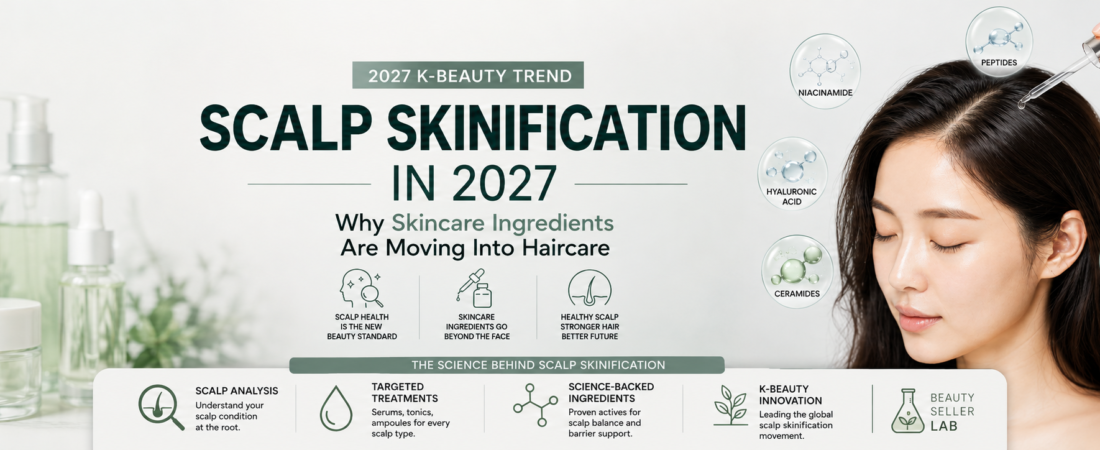
For years, skincare and haircare lived in separate sections of the beauty aisle.
Skincare focused on ingredients.
Haircare focused on results.
Consumers looked for:
- Niacinamide for pores
- Hyaluronic acid for hydration
- Ceramides for barrier support
- Peptides for firmness
- Salicylic acid for exfoliation
Then something changed.
Those same ingredient names started appearing on:
scalp serums, scalp tonics, exfoliating treatments, shampoos and leave-on hair products.
This shift is increasingly described as:
scalp skinification.
The basic idea is simple:
the scalp is skin, and consumers are beginning to care for it with the same ingredient-focused mindset they use for their face.
This was already visible in 2026. Vogue highlighted scalp health and ingredient-led treatments as major haircare themes, while Korean scalp routines continued gaining global visibility. Beauty Seller Lab also identified scalp care as one of the major K-Beauty trends heading toward 2027.
But scalp skinification may become bigger than another short-lived beauty trend.
It could change how consumers shop for haircare entirely.
Scalp Skinification: Quick Summary
| Factor | Traditional Haircare | Scalp Skinification |
|---|---|---|
| Main focus | Hair appearance | Scalp + hair condition |
| Consumer question | “Will this make my hair look better?” | “What does this ingredient do?” |
| Hero products | Shampoo, conditioner | Serum, tonic, ampoule, treatment |
| Ingredient language | Oils, proteins, silicones | Niacinamide, peptides, acids, ceramides, antioxidants |
| Routine style | Wash and condition | Cleanse, exfoliate, treat, hydrate |
| Main positioning | Shine, softness, volume | Scalp balance, hydration, barrier, buildup care |
| Product segmentation | Hair type | Hair type + scalp type |
| 2027 opportunity | Established | High growth potential |
The bigger change is not simply that skincare ingredients are appearing in shampoo.
It is that skincare logic is entering haircare.
What Is Scalp Skinification?
Scalp skinification means applying skincare-inspired thinking to scalp care.
Instead of treating shampoo as the only product that touches the scalp, consumers are increasingly building routines around specific concerns.
These can include:
- Excess oil
- Dryness
- Flaking
- Product buildup
- Scalp sensitivity
- Barrier condition
- Hydration
- Hair-density appearance
- General scalp comfort
The routine may therefore begin to resemble skincare.
For example:
cleanse → exfoliate → treat → hydrate
rather than simply:
shampoo → conditioner.
This does not mean that your scalp should receive the exact same routine as your face.
The scalp has a dense population of hair follicles and sebaceous glands, and its microbial environment also plays an important role in scalp homeostasis. Research into the scalp microbiome has connected microorganisms, sebum and inflammatory processes with several scalp conditions.
So scalp skinification is better understood as:
using skincare principles—not blindly copying a facial routine.
Why Is Scalp Skinification Growing Now?
Several beauty trends are converging at the same time.
1. Beauty Consumers Are Becoming Ingredient-Literate
Modern skincare consumers often recognize ingredient names before they recognize brands.
Someone shopping for a serum may specifically search for:
- Retinol
- Niacinamide
- PDRN
- Peptides
- Ceramides
- Vitamin C
This behavior is starting to move into haircare.
Vogue’s 2026 haircare trend coverage described consumers as increasingly ingredient-conscious and noted a shift toward scalp health and treatments addressing structural concerns instead of products that only change how hair looks temporarily.
That changes the marketing question.
Traditional haircare might say:
“For stronger-looking hair.”
Skinified haircare may say:
“Niacinamide + peptides + panthenol scalp serum.”
The second version gives consumers more information to investigate.
For ingredient-conscious shoppers, that can create a stronger reason to compare products.
2. The Scalp Is Becoming a Separate Beauty Category
Historically, many consumers only thought about their scalp when something went wrong.
For example:
- Dandruff
- Itching
- Excess oil
- Hair shedding
Now scalp care is increasingly becoming a routine category of its own.
Beauty products are moving toward:
- Scalp exfoliators
- Pre-shampoo treatments
- Scalp serums
- Root sprays
- Lightweight tonics
- Scalp masks
- Leave-on ampoules
Vogue’s 2026 coverage included both scalp-focused growth treatments and Korean scalp-cleansing products, including Aromatica’s Rosemary Scalp Scaling Shampoo, as examples of this broader move toward scalp-first haircare.
The important change is that consumers may eventually start shopping by:
scalp type
in the same way they already shop by:
skin type.
3. K-Beauty Is Well Positioned for the Trend
K-Beauty already trained consumers to think in routines.
Facial skincare commonly includes:
- Cleansing
- Exfoliation
- Essence or toner
- Serum
- Moisturizer
- Targeted treatments
That logic transfers surprisingly well to scalp products.
A scalp routine might become:
- Cleanse
- Remove buildup
- Apply targeted tonic
- Use scalp serum
- Treat hair lengths separately
Beauty Seller Lab’s broader 2027 K-Beauty forecast identified scalp serums, scalp ampoules, gentle exfoliation, microbiome positioning and scalp analysis as areas worth watching.
That makes scalp skinification especially relevant to Korean beauty brands.
K-Beauty does not need to teach consumers an entirely new philosophy.
It can extend an existing one.
Which Skincare Ingredients Are Moving Into Scalp Care?
This is where the category becomes particularly interesting.
1. Niacinamide
Niacinamide is one of the most recognizable skincare ingredients in the world.
On facial skin, it is widely associated with barrier support, oil-control positioning and skin-tone care.
In scalp products, the story changes.
Niacinamide may appear alongside ingredients such as:
- Panthenol
- Caffeine
- Antioxidants
- Anti-dandruff ingredients
One randomized controlled study evaluated a scalp regimen containing niacinamide, panthenol, caffeine and other functional ingredients. The regimen was associated with improved scalp barrier measurements and reduced hair shedding compared with the control regimen. Importantly, this does not prove that niacinamide alone is a hair-growth treatment because the study evaluated a multi-ingredient system.
That distinction matters.
2027 Positioning Opportunity
Rather than:
“Niacinamide grows hair.”
a more responsible cosmetic story is:
“Niacinamide-based scalp care for a healthier scalp environment.”
2. Peptides
Peptides have already become one of skincare’s most sophisticated ingredient categories.
Now they are showing up in scalp treatments too.
This makes sense from a marketing perspective.
Consumers already associate peptides with:
- Advanced skincare
- Firmness
- Skin quality
- Biotechnology
- Targeted treatment
Haircare brands can borrow that ingredient equity.
Peptides also fit naturally into leave-on formats such as:
- Scalp serum
- Root tonic
- Hair-density serum
- Ampoule
Vogue’s 2026 haircare reporting identified peptides among the ingredients being used in scalp-focused growth sprays, while the wider haircare market continues shifting toward science-heavy ingredient communication.
2027 Positioning Opportunity
Peptides could help scalp products move from:
basic haircare
toward:
premium treatment skincare for the scalp.
But peptide type, concentration and finished formulation will matter.
Simply writing:
PEPTIDE COMPLEX
may eventually be no more convincing in scalp care than it is becoming in facial skincare.
3. Hyaluronic Acid
Hyaluronic acid has one of the easiest skincare stories to transfer into haircare.
The message is:
hydration.
Dry scalp can feel uncomfortable, tight or flaky.
That creates a logical opportunity for lightweight humectant-based scalp treatments.
Hyaluronic acid is therefore increasingly appearing in scalp and hair products positioned around moisture and comfort.
However, hydration should not be confused with hair-loss treatment.
A hydrating scalp serum may improve how the scalp feels.
That does not mean hyaluronic acid automatically causes meaningful hair regrowth.
2027 Positioning Opportunity
Look for:
- Hyaluronic acid scalp tonics
- Lightweight moisturizing scalp serums
- HA + panthenol formulas
- Hydrating scalp mists
- Scalp barrier products
4. Ceramides
Ceramides are strongly associated with the skin barrier.
That makes them particularly interesting for scalp skinification.
The scalp also has a barrier that can be affected by factors such as:
- Frequent cleansing
- Harsh surfactants
- Chemical processing
- Styling practices
- Environmental exposure
Experimental research has explored ceramides and related compounds in hair and dermal papilla biology, although much of this evidence is laboratory or preclinical rather than proof that a standard ceramide shampoo will regrow hair.
For cosmetics, the clearer opportunity may therefore be:
barrier support.
2027 Positioning Opportunity
Ceramide scalp products could borrow directly from one of skincare’s largest existing categories:
barrier repair.
Expect language such as:
- Scalp barrier
- Moisture barrier
- Dry scalp support
- Barrier-strengthening scalp care
- Ceramide scalp treatment
5. Salicylic Acid and AHAs
Skincare consumers already understand exfoliating acids.
That makes acids an easy entry point into scalp skinification.
The goal is usually not anti-aging.
It is:
buildup management.
Scalp products may use exfoliating ingredients to help remove:
- Oil
- Dead skin
- Styling residue
- Product buildup
This is one reason the term:
scalp facial
is becoming commercially useful.
But scalp exfoliation also demonstrates why face and scalp routines should not be treated as identical.
Aggressive exfoliation can irritate the scalp.
More is not always better.
2027 Positioning Opportunity
The category could develop intensity levels similar to skincare:
gentle → regular → intensive
rather than one harsh scalp scrub for everyone.
6. Antioxidants
Antioxidants are another skincare concept moving into scalp products.
Research suggests there may be a relationship between oxidative stress, scalp barrier condition and hair retention.
A 24-week randomized, double-blind, placebo-controlled trial found that a regimen containing antioxidant and barrier-enhancing ingredients improved measures of scalp condition and reduced hair shedding compared with a placebo control.
Again, the study evaluated a combination of ingredients rather than proving a single antioxidant is a standalone treatment for hair loss.
But it provides an important commercial lesson:
scalp condition itself can become the benefit.
Haircare does not always need to promise dramatic hair growth.
7. Microbiome-Focused Ingredients
The facial skincare industry spent years building the concept of:
skin microbiome care.
Scalp care may be next.
The scalp microbiome includes communities of microorganisms that interact with sebum, follicles and the scalp environment.
Scientific reviews have found that the scalp microbiome is relevant to scalp homeostasis and several conditions, including dandruff-related disorders.
That does not mean every product labeled:
“microbiome balancing”
has proven clinical benefits.
But the concept has significant marketing potential.
2027 Positioning Opportunity
Expect increasing use of terms such as:
- Scalp microbiome
- Prebiotic scalp care
- Scalp balance
- Microbiome-friendly cleansing
- Postbiotic scalp treatment
Brands with meaningful testing may have an advantage over products relying only on trend terminology.
The Most Important Difference: Scalp Health vs Hair Growth
This may become one of the biggest consumer-education challenges in scalp skinification.
A healthier-feeling scalp and medically meaningful hair regrowth are not the same thing.
Improving:
- Hydration
- Flaking
- Buildup
- Barrier condition
- Comfort
can be valuable cosmetic outcomes.
But those benefits do not automatically prove a product can treat:
- Androgenetic alopecia
- Alopecia areata
- Hormonal hair loss
- Other medical causes of hair loss
This distinction becomes especially important as scalp serums become more sophisticated.
Beauty sellers should avoid turning every ingredient into a hair-growth claim.
A cosmetic product can still be useful without pretending to be a medical treatment.
Why Leave-On Scalp Serums Could Become a Major Category
Shampoo has one major limitation:
you rinse it off.
Scalp serums change the product experience.
They can be:
- Targeted
- Lightweight
- Leave-on
- Ingredient-led
- Premium
- Easy to layer into routines
Most importantly, consumers already understand serums.
The skincare industry spent years teaching consumers that a serum is:
a concentrated treatment step.
Haircare can now borrow that behavior.
This may make scalp serum one of the most important product formats to watch heading into 2027.
Scalp Care Could Become Personalized by Scalp Type
Skincare rarely uses one formula for everyone.
Consumers shop for:
- Dry skin
- Oily skin
- Sensitive skin
- Acne-prone skin
- Combination skin
Scalp care could move in the same direction.
Oily Scalp
Possible positioning:
- Lightweight serum
- Oil-control care
- Buildup removal
- Gentle exfoliation
Dry Scalp
Possible positioning:
- Hyaluronic acid
- Panthenol
- Ceramides
- Barrier support
Sensitive Scalp
Possible positioning:
- Minimal fragrance
- Gentle cleansing
- Soothing formulations
- Reduced exfoliation
Flake-Prone Scalp
Possible positioning:
- Anti-dandruff actives
- Controlled exfoliation
- Barrier support
- Scalp microbiome messaging
The next generation of haircare may therefore ask:
What is your scalp type?
before asking:
What is your hair type?
Scalp Analysis Could Make Haircare More Like Skincare
Technology may accelerate this transition.
Korean scalp spas already helped popularize experiences involving:
- Magnified scalp analysis
- Sebum observation
- Buildup assessment
- Scalp cleansing
- Exfoliation
- Targeted treatments
For consumers, seeing the scalp magnified creates a powerful visual experience.
Oil, flakes and buildup suddenly become visible.
That can make the need for scalp products easier to understand.
For 2027, Beauty Seller Lab expects greater interest in the combination of:
scalp analysis + personalized product recommendations.
This could eventually move beyond salons into:
- Retail stores
- Beauty devices
- Smartphone analysis
- AI-supported recommendations
- At-home scalp cameras
This remains a forecast rather than a guaranteed outcome, but it fits the wider beauty movement toward personalization and diagnostic-style shopping experiences.
Why K-Beauty Could Lead Scalp Skinification
Korean beauty has several structural advantages.
Routine Culture
Consumers already associate K-Beauty with multi-step care.
Ingredient Education
Korean brands frequently compete around identifiable hero ingredients.
Lightweight Textures
Essences, ampoules, watery serums and tonics transfer naturally to scalp care.
Scalp Spa Culture
Korean scalp treatments have created a visual and experiential way to explain scalp health.
Strong Global K-Beauty Awareness
Consumers who already buy Korean facial skincare may be more willing to try Korean scalp treatments.
Vogue’s 2026 coverage also pointed to Korea as one of the markets influencing the global shift toward ingredient-driven haircare.
This creates a logical expansion:
K-Skincare → K-Scalp Care → K-Haircare.
What Products Could Grow Most in 2027?
The most interesting opportunities may include:
Scalp Serums
Especially ingredient-focused leave-on formulas.
Scalp Ampoules
Premium, targeted treatment positioning.
Gentle Scalp Exfoliators
AHA, BHA or other controlled exfoliation systems.
Barrier-Focused Scalp Treatments
Ceramides, panthenol and hydrating ingredients.
Peptide Scalp Products
Particularly products that clearly identify their peptide technology.
Microbiome-Focused Scalp Care
If brands can support claims with meaningful evidence.
Scalp Mists
Easy daily hydration and refreshing formats.
Personalized Scalp Systems
Products divided by oily, dry, sensitive or buildup-prone scalp types.
What Should Beauty Sellers Watch?
For sellers, scalp skinification creates a new type of merchandising opportunity.
Instead of organizing products only by:
shampoo / conditioner / treatment
stores may eventually organize part of the category by:
problem / ingredient / scalp type.
For example:
| Consumer Need | Potential Product Story |
|---|---|
| Dry scalp | Hyaluronic acid + panthenol |
| Buildup | BHA / exfoliating scalp treatment |
| Sensitive scalp | Soothing + barrier support |
| Oily scalp | Lightweight balancing tonic |
| Premium scalp care | Peptide scalp serum |
| Barrier-focused care | Ceramide treatment |
| Flake-prone scalp | Targeted anti-dandruff system |
This is much closer to how skincare is already sold.
That could increase:
- Product differentiation
- Routine building
- Cross-selling
- Premiumization
- Repeat purchase
The Biggest Marketing Risk
The biggest risk is simple:
overclaiming.
As skincare ingredients enter haircare, brands may be tempted to turn familiar ingredient stories into exaggerated scalp claims.
For example:
niacinamide = hair growth
or:
peptide = prevents hair loss
or:
microbiome formula = cures dandruff.
Those conclusions may go beyond the available evidence.
Clinical research does show that improving scalp condition and barrier health can be associated with measurable benefits in certain tested regimens. But a multi-ingredient clinical formula cannot automatically validate every cosmetic product containing one of those ingredients.
For 2027, the stronger brands may be those that explain:
- What the ingredient actually does
- Why it is in the formula
- What concentration is used
- Whether the finished product was tested
- What claims the evidence actually supports
That is exactly the same direction ingredient-led skincare has been moving.
Will Scalp Skinification Replace Traditional Haircare?
No.
Consumers will still need:
- Shampoo
- Conditioner
- Masks
- Styling products
- Heat protection
- Repair treatments
Scalp skinification adds another layer.
The category is moving from:
How does my hair look?
toward:
What condition is my scalp and hair actually in?
That distinction creates space for more targeted products.
Scalp Skinification vs Traditional Haircare
| Category | Traditional Approach | Skinified Approach |
|---|---|---|
| Cleansing | Shampoo | Scalp-specific cleanser |
| Buildup | Clarifying shampoo | Controlled exfoliating treatment |
| Hydration | Conditioner | Scalp serum + conditioner |
| Treatment | Hair mask | Scalp ampoule + hair mask |
| Ingredient communication | General | Specific active ingredients |
| Diagnosis | Hair type | Hair type + scalp condition |
| Benefit | Appearance | Condition + appearance |
| Routine | Simple | Personalized |
The future probably sits somewhere between the two.
Consumers do not necessarily need ten scalp products.
They may simply become more selective about the few products they use.
The 2027 Scalp Skinification Trend
Beauty Seller Lab sees five developments as particularly important heading into 2027.
1. Scalp Serums Become Mainstream
The category may move beyond specialist hair-loss products into everyday beauty routines.
2. Ingredient Names Become More Important
Consumers may increasingly shop for:
“peptide scalp serum”
rather than simply:
“scalp treatment.”
3. Scalp Types Become a Shopping Filter
Oily, dry and sensitive scalp positioning could become more sophisticated.
4. Evidence Becomes a Differentiator
As more products use the same trending ingredients, finished-product testing may matter more.
5. K-Beauty Expands Beyond Facial Skincare
Scalp care offers Korean beauty brands another pathway into the global haircare market.
These are directional predictions based on trends visible in 2026 rather than guaranteed outcomes.
Beauty Seller Lab View
Scalp skinification is interesting because it represents more than another ingredient trend.
It changes the logic of the category.
Skincare taught consumers to ask:
What ingredient is this?
What does it do?
Is it right for my skin type?
Is there evidence?
Haircare consumers are beginning to ask the same questions.
That could shift haircare from a category dominated by broad promises such as:
shine
volume
smoothness
toward a more technical market built around:
scalp condition
ingredient selection
targeted treatment
routine personalization
clinical evidence.
The brands that win may not be the brands that create the longest scalp routine.
They may be the ones that make scalp care:
specific, understandable and evidence-aware.
FAQ
What does scalp skinification mean?
Scalp skinification is the trend of applying skincare-style routines, ingredients and product logic to scalp care.
Is your scalp the same as facial skin?
Both are skin, but they are not identical environments. The scalp has dense hair follicles, sebaceous activity and its own microbial ecosystem, so products should be formulated appropriately for scalp use.
Which skincare ingredients are used in scalp products?
Common examples include niacinamide, peptides, hyaluronic acid, salicylic acid, ceramides, panthenol and antioxidants.
Does a healthy scalp make hair grow faster?
A healthy scalp environment is important for normal hair and scalp condition, but general scalp care should not be confused with medically proven treatment for hair-loss disorders.
Can niacinamide grow hair?
Evidence does not justify treating niacinamide alone as a proven hair-growth ingredient. Some multi-ingredient scalp regimens containing niacinamide have shown improvements in scalp condition and hair-shedding measures, but those results cannot be attributed to niacinamide alone.
Are peptides good for the scalp?
Peptides are increasingly used in scalp products, but effectiveness depends on the specific peptide, concentration, formulation and intended benefit.
Can I use facial skincare products on my scalp?
It is generally better to use products formulated for scalp application. Facial products can have textures, concentrations or ingredient combinations that were not designed for use around dense hair follicles and the scalp environment.
Are scalp serums worth it?
They can be useful when they address a specific concern such as dryness, buildup or scalp comfort. Evaluate the entire formula and evidence rather than assuming every scalp serum improves hair growth.
Why is scalp care becoming popular?
Ingredient-conscious beauty shopping, K-Beauty routines, scalp spas, premium haircare and increasing interest in scalp health are all contributing to the category’s growth.
Will scalp skinification be a major K-Beauty trend in 2027?
Current 2026 signals suggest strong potential, particularly for scalp serums, personalized scalp care, ingredient-focused formulas and Korean scalp-care products expanding internationally. This remains a market forecast rather than a certainty.
The Bottom Line
Haircare is beginning to speak the language of skincare.
Ingredients that consumers learned through facial skincare are moving upward:
niacinamide
peptides
ceramides
hyaluronic acid
exfoliating acids
antioxidants.
But the biggest change is not the ingredients themselves.
It is the mindset.
Consumers are beginning to think about the scalp as something that can be:
analyzed
balanced
hydrated
exfoliated
treated
and:
personalized.
That is why scalp skinification has the potential to become one of the most important extensions of K-Beauty in 2027.
And if the trend continues, the next big Korean beauty routine may not stop at the hairline.