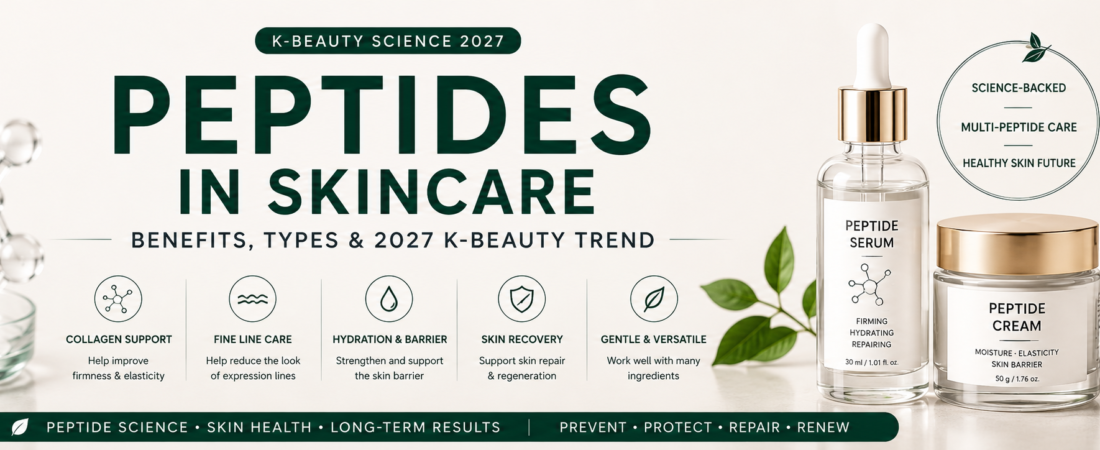
Peptides are not new to skincare.
But the way beauty brands are using them is changing.
For years, peptides were mostly associated with anti-aging creams promising firmer-looking skin and fewer visible wrinkles.
Now the category is becoming much broader.
Newer formulas combine multiple peptides with ingredients such as:
- PDRN
- Growth factors
- Ceramides
- Hyaluronic acid
- Niacinamide
- Retinoids
- Spicule delivery systems
At the same time, K-beauty is moving toward concepts such as skin longevity, regeneration and barrier resilience rather than simply promising to erase wrinkles.
That makes peptides particularly interesting heading into 2027.
But what exactly are peptides?
Do they really work?
And why are different products using completely different types of peptides?
Here is what beauty consumers, retailers and sellers should understand.
What Are Peptides in Skincare?
Peptides are short chains of amino acids.
Amino acids are the basic building blocks used to make proteins.
Some of the most important structural proteins in skin include:
- Collagen
- Elastin
- Keratin
Peptides are much smaller than full proteins.
In skincare, specific peptides can be designed or selected to interact with biological processes related to skin appearance, hydration, barrier function or extracellular matrix activity.
That does not mean every peptide cream automatically creates new collagen.
Different peptides have different structures and different intended functions.
This is one of the most important things to understand about the category.
“Contains peptides” is not enough information by itself.
The actual peptide matters.
Why Are Peptides Used in Skincare?
Peptides are attractive to cosmetic formulators because they can be designed around relatively specific functions.
Depending on the ingredient, peptide skincare may be positioned toward:
- Fine lines
- Firmness
- Elasticity
- Hydration
- Barrier support
- Skin recovery
- Uneven-looking pigmentation
- Overall signs of skin aging
This versatility helps explain why peptides appear across:
- Serums
- Eye creams
- Moisturizers
- Masks
- Ampoules
- Neck treatments
- Post-treatment skincare
They also fit well with the current shift toward multifunctional skincare.
Instead of selling one strong active around one concern, brands can build formulas containing several complementary signaling ingredients.
How Do Peptides Work on the Skin?
There is no single mechanism that explains every cosmetic peptide.
Instead, peptides are usually divided into functional categories.
The most commonly discussed groups include:
- Signal peptides
- Carrier peptides
- Neurotransmitter-inhibiting peptides
- Enzyme-inhibiting peptides
Some newer cosmetic peptides do not fit perfectly into only one category.
That is another reason consumers should look beyond the word peptide on the front of the package.
1. Signal Peptides
Signal peptides are among the best-known skincare peptides.
Research on signal peptides in cosmetics has examined their use in skin-aging, moisturizing and barrier-support applications.
They are generally designed to interact with processes involved in the skin’s extracellular matrix.
The basic marketing concept is:
send a signal → encourage skin-supporting activity
One famous group includes palmitoylated peptides such as:
- Palmitoyl Pentapeptide-4
- Palmitoyl Tripeptide-1
- Palmitoyl Tetrapeptide-7
These ingredients frequently appear in anti-aging formulas.
You may also see multiple signal peptides combined into one serum rather than relying on a single peptide.
Why Brands Like Them
Signal peptides fit easily into messaging around:
- Firmness
- Collagen support
- Fine lines
- Skin resilience
They also combine well with familiar ingredients such as hyaluronic acid and ceramides.
2. Carrier Peptides
Carrier peptides work differently.
Instead of functioning primarily as signals, they can bind and transport trace elements important to biological processes.
The most famous example is:
Copper Tripeptide-1, often associated with GHK-Cu.
This is why copper peptide products frequently have a distinctive blue color.
Copper peptides have been researched in connection with skin repair and extracellular matrix processes, which has helped them develop a strong reputation within advanced anti-aging skincare.
Why Copper Peptides Are Becoming More Interesting
Copper peptides sit at the intersection of several major skincare trends:
peptides + regeneration + longevity + skin recovery
That gives them a particularly strong marketing story.
Rather than being positioned as simply another anti-wrinkle ingredient, copper peptides can fit into a broader skin-health narrative.
This may become increasingly important as the industry moves away from traditional anti-aging language.
3. Neurotransmitter-Inhibiting Peptides
This category is often associated with expression-line skincare.
One of the best-known ingredients is:
Acetyl Hexapeptide-8
It is commonly marketed as a topical ingredient for reducing the appearance of expression-related lines.
You may also see terms such as:
- Expression line peptide
- Wrinkle-relaxing peptide
- Botox-like peptide
The last description should be treated carefully.
A cosmetic peptide applied to the skin is not the same thing as injectable botulinum toxin.
The mechanism, delivery, strength and clinical effect are very different.
Beauty Seller Lab generally considers direct comparisons such as “Botox in a bottle” too simplistic unless the limitations are made clear.
4. Enzyme-Inhibiting Peptides
Another group of peptides is studied for the ability to influence enzymes involved in processes such as extracellular matrix degradation or pigmentation.
This category illustrates how broad peptide technology has become.
The future of peptide skincare may therefore be less about:
Does this product contain peptides?
and more about:
Which peptide is being used, at what concentration, in what delivery system, and for what purpose?
That is a much more useful question.
Peptides Do Not All Do the Same Thing
Consider these four ingredients:
| Peptide | General Positioning |
|---|---|
| Palmitoyl Pentapeptide-4 | Signal / visible aging support |
| Copper Tripeptide-1 | Carrier / recovery and firmness positioning |
| Acetyl Hexapeptide-8 | Expression-line positioning |
| Palmitoyl Tripeptide-1 | Signal / extracellular matrix support |
All four can be marketed as peptides.
But they are not interchangeable.
This creates both an opportunity and a problem for skincare consumers.
The opportunity is greater formulation specialization.
The problem is that brands can simply write:
PEPTIDE COMPLEX
without explaining what is actually inside.
What Does the Research Say About Peptide Skincare?
The evidence surrounding peptides is more nuanced than skincare marketing sometimes suggests.
Scientific reviews have found promising results for certain peptide-based approaches, including improvements in measurements associated with hydration, elasticity and visible aging.
However, the strength of evidence varies significantly between individual peptides and formulations.
There are several reasons.
1. Different Peptides Are Being Studied
Research on one peptide cannot automatically prove that another peptide works.
2. Delivery Matters
A peptide may show biological activity in laboratory conditions but still need to reach the appropriate area of the skin in a topical formulation.
Skin is designed to keep substances out.
That makes delivery one of the central challenges in peptide skincare.
3. The Final Formula Matters
A peptide serum is not just a peptide.
It also contains:
- Solvents
- Humectants
- Emollients
- Stabilizers
- Delivery systems
- Other active ingredients
Two products containing the same peptide can therefore perform differently.
4. Marketing Often Moves Faster Than Clinical Evidence
This is not unique to peptides.
It happens throughout emerging skincare.
The commercial category can expand much faster than high-quality independent clinical research.
That is why Beauty Seller Lab prefers to separate:
promising mechanism
from
proven consumer outcome.
Why Delivery Technology Could Matter More in 2027
One of the biggest future opportunities for peptides may not involve discovering another peptide.
It may involve delivering existing peptides more effectively.
Peptides can face challenges related to:
- Molecular size
- Stability
- Skin permeability
- Formulation compatibility
This is where modern skincare technology becomes interesting.
Brands are increasingly experimenting with:
- Encapsulation
- Liposomes
- Advanced emulsions
- Spicule systems
- Microneedle-inspired delivery
- Controlled-release technologies
The next generation of peptide skincare may therefore compete on:
peptide + delivery system
rather than simply:
more peptides.
This connects directly with another major K-beauty trend: spicule skincare.
Beauty Seller Lab has already examined how microscopic spicules are being explored as topical delivery tools.
If improved delivery becomes a major part of peptide innovation, these two categories could increasingly overlap.
Peptides vs PDRN
PDRN and peptides are frequently discussed together because both fit the emerging regenerative-skincare category.
But they are fundamentally different.
| Factor | Peptides | PDRN |
| Basic structure | Short amino-acid chains | DNA-derived nucleotide fragments |
| Category maturity | Established | Rapidly emerging in topical skincare |
| Ingredient variety | Extremely high | Growing |
| Consumer familiarity | High | Rapidly increasing |
| K-beauty momentum | Strong | Very strong |
| Formula flexibility | Very high | High |
| Research history | Broad but peptide-specific | Stronger in medical/tissue-repair contexts than topical cosmetics |
Peptides currently have the advantage of a much broader cosmetic ecosystem.
PDRN has the advantage of novelty.
This creates an interesting commercial situation.
Consumers do not necessarily have to choose one.
Brands are already combining them.
For a deeper comparison, read our PDRN vs Peptides 2027 Guide.
Peptides vs Growth Factors
Peptides and growth factors also overlap in modern regenerative-skincare marketing.
Both categories are frequently positioned around:
- Skin recovery
- Firmness
- Visible aging
- Cellular signaling concepts
However, they are very different types of biological molecules.
Growth factors are generally larger proteins involved in cell signaling.
Peptides are smaller chains of amino acids.
From a commercial perspective, peptides currently have several advantages:
- Greater consumer familiarity
- Wide supplier availability
- Easier incorporation into many product concepts
- Multiple price levels
- Long cosmetic history
Growth factors, however, can support a more premium biotechnology story.
This means the two categories may increasingly be combined instead of competing directly.
A future serum might position itself around:
growth factors + copper peptides + barrier support
rather than making one ingredient do all the marketing work.
For more on this category, see our Growth Factor Skincare Products 2027 Guide.
Peptides vs Retinol
Peptides are sometimes marketed as an alternative to retinol.
That comparison needs context.
Retinoids have a much stronger and longer-established evidence base for photoaging and visible signs of aging.
Peptides offer something different.
Retinol
Usually associated with:
- Fine lines
- Texture
- Pigmentation
- Cell turnover
- Collagen-related effects
Potential drawbacks include:
- Dryness
- Irritation
- Peeling
- Adjustment periods
Peptides
Often associated with:
- Firmness
- Hydration
- Skin support
- Recovery
- Lower irritation potential
For many consumers, the better question is not:
Peptides or retinol?
It may be:
Can peptides complement a well-designed retinoid routine?
That is a much more realistic positioning strategy.
Can You Use Peptides With Other Skincare Ingredients?
In many modern formulations, peptides are already combined with other popular ingredients.
Common combinations include:
Peptides + Hyaluronic Acid
A natural pairing for formulas focused on hydration and plump-looking skin.
Peptides + Ceramides
Useful for barrier-focused anti-aging and skin-resilience positioning.
Peptides + Niacinamide
A versatile combination covering hydration, barrier support and overall skin appearance.
Peptides + PDRN
One of the most commercially interesting K-beauty combinations heading toward 2027.
Peptides + Growth Factors
A more premium regenerative-skincare positioning.
Peptides + Retinoids
Potentially complementary, although product instructions and individual skin tolerance still matter.
Why Peptides Fit the Skin Longevity Trend
Traditional anti-aging marketing usually starts with a problem:
You have wrinkles. Fix them.
Skin longevity changes the framing.
The goal becomes:
Maintain healthy-looking, resilient skin for as long as possible.
That creates space for ingredients associated with:
- Prevention
- Barrier support
- Recovery
- Hydration
- Structural support
- Long-term skin maintenance
Peptides fit naturally into this framework.
They can be positioned as part of a system rather than as a miracle wrinkle treatment.
That is one reason the peptide category may become more important as skin longevity becomes a larger beauty concept.
For more background, read our Skin Longevity in Skincare 2027 Guide.
Why K-Beauty Could Push Peptides Further
Korean skincare brands are particularly good at turning complicated ingredients into accessible consumer products.
We have already seen this with:
- Snail mucin
- Centella asiatica
- PDRN
- Spicules
- Fermented ingredients
Peptides are well suited to the same model.
They can be packaged into:
- Lightweight serums
- Ampoules
- Eye creams
- Masks
- Barrier creams
- Multi-active formulas
K-beauty also tends to combine ingredients rather than forcing one active ingredient to carry an entire formula.
This is important.
The next successful peptide product may not advertise:
1 peptide.
It may advertise:
9 peptides + PDRN + ceramides.
or:
Copper peptide + EGF + barrier complex.
The marketing story becomes an ingredient system.
The Rise of Multi-Peptide Formulas
One of the clearest developments in the peptide category is the increasing number of formulas containing several peptides.
This creates an attractive consumer message:
more types → more pathways → more complete care
But a bigger number is not automatically better.
A product containing ten peptides is not automatically superior to a product containing two.
Important questions include:
- Which peptides are included?
- Why were they chosen?
- Is the amount disclosed?
- Is there clinical testing on the finished formula?
- Does the formula contain supporting ingredients?
- Is there a meaningful delivery system?
This is likely to become an increasingly important distinction as peptide counts become a marketing tool.
What Should You Look for in a Peptide Product?
Instead of choosing a serum because the front says Peptide, check five things.
1. Identify the Actual Peptides
Look for ingredient names rather than relying only on marketing claims.
Common examples include:
- Copper Tripeptide-1
- Acetyl Hexapeptide-8
- Palmitoyl Pentapeptide-4
- Palmitoyl Tripeptide-1
- Palmitoyl Tetrapeptide-7
2. Look at the Supporting Formula
Peptides rarely need to work alone.
A good formula may also contain ingredients supporting:
- Hydration
- Barrier function
- Antioxidant protection
- Skin comfort
3. Check the Product’s Main Goal
A copper-peptide recovery serum and an expression-line peptide serum are not necessarily trying to solve the same problem.
4. Be Careful With Huge Peptide Numbers
“12 peptides” sounds impressive.
But the number alone does not tell you whether the formula is effective.
5. Look for Finished-Product Testing
Testing of the final formula can sometimes be more useful to consumers than biological claims about one isolated ingredient.
Who Might Like Peptide Skincare?
Peptide products may be especially interesting for consumers who want:
- Anti-aging skincare without relying only on strong exfoliating actives
- Support for firmer-looking skin
- Hydrating anti-aging formulas
- Skin-longevity routines
- Multi-active K-beauty
- Copper-peptide products
- Regenerative-skincare concepts
They may also appeal to consumers who find aggressive routines difficult to maintain.
However, individual tolerance can vary, and the presence of peptides does not guarantee that the entire product will be suitable for sensitive skin.
Always evaluate the complete ingredient list.
What Peptides Cannot Do
The peptide category also needs realistic expectations.
Peptide skincare cannot automatically:
- Replace professional cosmetic procedures
- Produce injectable-level effects
- Reverse all skin aging
- Guarantee collagen production simply because “peptide” appears on the label
- Make sunscreen unnecessary
- Replace proven skincare fundamentals
This last point matters most.
A futuristic peptide serum does not compensate for ignoring:
- Sun protection
- Basic moisturization
- Appropriate cleansing
- Evidence-based actives
- Consistent skincare habits
Advanced skincare should build on the fundamentals, not replace them.
The 2027 Peptide Trend: What Beauty Seller Lab Is Watching
Peptides are unlikely to become popular because they are new.
They are not.
The opportunity is coming from how the category is evolving.
Beauty Seller Lab is watching five developments heading into 2027.
1. Copper Peptides Move Mainstream
Copper peptides are moving beyond niche anti-aging enthusiasts and into broader regenerative and longevity positioning.
2. Peptide + PDRN Formulas Expand
PDRN provides the trendy regenerative story.
Peptides provide a familiar cosmetic technology.
Together, they create a strong K-beauty formula concept.
3. Better Delivery Becomes a Selling Point
Encapsulation, spicules and other delivery systems could become increasingly important.
4. Multi-Peptide Complexes Become More Sophisticated
The market may move beyond simply advertising the number of peptides toward explaining the function of each peptide.
5. Peptides Become Part of Skin Longevity
Instead of being marketed only for wrinkles, peptides could increasingly be positioned around:
resilience + recovery + firmness + long-term skin health.
Beauty Seller Lab View
Peptides may be one of the strongest examples of an old ingredient category becoming new again.
They already have:
- Consumer recognition
- Ingredient variety
- Scientific interest
- Broad formulation flexibility
- Strong anti-aging associations
Now they are gaining something else:
a new narrative.
Skin longevity, regenerative skincare, PDRN, growth factors and advanced delivery systems are creating an environment where peptides can be repositioned for a new generation of consumers.
For beauty sellers, the opportunity may not come from launching another generic “peptide serum.”
The more interesting opportunities are likely to involve:
a specific peptide
- a clear skin concern
- complementary technology
- understandable evidence.
That is where the category becomes more differentiated.
And heading toward 2027, copper peptides, multi-peptide complexes and PDRN-peptide combinations are three areas worth watching closely.
FAQ
What do peptides do for the skin?
Different peptides have different functions. Depending on the peptide and formula, skincare products may be positioned toward firmness, hydration, visible wrinkles, barrier support or skin recovery.
Are peptides good for wrinkles?
Certain peptides have been studied for visible signs of skin aging, but results depend on the specific peptide, concentration, delivery system and finished formulation. Peptides should not be treated as equivalent to prescription retinoids or cosmetic procedures.
What is the best peptide for skincare?
There is no single best peptide for everyone.
Copper Tripeptide-1, Acetyl Hexapeptide-8 and various palmitoylated signal peptides are among the best-known cosmetic peptides, but they serve different purposes.
Are copper peptides better than regular peptides?
Copper peptides are a type of peptide rather than a completely separate category. They are particularly interesting for products positioned around skin recovery, firmness and regenerative skincare.
Can peptides be used every day?
Many peptide products are formulated for daily use. Follow the instructions provided for the individual product and consider the complete formula rather than the peptide ingredient alone.
Can I use peptides with retinol?
Many routines and products can contain both peptide and retinoid ingredients. However, tolerance depends on the individual products and your skin.
Are peptides better than PDRN?
Not necessarily.
Peptides represent a large and established ingredient category, while PDRN is a rapidly emerging regenerative-skincare trend. They have different structures and research histories, and brands increasingly combine both.
Will peptides be a major skincare trend in 2027?
Peptides already have a major presence in skincare. The emerging trend is more specifically toward advanced peptides, copper peptides, multi-peptide systems and combinations with regenerative ingredients such as PDRN and growth-factor technologies.
Final Takeaway
Peptides are no longer just another anti-aging ingredient printed on a serum bottle.
The category is becoming more specialized.
Signal peptides.
Copper peptides.
Expression-line peptides.
Multi-peptide complexes.
Peptides + PDRN.
Peptides + growth factors.
Peptides + advanced delivery.
That evolution is what makes the category worth watching.
The skincare market of 2027 may not ask:
Does this product contain peptides?
It may increasingly ask:
Which peptides does it contain, what are they designed to do, and how effectively can the formula deliver them?
That is a much more mature question—and potentially the next stage of the peptide skincare market.