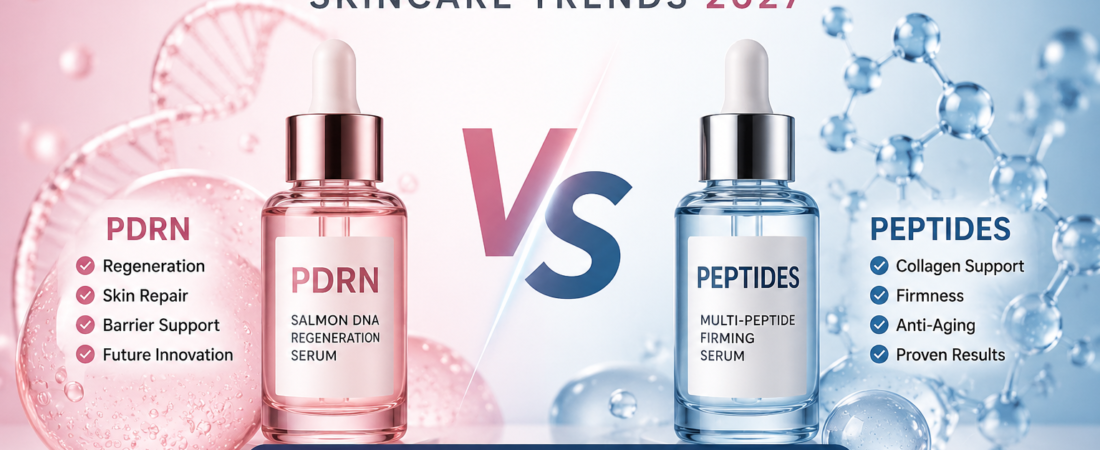
K-beauty has never been short of trending ingredients.
Snail mucin, centella asiatica, ceramides, niacinamide and retinol have all had their moments.
But going into 2027, two ingredients are becoming especially interesting for brands, retailers and beauty sellers:
PDRN and peptides.
PDRN represents the newer side of K-beauty — regenerative, clinical-inspired and highly marketable.
Peptides represent something different — a more established ingredient category with years of research, broad formulation flexibility and strong anti-aging positioning.
So when comparing PDRN vs peptides, which has more commercial potential in 2027?
The answer may be more complicated than choosing one winner.
For a deeper introduction to PDRN, read our PDRN Skincare in 2027 Guide.
PDRN vs Peptides: The Quick Comparison
| Factor | PDRN | Peptides |
|---|---|---|
| Consumer novelty | Very high | Medium |
| Current K-beauty buzz | Very high | High |
| Scientific maturity | Developing | More established |
| Marketing story | Strong | Strong |
| Product versatility | Rapidly expanding | Very broad |
| Anti-aging positioning | Regeneration / recovery | Firmness / collagen / wrinkles |
| Vegan positioning | Emerging | Widely possible |
| Consumer understanding | Still developing | Relatively familiar |
| 2027 trend potential | High | High |
| Long-term category potential | Still being proven | Very strong |
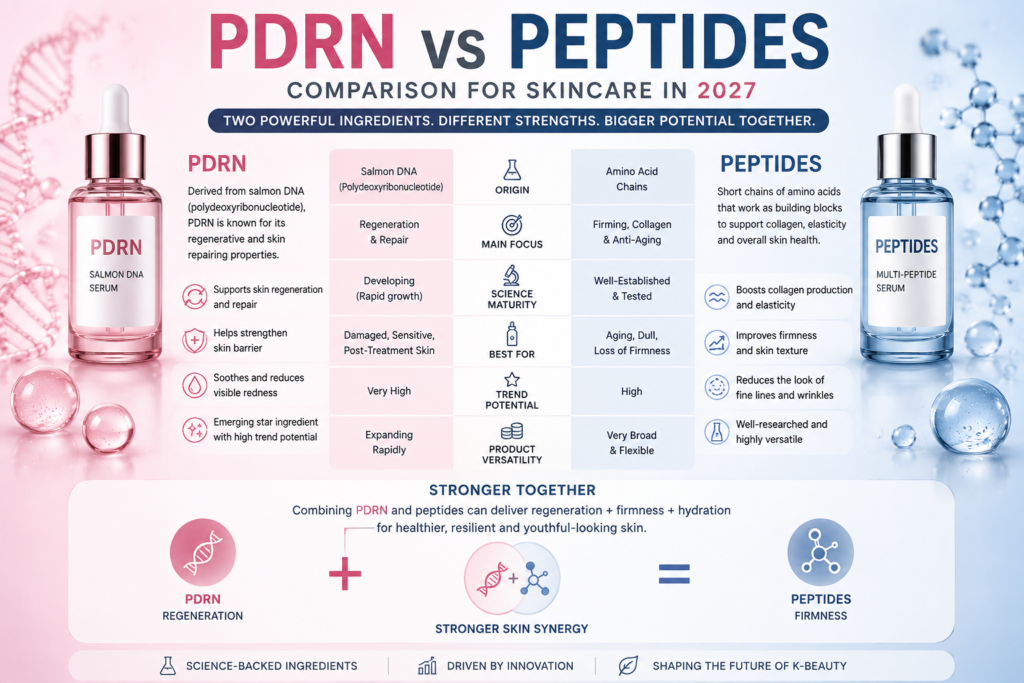
The biggest difference is simple:
PDRN currently has stronger novelty.
Peptides currently have stronger maturity.
That distinction matters for sellers.
What Is PDRN?
PDRN stands for polydeoxyribonucleotide and consists of DNA fragments traditionally derived from salmonid sources.
The ingredient has a history in regenerative and medical research, where PDRN and related polynucleotides have been investigated for tissue repair, wound healing and skin rejuvenation. Reviews describe mechanisms involving cellular repair processes, fibroblast activity and adenosine A2A receptor signaling.
That medical background gives PDRN an unusually powerful cosmetic marketing story.
Consumers do not simply hear:
“This is another hydrating ingredient.”
They hear:
“This ingredient comes from regenerative medicine.”
That distinction helped PDRN move rapidly into serums, creams, masks and other consumer skincare products.
Major beauty publications were still identifying PDRN as a defining regenerative skincare ingredient in 2026.
What Are Peptides?
Peptides are short chains of amino acids.
In cosmetics, different peptide types may serve different functions. They can act as signal peptides, carrier peptides, enzyme-inhibiting peptides or neurotransmitter-inhibiting peptides.
Research reviews describe cosmetic peptides as ingredients with potential roles in collagen and elastin synthesis, skin-cell activity, hydration, barrier function and the appearance of skin aging.
Unlike PDRN, peptides are not one single ingredient.
That is one of their biggest commercial advantages.
A brand can create:
Copper peptide skincare
Multi-peptide serum
Collagen peptide cream
Peptide eye cream
Peptide + retinol
Peptide + ceramide
and still remain inside the broader peptide category.
This makes peptides less dependent on one specific trend cycle.
Round 1: Which Ingredient Has More Scientific Support?
Winner: Peptides
When comparing PDRN vs peptides from a scientific perspective, peptides currently have the stronger foundation.
This is where peptides have the advantage.
Cosmetic peptides have been investigated for years, including topical applications.
Research has reported that certain peptide complexes can influence collagen-related proteins and improve visible signs associated with skin aging. Broader reviews published in recent years continue to describe peptides as promising cosmetic ingredients for collagen synthesis, elasticity, hydration and barrier support.
PDRN also has substantial scientific research behind it.
However, much of the stronger PDRN evidence comes from regenerative medicine, wound healing, injectables or aesthetic procedures rather than ordinary over-the-counter topical skincare.
That distinction is important.
The fact that an injected or medically delivered compound produces biological effects does not automatically mean a serum applied to the skin produces the same result.
Dermatologists interviewed by Allure in 2026 similarly noted that consumer interest in topical PDRN was moving faster than the clinical evidence supporting its cosmetic use.
For evidence-focused consumers, peptides currently have the stronger position.
Round 2: Which Ingredient Has More Marketing Power?
Winner: PDRN
Scientific maturity and marketing power are not the same thing.
And this is where PDRN becomes extremely competitive.
Compare these two product messages:
Multi-Peptide Firming Serum
versus:
Salmon DNA PDRN Regeneration Serum
The second immediately creates curiosity.
Consumers may ask:
What is salmon DNA?
Why is DNA in skincare?
Is this the same ingredient used in Korean skin clinics?
That curiosity drives clicks, TikTok videos, influencer content and product searches.
PDRN therefore has something peptides currently struggle to reproduce:
novelty.
Peptides are credible.
PDRN is clickable.
For a new brand trying to acquire attention quickly, that difference can be valuable.
Round 3: Which Ingredient Is Easier to Build a Product Line Around?
Winner: Peptides — for now
Peptides are extremely flexible.
COSRX’s current peptide category already spans serum, cream, hydrogel masks, eye patches, eye cream, lip products and even hair-care products. Its 6 Peptide Skin Booster is positioned around multiple benefits including firmness, hydration, texture and glow.
That illustrates a fundamental strength of the category:
Peptides can support many different product stories.
PDRN is catching up quickly.
Anua has already expanded PDRN beyond a single serum into creams, facial serum sprays and skincare sets.
Medicube’s PDRN range has also expanded into multiple skincare formats rather than remaining dependent on one hero serum.
So this gap may narrow considerably by 2027.
Round 4: Which Is Easier for Consumers to Understand?
Winner: Peptides
Most skincare consumers now associate peptides with concepts such as:
collagen
firmness
wrinkles
elasticity
anti-aging
That makes the selling proposition relatively straightforward.
PDRN requires more education.
Many consumers still need answers to basic questions:
What does PDRN mean?
Where does it come from?
Is it really salmon DNA?
Is vegan PDRN the same?
Does topical PDRN work like injectable PDRN?
For content creators and publishers, those questions are excellent SEO opportunities.
For brands, however, they create an additional education burden.
Round 5: Which Has the Stronger 2027 Growth Story?
Winner: PDRN
This is where the result changes again.
Peptides may have stronger scientific and category foundations, but PDRN appears to have more room for short-term category expansion.
Anua’s PDRN Hyaluronic Acid Capsule 100 Serum is currently positioned around a combination of salmon-derived Sodium DNA, hyaluronic acid and collagen and is listed at $30 on the brand’s U.S. store.
Medicube’s PDRN Pink Peptide Serum is currently $26 and combines PDRN with niacinamide and multiple peptides.
These are not luxury-only prices.
That matters because K-beauty has taken something that sounds highly clinical and made it accessible at mainstream serum pricing.
It creates a compelling formula:
advanced ingredient story + relatively accessible price + social-media-friendly concept.
That combination could continue driving PDRN growth into 2027.
The Most Important Trend: PDRN + Peptides
Perhaps the most important observation is that brands are already making the PDRN vs peptides debate irrelevant.
They are combining them.
Medicube’s current PDRN Pink Peptide Serum includes Sodium DNA alongside multiple peptides including Palmitoyl Pentapeptide-4, Palmitoyl Tripeptide-1, Palmitoyl Tetrapeptide-7, Copper Tripeptide-1 and Acetyl Hexapeptide-8.
COSRX’s peptide category even includes a Peptide & PDRN Eye Patch Duo.
That is an important market signal.
Brands do not necessarily need consumers to choose between the two ingredients.
Instead, they can give each ingredient a different role:
PDRN → regeneration and recovery story
Peptides → firmness and collagen-support story
Combined, they create a stronger consumer proposition:
Regeneration + firmness + hydration + skin longevity
This may become one of the most commercially attractive skincare formulas of 2027.
Why Hybrid Formulas Could Win
Consumers are becoming increasingly skeptical of products that rely entirely on one trendy ingredient.
A serum that simply says:
PDRN Serum
may still attract attention.
But a product positioned as:
PDRN + Multi-Peptide Barrier Serum
can communicate both novelty and familiar benefits.
The PDRN gets the click.
The peptides help explain the result.
Additional ingredients such as hyaluronic acid, niacinamide, ceramides and panthenol can then reinforce hydration and barrier claims.
This ingredient-stack strategy is already visible in current Korean products.
Anua combines PDRN with hyaluronic acid and collagen. Medicube combines PDRN with peptides and niacinamide.
That is probably not accidental.
What This Means for Beauty Sellers
From a seller’s perspective, the PDRN vs peptides decision should depend on the product concept and target consumer.
For sellers, the important question is not simply:
“Which ingredient is better?”
The better question is:
“Which ingredient gives me the strongest reason for the customer to click, understand and buy?”
For a highly trend-driven TikTok or social-commerce launch, PDRN may currently have the stronger hook.
For a long-term anti-aging product line, peptides offer stronger category stability.
For a new K-beauty brand entering 2027, a hybrid formula may offer the most balanced commercial proposition.
In other words:
PDRN attracts attention.
Peptides provide familiarity.
The combination may provide the strongest product story.
PDRN vs Peptides for Different Product Concepts
| Product concept | Better direction |
|---|---|
| Viral hero serum | PDRN |
| Long-term anti-aging serum | Peptides |
| Firming cream | Peptides |
| Regenerative skincare story | PDRN |
| Sensitive barrier care | Peptides + barrier ingredients |
| Clinic-inspired skincare | PDRN |
| Premium biotech positioning | PDRN + Peptides |
| Eye care | Peptides or PDRN + Peptides |
| Skin longevity | PDRN + Peptides |
| Broad product line | Peptides |
This does not mean every product needs both.
The right ingredient depends on the problem the product is trying to solve.
Could PDRN Eventually Lose Its Novelty?
Yes.
This is the biggest commercial risk.
Consumers have seen similar cycles before:
A new ingredient becomes viral.
Hundreds of brands launch versions.
Prices fall.
Products begin to look identical.
Consumers move to the next ingredient.
PDRN may eventually face the same problem.
Its future therefore depends on whether brands can move beyond simply placing PDRN in large letters on the front of the package.
Source transparency, molecular characteristics, delivery systems, vegan alternatives and ingredient combinations may become more important differentiators.
Plant-derived PDRN is already being researched, including Panax-derived and rose-derived materials, suggesting the category itself may continue evolving.
Could Peptides Become Trendy Again?
They already are.
Peptides may be an older cosmetic ingredient category, but modern formulations are changing how they are marketed.
Copper peptides, multi-peptide complexes, peptide-collagen combinations and peptide-based slow-aging routines give brands new ways to repackage an established ingredient story.
COSRX currently positions its peptide products around concepts such as slow aging, firmness, glow and multi-benefit skincare.
That makes peptides less of a temporary trend and more of a platform that can repeatedly be reinvented.
So Which One Wins in 2027?
There are actually three winners depending on the question.
For scientific maturity: Peptides.
For near-term trend momentum: PDRN.
For product-development potential: PDRN + Peptides.
That final category may be the most important one for beauty sellers.
The market is increasingly moving away from single-ingredient storytelling.
Consumers want visible benefits, while brands still need ingredients interesting enough to generate attention.
PDRN provides the novelty.
Peptides provide established anti-aging language.
Together, they fit perfectly into the broader K-beauty shift toward biotech-inspired, regenerative and slow-aging skincare.
The Bottom Line
Ultimately, PDRN vs peptides is less about choosing one universal winner and more about choosing the right ingredient strategy.
The PDRN vs peptides debate is unlikely to end with one ingredient replacing the other.
Peptides have a deeper research history, broader formulation flexibility and stronger long-term category stability.
PDRN has stronger current momentum, a more unusual origin story and a powerful connection to Korea’s regenerative skincare trend.
Going into 2027, that means:
Peptides may be the safer long-term ingredient.
PDRN may be the stronger short-term growth opportunity.
But the most interesting products may be the ones that combine both.
For beauty sellers, the opportunity is no longer simply finding the next trending ingredient.
It is finding the right ingredient + benefit + format + consumer problem combination.
And in 2027, PDRN + peptides may be one of the combinations worth watching most closely.
FAQ
Is PDRN better than peptides?
Not necessarily. PDRN and peptides have different strengths. Peptides currently have a broader history of topical cosmetic research, while PDRN has stronger recent trend momentum and regenerative positioning.
Can PDRN and peptides be used together?
Yes. Commercial skincare products already combine PDRN and multiple peptides, showing that the two ingredients can be positioned within the same formula.
Which is better for anti-aging?
Peptides have a more established position in topical anti-aging skincare. PDRN is promising, but evidence for ordinary topical cosmetic use remains less mature than evidence from medical or aesthetic applications.
Which ingredient will be more popular in 2027?
PDRN currently appears to have greater short-term trend momentum, while peptides have greater long-term stability. Based on current product development, a growing number of formulas may combine both ingredients rather than treat them as competitors. This is a market inference based on current brand activity rather than a certainty.
What should beauty sellers watch next?
Watch for PDRN products differentiated by source, delivery technology and complementary ingredients, as well as peptide formulas positioned around skin longevity, barrier care and multifunctional anti-aging.