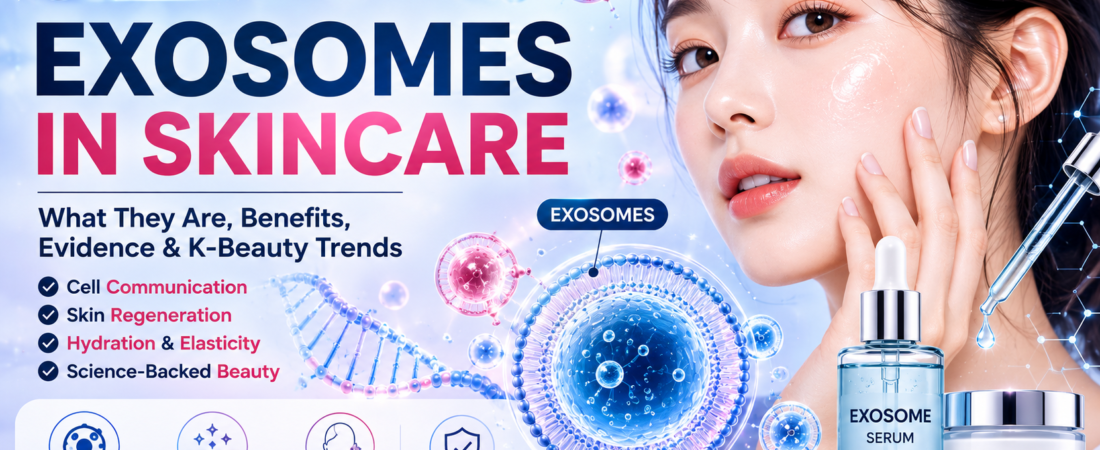
K-beauty has spent years turning unusual ingredients into global skincare trends.
Snail mucin became mainstream.
PDRN brought “salmon DNA skincare” into everyday beauty routines.
Spicules brought treatment-inspired skin stimulation into at-home products.
Now another biotechnology term is appearing across serums, masks, boosters and professional skin treatments:
exosomes.
Interest in exosomes in skincare is growing because the concept sounds almost futuristic.
Rather than being another vitamin, acid or moisturizing ingredient, exosomes are associated with the way cells communicate with each other.
That creates an extremely powerful skincare story.
But it also creates confusion.
What exactly are exosomes?
Are all products labeled “exosome” actually using the same material?
Can they really rejuvenate skin?
And how much of the current trend is supported by human evidence?
The answer is promising — but much more complicated than the marketing suggests.
What Are Exosomes?
Exosomes are generally discussed as a type of extracellular vesicle, or EV.
Extracellular vesicles are tiny membrane-bound particles released by cells. They can carry materials including proteins, lipids and nucleic acids and participate in communication between cells.
This has led to a common analogy:
Exosomes work like biological delivery messages between cells.
That is an easy way to understand why they became interesting in regenerative medicine.
Instead of acting like a conventional skincare ingredient that simply moisturizes or exfoliates, extracellular vesicles may carry biological cargo capable of influencing other cells.
Researchers have therefore investigated EVs and exosome-related technologies in areas including:
skin regeneration, wound healing, pigmentation, collagen production, inflammation and hair regeneration.
That scientific background is now moving into cosmetics.
Exosomes vs Extracellular Vesicles: An Important Difference
This is one of the most important things consumers should understand about exosomes in skincare.
The word exosome has a more specific scientific meaning than many cosmetic labels suggest.
The International Society for Extracellular Vesicles’ MISEV2023 recommendations emphasize that researchers should generally use the broader term extracellular vesicle unless the vesicle’s biological origin can be appropriately demonstrated.
Why does that matter?
Because a cosmetic ingredient may contain tiny extracellular particles or vesicles without necessarily proving that every particle meets the strict biological definition of an exosome.
In other words:
“Exosome” can be a scientific term.
But it can also become a marketing term.
That does not automatically make the product ineffective.
It simply means consumers and sellers should look beyond the word on the front label.
Where Do Skincare Exosomes Come From?
There is no single source.
Research on extracellular vesicles includes materials originating from many different biological systems.
These can include human or animal cells, plant materials and microorganisms.
That means two products marketed as exosome skincare may use completely different technologies.
Current cosmetic products already demonstrate this variety.
For example, COSRX’s PDRN EXOSOME Skinplaning Glaze Mask lists Lactobacillus Extracellular Vesicles in its ingredient list and markets the technology alongside PDRN.
Medicube’s Zero Exosome Shot similarly identifies Lactobacillus Extracellular Vesicles and describes its “Lacto Exosome” as originating from Lactobacillus.
That is very different from the stem-cell-derived exosome systems often discussed in regenerative medicine studies.
Source therefore matters.
Why Are Exosomes Becoming Popular in Skincare?
Exosomes fit several major beauty trends at once.
1. Regenerative Skincare
The anti-aging market is changing.
Instead of only promising to “reduce wrinkles,” brands increasingly use concepts such as:
skin recovery
regeneration
longevity
cell communication
barrier resilience
biotechnology
Exosome technology fits naturally into this new language.
2. Clinic-Inspired Skincare
Consumers increasingly want products that feel inspired by aesthetic treatments.
This is already visible with:
PDRN, spicules, microneedling-inspired boosters and skin-booster-style serums.
Exosomes add another clinical-sounding technology to this category.
3. Ingredient Sophistication
Consumers have become very familiar with ingredients such as niacinamide and hyaluronic acid.
Brands therefore need increasingly sophisticated concepts to generate curiosity.
Compare:
Hydrating Serum
with:
Exosome Regenerative Booster
The second product immediately sounds newer and more advanced.
That creates substantial marketing value.
What Does the Scientific Evidence Say?
This is where the story becomes more interesting.
Research on extracellular vesicles and exosome-based approaches for skin rejuvenation is growing quickly.
A 2026 systematic review examining exosomes and extracellular vesicles for skin rejuvenation reported promising findings across outcomes including elasticity, wrinkle appearance, hydration and pigmentation. However, the authors also concluded that larger standardized trials and longer follow-up are needed.
Another 2026 systematic review focusing on human populations similarly found encouraging results but identified significant evidence gaps.
This creates a reasonable conclusion:
Exosome-based skin rejuvenation is scientifically promising.
But:
the evidence is not mature enough to assume that every topical exosome cosmetic produces the same results.
The Research Has an Important Catch
Many promising studies do not simply involve applying an ordinary serum at home.
Exosome-related formulations may be used alongside procedures such as:
microneedling
laser treatments
or other professional delivery methods.
For example, published research has investigated exosome approaches combined with superficial microneedling and reported improvements in measures such as pores, redness and pigmentation.
Other controlled research has examined exosome treatments after aesthetic procedures and reported improvements in skin appearance.
This matters enormously.
A professional treatment that disrupts the skin barrier may deliver a material very differently from a serum placed on intact skin.
Therefore:
Evidence for procedure-assisted exosomes should not automatically be used as proof that an ordinary topical cosmetic produces identical results.
This is one of the biggest distinctions consumers should understand.
What Benefits Are Being Studied?
Current research suggests several areas of interest.
Skin Elasticity and Firmness
Extracellular-vesicle-based approaches have been investigated for their influence on collagen and extracellular-matrix activity.
Some research reports improvements in elasticity and wrinkle-related measurements.
Hydration
Human studies included in recent reviews have reported improvements in hydration-related outcomes following certain exosome-based treatments.
Skin Texture
Clinical studies involving exosome technologies, particularly when combined with aesthetic procedures, have reported improvements in skin texture and pore appearance.
Pigmentation
Some studies have explored effects on pigmentation and uneven tone, although protocols and materials vary considerably between studies.
Recovery and Regeneration
Preclinical and clinical literature has explored extracellular vesicles in wound healing and skin-repair pathways, which is one reason the technology has become connected with regenerative skincare.
Why You Cannot Judge an Exosome Product by the Word “Exosome”
This may be the most important buying lesson.
Imagine two bottles both labeled:
EXOSOME SERUM
They could differ in:
- biological source
- particle characteristics
- concentration
- isolation method
- purification
- stability
- storage
- supporting ingredients
- delivery technology
- product testing
That means the ingredient name alone tells you very little.
This is one reason the scientific EV field has invested so heavily in standardized characterization and reporting. MISEV2023 was specifically developed to improve rigor, transparency and reproducibility in extracellular-vesicle research.
The cosmetics market may eventually face similar pressure.
What Should Consumers Look For?
A more sophisticated shopper should ask several questions.
What is the source?
Does the brand clearly say whether the material comes from:
Lactobacillus
Centella
plant material
milk
or another source?
Greater transparency is better.
Does the ingredient list support the marketing?
Some brands identify the actual EV material in the INCI list.
For example, COSRX lists Lactobacillus Extracellular Vesicles in its PDRN EXOSOME mask.
Is there product-specific testing?
Claims based on a finished product are more directly relevant than research performed on a completely different exosome source or delivery method.
Is the brand relying only on the word “exosome”?
If the product provides no meaningful information about source, formulation or evidence, consumers have less information to evaluate.
Real K-Beauty Example: COSRX PDRN EXOSOME Skinplaning Glaze Mask
COSRX shows how exosome technology is entering mainstream K-beauty.
Its PDRN EXOSOME Skinplaning Glaze Mask combines:
PDRN
with
Lactobacillus extracellular vesicles
plus familiar skincare ingredients including niacinamide, panthenol, collagen, hyaluronic acid and a peptide.
The product is currently listed at $17 on COSRX’s official U.S. store.
That price is commercially significant.
Exosome positioning is no longer limited to extremely expensive professional treatments.
K-beauty brands are translating it into affordable consumer products.
Real K-Beauty Example: Medicube Zero Exosome Shot
Medicube takes a more treatment-inspired approach.
The Zero Exosome Shot combines Lactobacillus extracellular vesicles with hydrolyzed sponge spicules and is positioned as an at-home booster for pores and texture.
Medicube states that the Lacto Exosome in the product comes from Lactobacillus, and its published ingredient list identifies Lactobacillus Extracellular Vesicles.
The formula demonstrates an important 2027 trend:
exosomes + delivery technology.
Instead of relying on exosome positioning alone, the product pairs the concept with a spicule-style delivery experience.
Exosomes Are Already Moving Beyond One Product Type
The technology is appearing across:
serums
ampoules
masks
toner pads
spicule boosters
and premium regenerative formulas.
Medicube currently markets Exosome Cica Calming Toner Pads as another exosome-positioned product, while COSRX has introduced a PDRN + exosome mask.
This suggests exosomes are beginning to evolve from:
one viral ingredient
into:
a broader product platform.
That is usually a stronger commercial signal than a single hero serum.
Exosomes + PDRN May Be More Important Than Exosomes Alone
One of the clearest trends emerging in 2026 is ingredient stacking.
Instead of:
PDRN vs exosomes
brands increasingly appear interested in:
PDRN + exosomes.
COSRX already combines them in its Skinplaning Glaze Mask.
Medicube markets a PDRN Pink Collagen Exosome Shot combining salmon PDRN and exosome positioning.
Medik8’s Exo-PDRN Prismatic+ combines its PDRN system with a Triple Exosome Complex and positions the product in the premium regenerative-skincare category.
This suggests the market may be moving toward regenerative ingredient stacks rather than single-ingredient products.
What About Safety?
This requires careful distinction.
Research reviews describe exosome-based aesthetic treatments as promising, but they repeatedly call for larger trials, better standardization and longer follow-up.
There is also a regulatory distinction between ordinary cosmetics and products made from human cells or tissues that are marketed as medical regenerative treatments.
The U.S. FDA continues to warn consumers about unapproved human-cell- or tissue-derived regenerative medicine products, including products marketed with exosome-related claims.
That warning should not be interpreted as saying every cosmetic containing bacterial or plant-derived EV ingredients is an illegal medical product.
The category and intended use matter.
But it reinforces an important point:
“Exosome” does not automatically mean proven, approved or medically validated.
Are Exosomes Better Than PDRN?
They are not really equivalent ingredients.
PDRN is composed of DNA fragments.
Exosomes are vesicular biological structures involved in cellular communication.
PDRN currently has stronger consumer recognition in K-beauty.
Exosomes offer a more complex and futuristic biotechnology story.
For sellers, PDRN may currently be easier to explain.
Exosomes may offer more premium differentiation.
And increasingly, the most interesting products combine both.
For our full comparison, read the PDRN vs Exosomes 2027 Guide.
What Exosomes Mean for Beauty Sellers
For sellers and product developers, exosomes create both an opportunity and a risk.
The opportunity is obvious.
The word is new.
It sounds technologically advanced.
It connects directly with regenerative and clinic-inspired skincare.
That makes it highly marketable.
The risk is that the category becomes flooded with products using vague exosome language without explaining:
source
concentration
characterization
delivery
or
evidence.
If that happens, consumers may eventually become skeptical.
The strongest products will likely provide greater transparency.
The Next Competitive Question
The first generation of exosome cosmetics could compete on:
Contains exosomes.
The next generation may compete on:
What kind of extracellular vesicles?
From which source?
At what concentration?
Combined with which active ingredients?
Delivered using which technology?
Supported by what testing?
That is exactly how a trend becomes a mature category.
Will Exosomes Be a Major K-Beauty Trend in 2027?
There are strong reasons to watch the category.
Research activity remains high, with multiple systematic reviews and clinical studies appearing in 2025 and 2026.
At the same time, commercial skincare products from brands including COSRX and Medicube already use exosome or extracellular-vesicle positioning.
This does not guarantee exosomes will become the next PDRN.
But the pattern is familiar:
clinical research
→ beauty-industry curiosity
→ professional treatment use
→ consumer skincare
→ ingredient combinations
Exosomes appear to be moving through that commercialization cycle.
The Bottom Line
Exosomes in skincare are one of the most scientifically interesting — and most easily misunderstood — emerging beauty trends.
The biology behind extracellular vesicles is real.
Cells use EVs as part of complex communication processes, and research on their regenerative applications is substantial.
Research in skin rejuvenation is also increasingly promising.
Recent reviews report improvements across several skin-related measures while simultaneously emphasizing the need for better-quality, standardized and longer-term studies.
But consumers should not assume:
all exosomes are the same
or
every exosome serum is equivalent to a clinical regenerative treatment.
The most important question in 2027 may therefore not be:
Does this product contain exosomes?
It may be:
What exactly does this brand mean by exosomes?
For consumers, that means reading beyond the front label.
For beauty sellers, it means that transparency may become one of the strongest competitive advantages in the category.
And for K-beauty, exosomes could represent another step toward a future built around:
biotechnology + regeneration + ingredient delivery + skin longevity.
FAQ
What are exosomes in skincare?
Exosomes are commonly described in skincare as tiny extracellular vesicles involved in biological communication. However, scientific guidelines recommend careful terminology because not every extracellular vesicle can automatically be classified as a true exosome.
What do exosomes do for skin?
Research is investigating exosome and extracellular-vesicle technologies for areas including hydration, elasticity, wrinkles, pigmentation, wound healing and skin regeneration. Current evidence is promising but still developing.
Are topical exosome serums scientifically proven?
Not to the extent that all commercial products can be treated as equally proven. Studies use different EV sources, formulations and delivery methods, and many clinical approaches involve procedures such as microneedling rather than ordinary topical application.
Are all exosomes in skincare the same?
No. Source, production, purification, characterization and formulation can differ substantially. Scientific EV guidelines emphasize the importance of rigorous characterization.
Are there exosome products in Korean skincare?
Yes. Current examples include COSRX PDRN EXOSOME Skinplaning Glaze Mask and Medicube Zero Exosome Shot, both of which identify Lactobacillus extracellular-vesicle ingredients.
Are exosomes better than PDRN?
They are different technologies rather than direct substitutes. PDRN currently has greater consumer recognition, while exosomes provide a more complex cell-communication and biotechnology story. Some products now combine both.
Will exosomes become popular in 2027?
It is plausible but not guaranteed. Current research activity and new consumer products indicate growing commercial interest, while unresolved issues around terminology, standardization and evidence may determine how far the category develops.