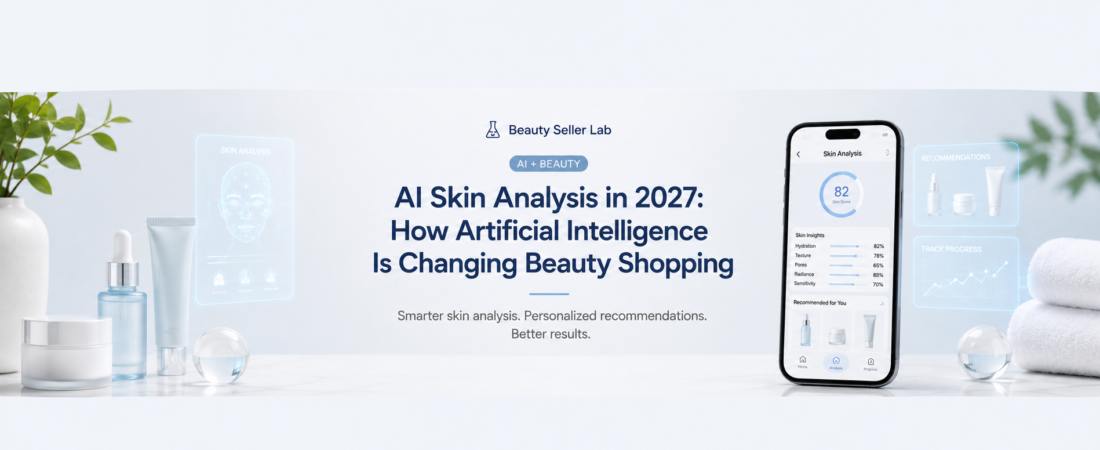
AI Skin Analysis is moving from a novelty feature into a serious part of the beauty shopping experience.
For years, online skincare shopping relied on a familiar process:
- Choose your skin type
- Select your main concern
- Answer a short quiz
- Receive a product recommendation
The problem is obvious.
Consumers do not always describe their own skin accurately.
One shopper may describe visible pores as “texture.”
Another may confuse dehydration with dryness.
Someone else may simply choose the answer that sounds closest.
AI-powered skin analysis changes that process by starting with an image instead of a questionnaire.
A selfie can now be analyzed for visible cosmetic features such as:
- Pores
- Wrinkles
- Redness
- Dark spots
- Texture
- Radiance
- Oiliness
- Moisture-related appearance
- Firmness-related appearance
- Acne-related visible features
A 2026 Scientific Reports study on consumer-selfie skin profiling described the growing demand for personalized skincare and introduced a standardized dataset of 3,203 facial selfies annotated across eight cosmetic skin features. Importantly, the researchers explicitly framed the system as appearance-based cosmetic profiling, not medical diagnosis.
Read the 2026 Scientific Reports study
That distinction may become one of the most important rules of beauty technology in 2027.
AI can help personalize beauty shopping without pretending to replace a dermatologist.
AI Skin Analysis: Quick Summary
| Factor | Traditional Skincare Quiz | AI Skin Analysis |
|---|---|---|
| Main input | Self-reported answers | Selfie / camera image |
| Personalization | Broad | More individualized |
| Consumer effort | Several questions | Usually seconds |
| Visible skin assessment | Limited | Automated image analysis |
| Product recommendation | Rule-based | AI + catalog mapping |
| Progress tracking | Rare | Increasingly possible |
| Main risk | Generic recommendations | Bias, image quality, overconfidence |
| 2027 opportunity | Established | Very high |
The biggest shift is simple:
Beauty shopping is becoming measurement-led rather than questionnaire-led.
What Is AI Skin Analysis?
AI skin analysis uses technologies such as:
- Computer vision
- Deep learning
- Image segmentation
- Facial landmark detection
- Pattern recognition
- Recommendation algorithms
to evaluate visible cosmetic features from an image or live camera feed.
The technology does not “understand” skin in the same way a dermatologist does.
It looks for patterns in images that resemble patterns found in the data used to train and validate the model.
That means performance depends heavily on:
- Training data
- Lighting
- Camera quality
- Face angle
- Image consistency
- Skin-tone diversity
- Annotation quality
- Model design
This is why two tools that both claim to use “AI skin analysis” may perform very differently.
Why AI Skin Analysis Is Growing Now
The technology itself is not completely new.
What changed is the beauty market around it.
1. Personalized Skincare Has Become an Expectation
Consumers increasingly expect recommendations based on their own needs rather than generic categories.
This fits the broader shift toward personalized beauty that we also track in our 2027 K-Beauty Trends guide.
Instead of being told:
“This serum is good for dry skin.”
the shopper may increasingly expect:
“Your visible concerns appear to be dehydration, uneven texture and redness, so these three products may be more relevant.”
Perfect Corp., one of the major commercial AI-beauty technology providers, says its 2026 skin-analysis platform can assess more than 15 visible concerns and classify multiple skin types before mapping the results to products in a retailer’s catalog.
See Perfect Corp.’s 2026 AI Skin Analysis guide
These are vendor-reported capabilities rather than universal benchmarks for the entire industry, but they show where beauty commerce is heading.
2. The Selfie Is Becoming a Beauty Input
Consumers already use smartphone cameras for:
- Virtual makeup try-on
- Foundation shade matching
- Hair-color simulation
- Face filters
- Product reviews
Skin analysis is a natural extension.
A selfie is much faster than a long consultation.
That matters in e-commerce because every extra step can cause shoppers to leave.
The commercial promise is:
selfie in → personalized routine out.
However, image capture is not trivial.
The 2026 Scientific Reports cosmetic-profiling study emphasized standardized image acquisition, and commercial AI platforms increasingly guide users on:
- Lighting
- Face position
- Angle
- Framing
because inconsistent photos can change the analysis.
Read the research on standardized consumer selfies
3. AI Is Moving From Recommendation to Commerce
The next stage is not simply:
analyze skin.
It is:
analyze → recommend → explain → add to cart.
In June 2026, L’Oréal and OpenAI announced a collaboration focused partly on AI-powered consumer journeys and agentic commerce across beauty.
Read L’Oréal’s June 2026 AI announcement
That direction is strategically important.
An AI beauty assistant could potentially:
- Analyze visible skin concerns
- Ask follow-up questions
- Explain product differences
- Build a routine
- Adjust for budget or preferences
- Recommend products
- Move the shopper directly toward checkout
The beauty website starts behaving less like a static catalog and more like a digital consultant.
4. Skin Analysis Is Moving Beyond the Selfie
The future may not rely on images alone.
L’Oréal’s Cell BioPrint, introduced in 2025 and piloted with Lancôme in March 2026, uses a portable lab-on-chip system to analyze five skin-related protein biomarkers in about five minutes.
This is not the same technology as selfie-based AI skin analysis.
But it shows the direction of personalized beauty:
visual information + biological information + algorithmic recommendation.
In the future, high-end beauty consultation may combine:
- Camera analysis
- Biomarker measurements
- Lifestyle information
- Product history
- Environmental data
to create more individualized recommendations.
5. AI Skin Analysis Is Becoming a Retail Tool
AI beauty technology is increasingly designed for more than brand websites.
It can appear in:
- Online stores
- Mobile apps
- Beauty counters
- Department stores
- Salons
- Clinics
- Smart mirrors
- Retail kiosks
Haut.AI, another beauty-tech provider, presented AI skin analysis at in-cosmetics Global 2026 as a way to measure more than 29 skin parameters and generate reproducible data for consumer experiences, R&D and clinical-style testing.
See Haut.AI at in-cosmetics Global 2026
Again, those performance and scale claims come from the vendor.
The larger trend is more important:
skin measurement is becoming part of the shopping interface.
AI Skin Analysis vs a Traditional Skincare Quiz
A skincare quiz usually asks questions such as:
- Is your skin oily?
- Do you experience dryness?
- Are you concerned about wrinkles?
- Do you have dark spots?
This is easy to deploy.
It is also highly dependent on self-perception.
AI skin analysis adds visual information.
That may help identify visible patterns the shopper did not select.
But AI does not know everything.
A selfie cannot reliably tell the complete story of:
- Allergies
- Past irritation
- Medication
- Pregnancy
- Medical conditions
- Product tolerance
- Lifestyle
- Previous reactions
Beauty Seller Lab View
The strongest system may therefore be:
AI image analysis + a short intelligent questionnaire.
Not one or the other.
What Can Cosmetic AI Skin Analysis Actually Measure?
The answer depends on the platform.
Common cosmetic parameters include:
Visible Pores
Computer vision can identify pore-related texture patterns under suitable imaging conditions.
Fine Lines and Wrinkles
Algorithms can estimate visible line patterns in different facial regions.
Pigmentation and Spots
Image-processing systems can segment darker visible areas and estimate their distribution.
Redness
Color-related analysis may estimate visible redness.
Texture
Surface irregularity can be approximated through image patterns.
Radiance
Some platforms generate a radiance or dullness score using image characteristics.
Oiliness or Moisture-Related Appearance
Certain platforms attempt to classify visible signs associated with oiliness or dryness.
These are cosmetic appearance measurements.
They should not automatically be interpreted as clinical diagnoses.
AI Skin Analysis Is Not a Dermatologist
This is essential.
A cosmetic skin analyzer may say:
“visible redness detected.”
It should not automatically conclude:
“you have rosacea.”
It may identify:
“visible dark spots.”
It should not claim:
“this lesion is medically harmless.”
Medical dermatology is a much higher-stakes use case.
Recent research shows why caution matters.
A 2026 prospective study of an AI smartphone skin-cancer app found that image capture failed for a meaningful proportion of lesions, performance changed across smartphone models and user-captured images created additional challenges.
Read the 2026 prospective diagnostic study
Another 2026 study testing popular AI skin-diagnosis apps on a diverse skin-image dataset reported poor overall diagnostic accuracy and concluded that the apps should not be used as standalone diagnostic tools.
Read the diverse-skin diagnostic accuracy study
These studies concern medical lesion diagnosis, not ordinary cosmetic scoring.
But they highlight an important general lesson:
AI confidence should never be confused with clinical certainty.
Skin Tone Bias May Become a Major Beauty-Tech Issue
AI systems learn from data.
If the training data does not adequately represent:
- Darker skin tones
- Different ethnicities
- Different ages
- Different lighting environments
performance may not be equally reliable for everyone.
A 2025 systematic review and meta-analysis of AI skin-lesion systems found lower performance in darker skin tones than lighter skin tones.
Read the skin-tone equity meta-analysis
Again, diagnostic dermatology is not identical to cosmetic skin analysis.
However, the fairness issue applies broadly:
A beauty analyzer should be validated across the people expected to use it.
For beauty brands, inclusivity may become a technical requirement rather than only a marketing value.
Image Quality May Matter More Than Consumers Realize
AI analysis begins with the image.
That means:
bad image → unreliable input.
Common problems include:
- Uneven lighting
- Strong shadows
- Makeup
- Beauty filters
- Wrong face angle
- Low-resolution cameras
- Overexposure
- Facial expression
The 2026 consumer-selfie study specifically found that facial expression matters and recommended standardized acquisition for multi-attribute skin profiling.
Read the 2026 selfie-profiling benchmark
This means future beauty apps may become more aggressive about guiding the user before the analysis starts.
For example:
“Move closer.”
“Remove glasses.”
“Use neutral expression.”
“Face natural light.”
“Turn slightly left.”
Good image capture may become a hidden competitive advantage.
AI Skin Analysis and Skinimalism 2.0
AI personalization also connects with the rise of Skinimalism 2.0.
If a consumer wants fewer skincare products, the recommendation system needs to identify:
which products matter most.
Instead of suggesting:
- Five serums
- Three boosters
- Two creams
an intelligent routine builder could prioritize:
- Primary concern
- Secondary concern
- Barrier needs
- Sunscreen
- One or two high-value treatments
This could make AI useful not because it recommends more products, but because it recommends fewer, more relevant ones.
That would be a much more credible personalization story.
AI Could Turn Skincare Into a Trackable Routine
One of the biggest opportunities is follow-up analysis.
A shopper could take a baseline selfie.
Then repeat the scan:
- 2 weeks later
- 4 weeks later
- 8 weeks later
The platform could compare changes in visible parameters.
This creates:
skincare progress tracking.
Commercial platforms already promote repeat scanning as a way to track consumer progress.
See Perfect Corp.’s AI skin-analysis platform
For brands, this could improve:
- Engagement
- Repeat visits
- Routine adherence
- Product education
But the analysis needs consistent imaging conditions.
Otherwise the “improvement” may partly reflect:
- Better lighting
- Different phone
- Different angle
- Makeup
- Camera processing
rather than actual skin change.
AI Beauty Assistants Could Become Personal Shopping Agents
Skin analysis is only one input.
By 2027, beauty AI may combine it with conversational agents.
Imagine this experience:
Step 1
AI analyzes a selfie.
Step 2
It identifies visible concerns.
Step 3
The shopper says:
“I have sensitive skin and only want three products under $80.”
Step 4
The AI removes unsuitable options.
Step 5
It explains why each product was selected.
Step 6
It builds the cart.
This is where AI skin analysis becomes part of agentic commerce rather than a standalone scanner.
L’Oréal’s 2026 collaboration with OpenAI explicitly identifies AI-powered consumer journeys and AI-native commerce as strategic areas.
Read the L’Oréal and OpenAI announcement
AI Is Also Changing Beauty Product Development
Beauty AI does not stop at shopping.
It is moving into formulation research.
In March 2026, L’Oréal announced an expanded collaboration with NVIDIA focused on predictive AI and computational chemistry for beauty R&D.
Read the L’Oréal and NVIDIA announcement
The idea is to use machine learning to help predict how molecules may behave and interact.
That creates an interesting long-term loop:
AI helps develop products → AI analyzes consumers → AI recommends products → consumer data informs future development.
This could make beauty increasingly data-driven at both ends of the market.
Privacy Could Become a Major Consumer Concern
A skin-analysis selfie is not just another website click.
It is facial data.
That creates important questions:
- Is the image stored?
- For how long?
- Is it used to train models?
- Is consent explicit?
- Can the user delete the data?
- Is the image linked to purchase history?
- Is facial information shared with third parties?
AI beauty tools need to make these answers easy to understand.
Consumers may become more willing to share a selfie if they clearly know:
what happens to it afterward.
Opaque data practices could damage trust quickly.
The Psychological Risk of Constant Skin Scoring
There is another issue.
If a beauty app gives consumers scores for:
- Wrinkles
- Pores
- Spots
- Texture
- Redness
every time they open it, beauty shopping can start to feel like an exam.
Allure’s 2026 review of an AI-powered smart beauty mirror raised concerns about unnecessary self-awareness, privacy and the psychological effect of repeated skin evaluation.
Read Allure’s AI beauty mirror review
This is a design problem as much as a technology problem.
A responsible analyzer should not make healthy, normal skin features feel like defects that must always be corrected.
Better Experience
Instead of:
“Your pore score is poor.”
a platform could say:
“Visible pores are one of the features detected. If this is a concern for you, here are relevant options.”
That gives the consumer control.
7 AI Skin Analysis Trends to Watch in 2027
1. Selfie Analysis Becomes a Standard E-Commerce Feature
Skin analysis may increasingly appear beside:
- Product filters
- Reviews
- Shade finders
- Routine quizzes
rather than living on a separate novelty page.
2. AI Analysis Connects Directly to Product Catalogs
The scan itself is not the commercial endpoint.
The real value is:
analysis → relevant SKU.
Brands will increasingly need systems that map detected concerns to specific products and explain the logic.
3. Progress Tracking Becomes a Loyalty Tool
Repeat analysis could help brands bring shoppers back after purchase.
This may turn skincare into a measurable, ongoing relationship.
4. AI Agents Replace Static Routine Builders
Instead of giving everyone the same routine template, conversational AI can adapt recommendations around:
- Budget
- Product preferences
- Number of steps
- Sensitivity
- Existing products
5. Camera Analysis Combines With Biological Measurement
L’Oréal’s Cell BioPrint shows how personalization can extend beyond visual analysis.
Future premium beauty experiences may combine:
selfie + biomarker + lifestyle data.
6. Validation and Inclusivity Become Competitive Advantages
Brands may increasingly compete on:
- Diverse training data
- Published validation
- Reproducibility
- Transparency
- Skin-tone performance
The phrase:
“AI-powered”
will become less impressive on its own.
Consumers and retailers may ask:
How was the AI validated?
7. AI Moves Into Beauty R&D
Predictive modeling may influence:
- Ingredient discovery
- Formula optimization
- Clinical testing
- Consumer simulation
- Product personalization
This makes AI a beauty-industry infrastructure trend, not just a shopping gimmick.
What Should Beauty Sellers Look For?
Not every AI skin analyzer will be equally useful.
When evaluating a platform, sellers should ask:
What Does It Measure?
Does it assess:
- Pores?
- Wrinkles?
- Pigmentation?
- Redness?
- Texture?
How Was It Validated?
Look for:
- Published studies
- Independent testing
- Reproducibility
- Diverse skin tones
How Does It Handle Image Quality?
Does the tool actively guide users toward better photos?
Can It Connect to the Product Catalog?
A scan with no recommendation layer may create curiosity but little commercial value.
Does It Explain Recommendations?
Consumers should understand:
why this serum?
not simply:
AI says buy it.
How Is Data Handled?
Privacy and consent should be clear.
The Biggest Marketing Risk: Calling Everything a Diagnosis
The word:
diagnosis
creates authority.
That makes it tempting.
But cosmetic AI should be careful.
A system designed to analyze:
- Visible pores
- Texture
- Spots
- Fine lines
should not imply that it can diagnose:
- Melanoma
- Rosacea
- Eczema
- Dermatitis
- Other medical conditions
unless it is specifically developed, validated and regulated for that use.
The 2026 Scientific Reports cosmetic skin-profiling study explicitly separated cosmetic appearance assessment from medical diagnosis.
Read the non-diagnostic cosmetic AI study
That is a useful standard for the beauty industry.
Another Risk: Fake Precision
Imagine a skin analyzer says:
“Your skin is 73% hydrated.”
That number looks scientific.
But consumers should ask:
What does 73% actually represent?
AI-generated scores are usually model outputs.
They may be useful for:
- Relative comparison
- Progress tracking
- Recommendation ranking
but should not automatically be interpreted as laboratory measurements.
Beauty brands should explain what scores mean.
Otherwise precision becomes decoration.
AI Skin Analysis and K-Beauty
K-beauty is particularly well positioned for AI personalization.
Why?
Because Korean beauty already emphasizes:
- Skin concerns
- Routine building
- Ingredient matching
- Lightweight layering
- Customization
AI can make that philosophy more individualized.
Instead of recommending the same famous 10-step routine to everyone, a system might recommend:
User A
- Gentle cleanser
- Barrier serum
- Moisturizing sunscreen
User B
- Cleanser
- Vitamin C serum
- Lightweight moisturizer
- Sunscreen
User C
- Cleanser
- Peptide serum
- Retinoid
- Barrier cream
- Sunscreen
That is more aligned with modern K-beauty than simply increasing step count.
Could AI Analyze the Scalp Too?
Potentially.
The same computer-vision principles can be extended beyond facial skin.
This connects with the rise of scalp skinification.
Future scalp analysis could potentially evaluate visible features such as:
- Flaking
- Oiliness
- Part width
- Redness
- Buildup
before recommending scalp-care products.
Again, cosmetic analysis should remain separate from medical diagnosis of hair-loss disorders.
But scalp imaging could become another personalized beauty category.
Beauty Seller Lab View
The most important thing about AI Skin Analysis is not whether a camera can generate another beauty score.
The bigger change is what happens after the analysis.
The real 2027 opportunity is:
measurement
→ personalization
→ education
→ product recommendation
→ progress tracking
→ repeat shopping.
That can make online beauty shopping feel much more individual.
But the technology also creates new responsibilities.
Brands need to take seriously:
validation
skin-tone fairness
image quality
privacy
non-diagnostic boundaries
and:
consumer psychology.
The winners may not be the brands with the most futuristic-looking scanner.
They may be the ones that make AI feel:
useful, transparent and trustworthy.
FAQ
What is AI skin analysis?
AI skin analysis uses computer vision and machine-learning models to evaluate visible cosmetic skin features from a selfie or camera image.
What can AI skin analysis detect?
Depending on the platform, it may estimate visible pores, wrinkles, spots, redness, texture, radiance, oiliness and other appearance-related parameters.
Is AI skin analysis accurate?
Performance varies by platform, training data, image quality and validation methods. Cosmetic analysis and medical diagnosis should also be treated as separate use cases.
Can AI diagnose skin conditions?
A cosmetic skin analyzer should not be assumed to diagnose medical conditions. Medical diagnosis requires appropriate clinical validation and regulatory oversight.
Can AI recommend skincare products?
Yes. Many commercial systems map visible concerns and questionnaire information to products in a brand or retailer catalog.
Is AI skin analysis safe for all skin tones?
It depends on the model. AI systems need diverse training data and skin-tone-specific validation to reduce performance gaps.
Does lighting affect AI skin analysis?
Yes. Lighting, image quality, camera type, face position and expression can influence image-based analysis.
Will AI skin analysis replace dermatologists?
No. Cosmetic AI can support beauty personalization, while dermatologists provide medical evaluation, diagnosis and treatment.
How will AI change beauty shopping in 2027?
Likely growth areas include selfie-based personalization, AI shopping agents, product mapping, progress tracking, in-store analysis and integration with biological measurements.
Is AI skin analysis a major 2027 beauty trend?
Current 2026 research, retailer adoption and beauty-tech investment suggest strong growth potential. It remains a forecast rather than a guarantee.
The Bottom Line
AI Skin Analysis is turning beauty shopping from:
“Which product sounds right for me?”
into:
“What does my skin data suggest I should look at?”
The technology is becoming:
faster
more personalized
more integrated with shopping
and:
more measurable.
But more advanced technology also demands better standards.
For 2027, the strongest AI beauty experiences should not simply produce impressive scores.
They should produce:
better questions
clearer recommendations
more transparent evidence
and:
more confident consumer decisions.
That is when AI skin analysis stops being a beauty-tech demo.
It becomes part of the shopping journey.