Regenerative skincare is becoming crowded.
PDRN.
Growth factors.
Exosomes.
Spicules.
Peptides.
Skin-longevity technologies.
Among these, two categories sound especially futuristic:
EGF
and
exosomes.
Both are associated with cellular communication.
Both appear in regenerative and treatment-inspired skincare.
Both are increasingly combined with advanced delivery systems.
But scientifically, they are very different technologies.
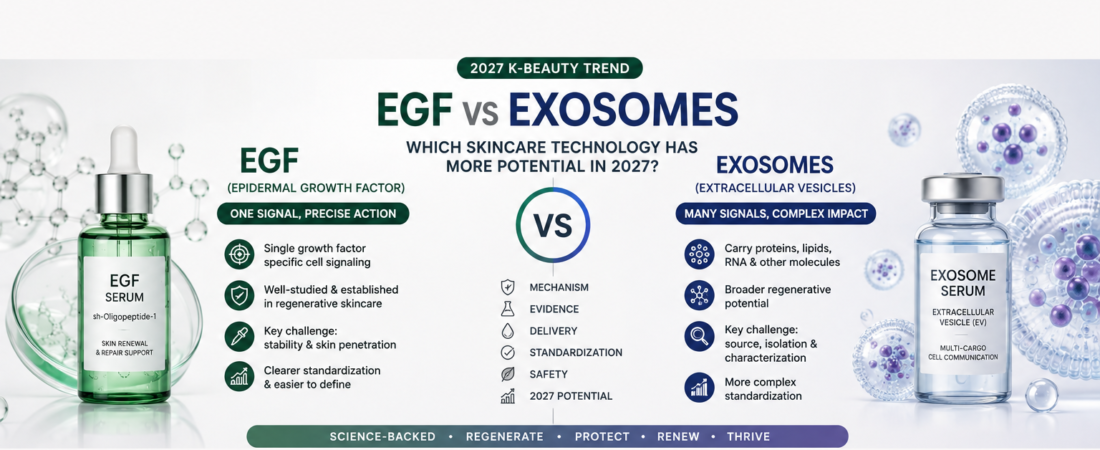
EGF is a specific signaling growth factor.
Exosomes are a subtype of extracellular vesicles capable of carrying a complex mixture of biological cargo including proteins, lipids and nucleic acids.
So the question is not simply:
Which one is stronger?
The more useful question is:
Which technology currently has clearer evidence, better standardization, more scalable cosmetic potential and the stronger 2027 K-beauty story?
For a full introduction to the first technology, read our EGF Skincare 2027 Guide.
EGF vs Exosomes: Quick Comparison
| Factor | EGF | Exosomes / EVs |
|---|---|---|
| Technology type | Single growth factor | Extracellular vesicle |
| Main concept | Specific cell signal | Multi-cargo communication system |
| Typical cargo | EGF itself | Proteins, lipids, RNA and other molecules |
| Scientific history | Long-established | Rapidly expanding |
| Cosmetic evidence | Older but relatively modest | Newer and heterogeneous |
| Main formulation problem | Stability + penetration | Source + isolation + characterization + stability |
| Standardization | Comparatively simpler | Much more complex |
| Delivery challenge | High | High |
| Consumer story | Growth factor / regeneration | Biotechnology / cellular communication |
| 2027 commercial potential | Strong niche platform | Potentially larger, but higher complexity |
The simplest distinction is:
EGF = one defined biological signal
while:
exosomes = a biological delivery package containing multiple signals.
What Is EGF?
EGF stands for:
Epidermal Growth Factor.
It is a signaling protein involved in processes such as epidermal homeostasis, cell proliferation, migration and tissue repair.
Recombinant EGF has been studied for decades in dermatology and regenerative medicine, particularly in wound-related biology.
How It Appears in Cosmetics
Cosmetic products may use recombinant EGF-related ingredients such as:
sh-Oligopeptide-1.
A 2023 review specifically examined topical sh-Oligopeptide-1 and its use as the cosmetic bioequivalent of EGF.
The beauty story is therefore relatively easy to explain:
EGF
→ receptor signaling
→ skin-renewal biology
→ cosmetic positioning around texture, fine lines, elasticity and recovery.
What Are Exosomes?
Exosomes are small extracellular vesicles produced by cells.
They belong to the broader family of extracellular vesicles, or EVs, and can transport proteins, lipids, nucleic acids and metabolites between cells.
That makes their biological story much broader than EGF.
EGF
One defined signaling molecule.
Exosome
A vesicle potentially carrying many different signaling molecules at once.
That gives exosomes an obvious commercial advantage:
they sound like a complete biological communication system.
But it also creates their biggest scientific problem.
What exactly is inside the vesicle?
That answer depends heavily on:
- Cell source
- Cell condition
- Culture method
- Isolation process
- Purification
- Storage
- Characterization
This is one reason standardized EV research is technically demanding.
Important: “Exosome” Is Not Always the Most Precise Term
This distinction is going to become increasingly important in beauty marketing.
The International Society for Extracellular Vesicles’ MISEV2023 guidance recommends careful characterization and terminology for extracellular vesicle research.
In many circumstances, researchers cannot definitively prove the cellular biogenesis pathway required to classify every isolated particle as an “exosome.”
As a result, the broader term:
extracellular vesicle
or
EV
may sometimes be scientifically more appropriate.
Why This Matters for Skincare
A cosmetic label saying:
10 billion exosomes
sounds impressive.
But sophisticated consumers may eventually ask:
How were they characterized?
What is the cell source?
Which EV markers were confirmed?
What was the isolation method?
Is the number measured before or after formulation?
The exosome market is therefore likely to face the same transparency problem PDRN is beginning to experience — only more complicated.
Difference 1: One Signal vs Multiple Signals
This is the fundamental difference in EGF vs exosomes.
EGF
EGF has one primary identity:
a defined growth factor interacting with EGF receptors.
Its biological function is comparatively focused.
Exosomes
Exosomes can carry:
- Proteins
- Lipids
- mRNA
- microRNA
- Other nucleic acids
- Metabolites
and can influence recipient cells through multiple pathways.
Which Is Better?
That depends on the objective.
If you want:
a defined active with a clearer mechanism
EGF has an advantage.
If you want:
a complex multi-signal biotechnology platform
exosomes have greater theoretical breadth.
Winner for simplicity:
EGF
Winner for biological complexity:
Exosomes
Difference 2: Which Has Stronger Human Cosmetic Evidence?
This comparison is more nuanced than the marketing suggests.
EGF Evidence
A 2023 systematic review of topical growth-factor preparations for facial rejuvenation found modest improvements in texture, fine lines/wrinkles and overall facial appearance.
Importantly, the review also reported that three comparative randomized controlled trials did not show statistically significant differences between treatments.
That means EGF/growth-factor skincare has legitimate clinical history.
But:
the evidence is not overwhelmingly strong.
Exosome Evidence
A 2026 systematic review identified 21 studies evaluating EV/exosome-based interventions for skin rejuvenation.
The reviewed literature reported improvements across elasticity, wrinkles, hydration and pigmentation, alongside molecular findings related to collagen, elastin, oxidative stress and matrix remodeling.
However, reviews of cosmetic exosomes continue to emphasize variation in:
- EV source
- treatment protocol
- application method
- characterization
- study quality
and the need for more standardized clinical research.
Beauty Seller Lab View
EGF has the longer clinical history.
Exosomes currently have the faster-growing research pipeline.
Neither deserves blanket claims such as:
clinically proven to reverse aging.
Difference 3: Which Technology Is Easier to Standardize?
Winner: EGF
This is one of EGF’s biggest advantages.
EGF is a defined protein.
Manufacturers still need to control:
- Purity
- Activity
- concentration
- stability
- storage
- formulation
but at least they know what the target molecule is.
Exosomes Are Much More Complicated
An exosome product can vary according to:
- source cell
- culture conditions
- isolation method
- particle population
- cargo
- storage
- formulation.
MISEV2023 exists partly because EV characterization is complex enough that researchers need standardized reporting and experimental controls.
Two products both labeled:
EXOSOME SERUM
may therefore contain biologically very different materials.
That makes direct comparison much harder than:
Product A contains recombinant EGF.
Difference 4: Which Has the Bigger Delivery Problem?
EGF Has a Clear Problem
Growth-factor skincare faces a fundamental obstacle:
the skin barrier.
A major review on growth-factor cosmetics identifies low transdermal delivery, protein instability and formulation interactions as key limitations.
EGF can be scientifically active in the right biological environment.
But ordinary topical application does not guarantee efficient delivery.
Exosomes Are Also Not Magically Barrier-Proof
Exosomes are nanoscale vesicles, which makes their delivery story attractive.
But their existence as small particles does not automatically prove that a finished cosmetic serum delivers functionally intact vesicles to the exact desired skin layer.
Delivery efficiency can depend on:
- Particle size
- Surface properties
- formulation
- skin condition
- application method
- accompanying procedures
Clinical and aesthetic research frequently combines EVs with interventions such as microneedling or other procedures, which makes ordinary topical-serum performance harder to generalize.
Winner:
Neither.
Delivery remains a major challenge for both categories.
Difference 5: Delivery Technology May Favor EGF in the Short Term
This is where EGF has recently become more interesting.
A 2026 study evaluated an EGF-loaded FLEXIR-SOME system designed specifically to improve EGF stability and skin penetration.
The researchers reported an average particle size around 125 nm and improved stability and delivery compared with a conventional liposomal control. Clinical testing associated with the formulation also reported improvements in several skin parameters.
Why This Matters
EGF has an obvious weakness:
poor topical delivery.
But that weakness gives product developers a very clear innovation target:
solve delivery.
Possible technologies include:
- Liposomes
- Nanocarriers
- Flexible vesicles
- Microneedles
- Spicules
- Encapsulation
The value proposition becomes:
Same biologically defined EGF — better delivery system.
That is easy for consumers to understand.
Difference 6: Exosomes May Have the Larger Long-Term Platform Opportunity
This is where the balance changes.
Exosomes are not limited to carrying one active.
Their biological function as extracellular vesicles gives researchers the ability to explore them as delivery systems as well as biological materials themselves.
Recent research is already investigating engineered extracellular vesicles loaded with additional therapeutic cargo.
What This Could Mean for Future Skincare
Conceptually, an advanced EV product could involve:
- EV source
- native biological cargo
- added active
- surface engineering
- targeted delivery.
That creates significantly more possibilities than simply:
increase the concentration of one growth factor.
But
The more sophisticated the technology becomes, the harder it becomes to:
- manufacture consistently
- characterize properly
- explain to consumers
- regulate
- compare between brands
So exosomes may have the larger technological ceiling.
They also carry the larger execution risk.
Difference 7: Which Has the Stronger K-Beauty Story?
Both do — in very different ways.
EGF Has Heritage
Korean brand Easydew has built a long-standing commercial platform around DW-EGF, presenting it as a proprietary high-purity growth-factor technology tied to Daewoong’s pharmaceutical research.
That gives EGF something most emerging ingredients do not have:
history.
Exosomes Have Novelty
Exosome skincare has:
- Biotechnology language
- Cellular communication
- Regenerative positioning
- Stem-cell-adjacent narratives
- High premium potential
- Compatibility with PDRN and spicules
The consumer story feels newer.
Beauty Seller Lab View
EGF = credible Korean regenerative heritage
Exosomes = future-facing biotech excitement
Both can succeed, but they target different emotional purchase motivations.
EGF vs Exosomes: Which Is Better for Wrinkles?
Neither technology should be treated as a guaranteed wrinkle solution.
EGF
Growth-factor studies have reported modest improvements in facial rejuvenation outcomes, including fine lines and texture, but evidence varies across products and study designs.
Exosomes
Recent systematic reviews report encouraging rejuvenation findings, including wrinkle-related outcomes, but the field remains heterogeneous and standardization remains an important limitation.
Current Winner for Mature Evidence:
EGF / growth-factor skincare
Current Winner for Research Momentum:
Exosomes
EGF vs Exosomes: Which Is Better for Skin Recovery?
This is more difficult.
EGF has a substantial research history related to wound-healing biology and tissue repair.
Extracellular vesicles are also extensively studied in regenerative medicine, including wound repair and intercellular signaling.
But medical recovery evidence should not automatically be converted into:
this cosmetic serum heals damaged skin.
For Cosmetic Products
The better question is:
Which finished product has evidence supporting the exact cosmetic outcome being claimed?
That should matter more than the trend name.
Could EGF Be Put Inside Exosomes?
Conceptually, this is where the comparison becomes especially interesting.
EVs are being actively researched as biological delivery vehicles for proteins and peptides, and engineered EV systems can be loaded with additional cargo.
That means the future may not always be:
EGF vs exosomes.
It could eventually become:
EGF delivered by an advanced vesicle system.
This is a broader technological inference from current EV engineering research rather than evidence that a specific cosmetic EGF-exosome product currently delivers superior results.
That combination would fundamentally change the competitive framing.
EGF vs Exosomes vs PDRN
These three regenerative technologies occupy different positions.
| Technology | Core Story |
|---|---|
| EGF | Specific growth-factor signaling |
| Exosomes / EVs | Multi-cargo cell communication |
| PDRN | DNA-fragment-based regenerative positioning |
EGF
Best positioned around:
specific biological signaling
Exosomes
Best positioned around:
complex biotechnology and communication
PDRN
Currently easiest to position around:
recovery and regeneration
This is why all three may eventually coexist rather than one completely replacing the others.
EGF vs Exosomes vs Spicules
Spicules are different again.
They are primarily a:
delivery / stimulation technology.
That means future product architecture could look like:
EGF + spicule delivery
or
EV/exosome technology + spicule delivery
rather than forcing consumers to choose one trend.
For the delivery side of this category, read our Spicule Skincare 2027 Guide.
Which Technology Fits Skin Longevity Better?
Both can fit.
EGF Longevity Story
Maintain signaling associated with renewal and resilience.
Exosome Longevity Story
Support complex intercellular communication and regenerative pathways.
The exosome story sounds broader.
The EGF story is easier to define.
For the larger healthy-aging framework, see our Skin Longevity in Skincare 2027 Guide.
The Biggest Advantage of EGF
The biggest advantage is:
Definition
We know what EGF is.
It is much easier to ask:
- What EGF?
- What purity?
- What concentration?
- What activity?
- What delivery system?
That makes product evaluation more straightforward.
The Biggest Disadvantage of EGF
Delivery
A powerful biological signal is of limited cosmetic value if the protein becomes unstable or cannot reach the environment where it is intended to act.
That is why delivery technologies may determine whether EGF experiences a genuine revival.
The Biggest Advantage of Exosomes
Biological Breadth
Exosomes/EVs can potentially carry multiple forms of biological cargo rather than one single active.
That gives the platform enormous scientific and marketing flexibility.
The Biggest Disadvantage of Exosomes
Complexity
The exact biological identity of an EV product depends on how it was produced and characterized.
MISEV2023 emphasizes detailed EV characterization precisely because particle count alone is not enough to establish identity or function.
This means exosome skincare could face a major future transparency challenge.
Which One Has More Commercial Potential in 2027?
Short-Term: EGF May Be Easier to Commercialize Credibly
Why?
Because:
- The active is more defined
- EGF already has cosmetic history
- Korea already has established EGF brands
- New delivery research creates a credible innovation story
- Product claims can remain relatively understandable
Long-Term: Exosomes Probably Have the Bigger Technology Ceiling
Because the EV concept can potentially become:
- ingredient
- delivery system
- biotechnology platform.
But this is an inference based on current research momentum and platform complexity, not a guarantee that commercial exosome cosmetics will outperform EGF products.
Beauty Seller Lab Verdict
Best for Defined Science
EGF
Best for Long Clinical History
EGF
Best for Biological Complexity
Exosomes
Best for Future Engineering Potential
Exosomes
Best for Standardization
EGF
Best for 2027 Biotech Hype
Exosomes
Best for Credible K-Beauty Heritage
EGF
Best Long-Term Platform Opportunity
Exosomes — if standardization improves
So if the question is:
Which technology is currently easier to evaluate?
EGF.
If the question is:
Which technology could eventually become the larger biotechnology platform?
Exosomes.
What Beauty Sellers Can Learn
The weakest strategy is:
EXOSOME EGF SUPER REGENERATION SERUM
with no explanation.
A stronger strategy separates the role of each technology.
Growth-Factor Strategy
EGF + Advanced Delivery + Specific Cosmetic Outcome
Example:
Encapsulated EGF Firming Serum
Exosome Strategy
Defined EV Source + Characterization + Specific Skin Benefit
Example:
Plant-Derived EV Barrier Recovery Serum
Hybrid Strategy
Defined Active + Defined Delivery Platform
Example:
EGF + Vesicle Delivery Resilience Ampoule
The key is:
technology should explain the product.
It should not simply decorate the packaging.
Transparency Could Decide the Winner
Going into 2027, consumers are likely to become increasingly skeptical of biotechnology numbers.
For EGF, brands may need to explain:
- EGF identity
- concentration
- purity
- activity
- delivery method
For exosomes/EVs:
- source
- particle characterization
- isolation process
- concentration
- cargo claims
- finished-formula stability
Brands that explain these details clearly could gain a significant trust advantage.
The Bottom Line
The comparison between EGF vs exosomes is ultimately a comparison between:
precision
and
complexity.
EGF is a defined growth factor with decades of biological research behind it.
Its biggest weakness is the difficulty of delivering a delicate protein effectively through topical skincare.
Exosomes and other extracellular vesicles represent a broader cellular communication platform capable of carrying multiple biological molecules.
Their biggest weakness is that the technology is significantly harder to characterize and standardize.
Current clinical literature around growth-factor facial rejuvenation suggests modest benefits, while the newest exosome/EV systematic reviews report promising rejuvenation outcomes but also reveal a much newer and more heterogeneous evidence base.
So Beauty Seller Lab’s current conclusion is:
EGF is the more mature and defined skincare technology.
But:
Exosomes may have the larger long-term biotechnology opportunity.
The 2027 competition therefore may not be decided by which ingredient sounds more futuristic.
It may be decided by:
- better delivery
- better characterization
- better clinical evidence
- greater transparency.
And eventually, the most advanced products may combine these technologies rather than forcing consumers to choose between them.
FAQ
Is EGF the same as an exosome?
No. EGF is a specific signaling growth factor. Exosomes are extracellular vesicles capable of carrying multiple proteins, lipids and nucleic acids.
Which has more skincare research, EGF or exosomes?
EGF and topical growth factors have a longer history in skin and facial-rejuvenation research. Exosome/EV research is newer but expanding quickly, including a 2026 systematic review focused on skin rejuvenation.
Are exosomes better than EGF?
There is currently insufficient standardized comparative evidence to conclude that exosome skincare is universally superior to EGF skincare.
Why is EGF difficult to formulate?
EGF is a protein, and growth-factor skincare faces challenges involving protein stability, formulation compatibility and transdermal delivery.
Why are exosome products difficult to compare?
EV products can differ according to source cells, culture conditions, isolation, purification, characterization and cargo. MISEV2023 provides detailed guidance because standardized EV characterization is complex.
Is every extracellular vesicle an exosome?
Not necessarily. EV is the broader term. MISEV2023 recommends careful terminology because definitive classification as an exosome may require evidence about vesicle biogenesis that is not always available.
Can EGF and exosomes be combined?
EVs are being researched as delivery platforms for additional biological cargo, so combinations are scientifically conceivable. However, this does not prove that a specific EGF-exosome cosmetic product is clinically superior.
Which has more potential in 2027?
EGF currently has advantages in definition, history and standardization. Exosomes have greater platform complexity and potentially broader long-term biotechnology applications, provided characterization and standardization continue improving. This is a market inference based on the current evidence landscape.