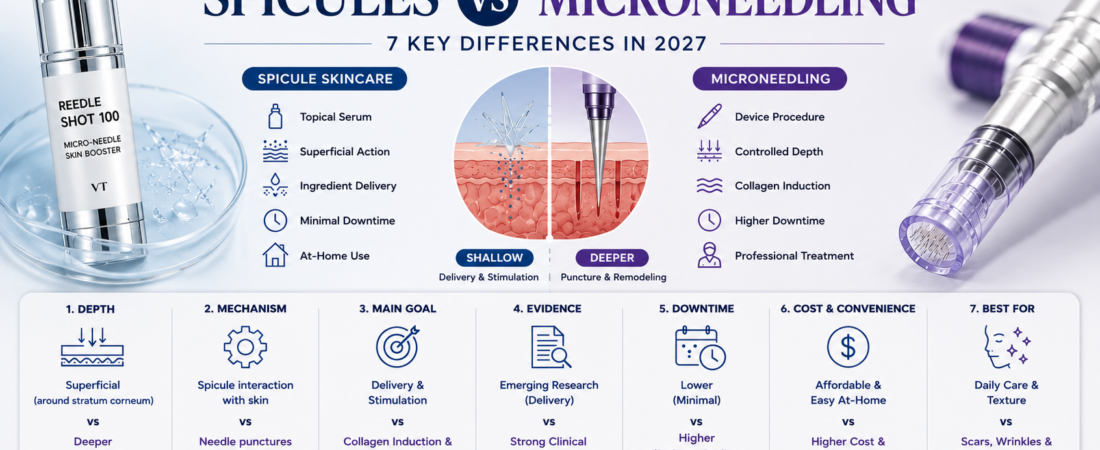
“Liquid microneedling.”
“Microneedles in a bottle.”
“Reedle skincare.”
These phrases are becoming increasingly common as K-beauty brands turn microscopic spicules into at-home serums and boosters.
But there is an important problem:
Spicule skincare is not the same thing as professional microneedling.
Both approaches can physically interact with the skin barrier, and both may increase skin permeability.
But their mechanism, depth, evidence, risks and intended use are very different.
So when comparing spicules vs microneedling, what actually separates them — and which approach makes sense for different skincare goals?
The short answer is:
Spicules are primarily an at-home topical delivery and stimulation technology.
Microneedling is a controlled procedure designed to create repeated needle punctures in the skin and stimulate a wound-healing response.
The difference is much bigger than the marketing language suggests.
Spicules vs Microneedling: Quick Comparison
| Factor | Spicule Skincare | Microneedling |
|---|---|---|
| Format | Topical serum / booster | Device-based procedure |
| Mechanism | Microscopic spicules interact with outer skin | Needles repeatedly puncture skin |
| Typical purpose | Ingredient delivery / texture / stimulation | Collagen induction / scars / rejuvenation |
| Depth control | Usually not individually adjustable | Can be controlled on some devices |
| Professional treatment | No | Often yes |
| Downtime | Usually lower | Usually higher |
| Bleeding expected | Generally no | Can occur |
| Scientific evidence | Mainly delivery-system research | Much broader clinical literature |
| At-home convenience | High | Lower |
| Best positioned for | Routine skincare | More significant skin concerns |
The most important takeaway from spicules vs microneedling is that they may share a needle-inspired concept, but they are not equivalent treatments.
What Are Spicules?
Spicules are microscopic needle-like structures.
Natural sponge-derived spicules have been investigated in cosmetic and pharmaceutical research because they can help overcome the skin barrier.
A 2022 study described natural siliceous spicules averaging around 250 μm in length and 12 μm in diameter and evaluated them as carriers for topical ingredients. The researchers concluded that the spicule-based system could improve dermal delivery compared with conventional topical application.
Other research using Haliclona sponge spicules found that topical treatment could create large numbers of temporary microchannels and increase the penetration and deposition of hyaluronic acid.
This makes spicules particularly interesting as a delivery technology.
They can be paired with ingredients such as:
PDRN, peptides, hyaluronic acid, cica, retinoid-related formulas and exosome-positioned ingredients.
That is why modern K-beauty rarely sells the spicule alone.
The commercial concept is usually:
Spicule + Hero Active.
For a full introduction to the technology, read our Spicule Skincare 2027 Guide.
What Is Microneedling?
Microneedling uses a device containing multiple small needles, pins or tips that repeatedly enter and leave the skin.
The FDA explains that microneedling devices can take forms such as rollers, stamps or motorized pen-style devices. Some motorized devices allow a trained practitioner to adjust needle penetration depth and speed.
The biological goal is also different from ordinary skincare.
Microneedling creates controlled micro-injuries that initiate a wound-healing response involving fibroblast activity and collagen and elastin remodeling. Reviews describe increased collagen deposition and improved skin texture as important mechanisms behind the procedure.
The FDA currently notes that legally marketed microneedling devices have been authorized for certain uses including improving the appearance of facial acne scars, facial wrinkles and abdominal scars in adults 22 or older, depending on the specific authorized device.
That already shows why comparing a Reedle serum directly with professional microneedling can be misleading.
Difference 1: How Deep Do They Work?
Microneedling goes deeper and can be controlled.
This is perhaps the biggest difference in spicules vs microneedling.
Professional microneedling devices use physical needles that penetrate the skin. On some motorized devices, penetration depth can be adjusted by the practitioner.
Spicule systems are generally studied as more superficial delivery approaches.
For example, one sponge-spicule and liposome study measured temporary channels averaging approximately 48.6 μm deep under its specific experimental conditions.
That number should not be treated as a universal depth for every commercial spicule product.
Spicule size, source, formula and application method can differ significantly.
But the overall distinction remains:
Microneedling → intentionally controlled needle penetration
Spicules → dispersed microscopic structures applied topically
Winner for controlled depth:
Microneedling
Difference 2: What Is the Main Goal?
Spicules: delivery and topical skincare enhancement
Much of the spicule literature focuses on overcoming the stratum corneum to improve topical delivery.
Studies have investigated spicule-assisted delivery of:
- Hyaluronic acid
- Proteins and growth-factor-containing materials
- siRNA
- Other active compounds
Microneedling: tissue remodeling
Microneedling is much more closely associated with intentionally triggering a controlled wound-repair process.
Recent reviews describe mechanisms involving:
collagen production
elastin production
angiogenesis
increased permeability
and
dermal remodeling.
Therefore the two technologies may sometimes produce overlapping cosmetic outcomes, but they start from different objectives.
Better for ingredient-delivery positioning:
Spicules
Better for collagen-remodeling procedures:
Microneedling
Difference 3: Which Has Stronger Scientific Evidence?
Winner: Microneedling
Microneedling has a much broader clinical literature.
Research covers applications including acne scars, skin rejuvenation, wrinkles, pigmentation and various dermatological uses. A comprehensive 2024 review describes the procedure as inducing micro-injuries that activate fibroblasts and stimulate collagen and elastin production.
Spicule research is legitimate, but the evidence base is narrower.
The strongest research supports the idea that sponge-derived spicules can:
alter skin permeability
and
improve delivery of selected compounds.
There are emerging studies examining broader cosmetic outcomes, but the evidence supporting every commercial Reedle-style product is not equivalent to the clinical evidence surrounding established microneedling procedures.
So:
Scientific maturity → Microneedling
Emerging topical delivery innovation → Spicules
Difference 4: Pain, Sensation and Downtime
Spicule products often create a prickling or tingling sensation.
VT even notes that tingling can occur with Reedle Shot 100 and advises users to follow the product’s usage instructions carefully. The company also advises against using the product immediately after dermatological procedures or alongside certain beauty devices.
Professional microneedling can produce a significantly more intensive response.
According to the FDA, common risks or side effects associated with authorized microneedling-device uses include:
- Redness
- Dryness
- Tightness
- Peeling
- Discomfort
- Burning
- Bruising
- Bleeding
- Crusting
Less common risks include pigmentation changes, infection and herpes reactivation.
Therefore:
Lower-intensity routine experience:
Spicules
More invasive procedure:
Microneedling
But “less invasive” does not mean every spicule product is irritation-free.
Difference 5: What Results Should You Expect?
This is where marketing expectations matter.
Spicules
A reasonable expectation is:
temporary skin stimulation + enhanced delivery + potentially smoother-looking texture depending on the formula.
Research supports the delivery mechanism, but claims about major scar remodeling or dramatic collagen induction cannot automatically be generalized across all cosmetic spicule products.
Microneedling
Microneedling has more established clinical use for concerns such as acne scars and wrinkles.
The FDA specifically recognizes legally marketed microneedling devices for certain facial acne scar, facial wrinkle and abdominal scar indications.
So if someone has significant atrophic acne scars, professional microneedling has a fundamentally different evidence base and treatment objective from a topical spicule serum.
For routine texture enhancement:
Spicules may make sense.
For clinically significant acne scarring:
Professional microneedling is the more relevant category to discuss with a qualified professional.
Difference 6: Convenience and Cost
This is where spicule skincare has a major commercial advantage.
A consumer can apply a spicule serum at home as part of a normal skincare routine.
VT currently sells Reedle Shot 100 as a 50 ml daily booster, while its broader Reedle line includes Mild 50, Reedle Shot 300 for every-three-day positioning and Reedle Shot 700 as a more intensive weekly product.
VT currently lists Reedle Shot 100 around $26.11 on its global official store, though prices and promotions can change.
Professional microneedling, by contrast, requires a procedure and often a trained provider. The FDA explicitly recommends choosing a healthcare provider trained in performing microneedling procedures when considering medical microneedling.
Exact professional treatment costs vary substantially by country, clinic, treatment area and device, so comparing a single universal dollar figure would be misleading.
Winner for convenience:
Spicules
Winner for professional customization:
Microneedling
Difference 7: Who Should Choose Which?
The spicules vs microneedling decision depends mainly on the goal.
Spicule skincare may make more sense if you want:
- An at-home treatment-inspired product
- A low-commitment introduction to skin-stimulation skincare
- Texture-focused daily or weekly care
- A formula combining spicules with PDRN, cica, hyaluronic acid or other actives
- Less downtime than an invasive procedure
VT’s Reedle line demonstrates how the category is being designed around different strengths and active-ingredient combinations rather than one universal product.
Professional microneedling may make more sense if you are addressing:
- Atrophic acne scars
- More significant textural irregularity
- Certain wrinkle concerns
- A treatment goal requiring controlled needle depth
- A concern that should be evaluated by a trained professional
Microneedling has a more established clinical and regulatory framework for these types of applications.
Why “Liquid Microneedling” Can Be Misleading
This phrase is one of the biggest reasons consumers confuse the categories.
VT currently markets Reedle Shot 100 using language such as “microneedle solution” and describes the line as “micro-needling in a bottle.”
That communicates the physical sensation and concept effectively.
But scientifically and practically, a topical spicule serum remains different from an adjustable medical microneedling device.
The FDA even distinguishes products that do not penetrate living skin layers and are intended only for exfoliation, smoother appearance or luminosity from microneedling products that meet the definition of medical devices.
So for consumers:
“Liquid microneedling” is useful marketing shorthand.
It is not proof of equivalence to professional microneedling.
Can Spicules and Microneedling Be Used Together?
This is an area where caution matters.
VT specifically instructs users not to use Reedle Shot immediately after dermatological procedures.
The FDA also states that risks associated with combining microneedling devices with other products may not be known and notes that authorized microneedling devices are not approved specifically for delivering cosmetics, topical medications, vitamins, drugs or blood products into the skin.
Therefore, applying an irritating or spicule-containing product immediately after a professional procedure should not be treated as an automatic “extra boost.”
Follow the instructions of the specific device, product and qualified practitioner instead.
What About At-Home Microneedling Devices?
This creates another important distinction.
Not every product called a microneedler is equivalent.
The FDA notes that some products marketed around microneedling may not be classified as medical devices if they do not penetrate living skin and make only superficial appearance or exfoliation claims.
Medical microneedling devices, however, involve different regulatory considerations and risks.
For consumers, that means there are really three categories, not two:
| Category | Example |
|---|---|
| Spicule skincare | Reedle-style serum |
| Superficial cosmetic needling product | Very shallow cosmetic device |
| Medical microneedling | Controlled professional needle device |
They should not all be treated as interchangeable.
Why K-Beauty Is Choosing Spicules
The commercial advantage is easy to understand.
Spicules allow brands to borrow some of the excitement of clinic-inspired skincare without requiring consumers to book an appointment.
VT has expanded its Reedle collection to 19 products on its current global store, including different strengths and combinations involving PDRN, collagen, hyaluronic acid, cica and retinoid-positioned formulas.
That suggests the technology is evolving from a single viral product into a platform.
Instead of selling:
one spicule serum
brands can create:
beginner
→ daily
→ advanced
→ weekly
and then add:
PDRN
collagen
retinoids
hydration
brightening
This is one reason spicule technology has strong commercial potential going into 2027.
See our 2027 K-Beauty Trends Guide for the broader shift toward treatment-inspired and regenerative skincare.
What Beauty Sellers Can Learn From Spicules vs Microneedling
For beauty sellers, the key is not to overclaim equivalence to a medical procedure.
A stronger positioning strategy is:
Professional-treatment-inspired delivery technology for at-home skincare.
That communicates innovation without telling consumers that a cosmetic serum replaces medical microneedling.
Product differentiation can then come from:
Spicule intensity
Hero ingredient
Skin concern
Usage frequency
For example:
Mild Spicule + Ceramide Daily Barrier Booster
or
Spicule + PDRN Firming Treatment
or
Spicule + Exosome Pore Booster.
This gives the customer a much clearer reason to choose one product over another.
Spicules vs Microneedling: Which Is Better?
There is no universal winner.
For convenience:
Spicules
For professional depth control:
Microneedling
For ingredient-delivery innovation:
Spicules
For established acne-scar treatment evidence:
Microneedling
For low-downtime K-beauty routines:
Spicules
For deeper collagen-remodeling treatment:
Microneedling
The wrong question is:
Which one is better?
The better question is:
What problem are you actually trying to solve?
The Bottom Line
The biggest lesson from spicules vs microneedling is that similar language does not mean identical technology.
Spicule skincare is an emerging topical delivery system.
Scientific studies support the ability of natural sponge-derived spicules to alter the outer skin barrier and improve delivery of selected compounds.
Microneedling is a more established procedure.
It uses actual needle devices to create controlled punctures and stimulate skin-repair processes including collagen remodeling.
K-beauty is making spicules exciting because they bring some of the treatment-inspired experience into a product consumers can use at home.
But consumers should not interpret:
Reedle
or
Liquid Microneedling
as meaning:
professional microneedling in a bottle.
The future opportunity is not replacing professional procedures.
It is creating a new category between conventional skincare and treatment-inspired homecare.
And going into 2027, that category may become increasingly important.
FAQ
Are spicules the same as microneedling?
No. Spicules are microscopic structures typically applied topically, while microneedling devices repeatedly insert needles into skin and may allow controlled penetration depth.
Do spicules penetrate the skin?
Research shows sponge spicules can disrupt the stratum corneum and create temporary pathways that improve topical delivery. The depth and effect depend on the specific material and application system.
Is Reedle Shot real microneedling?
VT markets Reedle Shot using microneedle-inspired language, but it is a topical skincare product using Cica Reedle™ technology rather than a professional adjustable microneedling device.
Which is better for acne scars?
Professional microneedling has a more established evidence base and FDA-authorized devices exist for improving the appearance of facial acne scars in specified adult populations. A topical spicule serum should not be assumed to provide equivalent scar remodeling.
Does spicule skincare hurt?
Many users experience prickling or tingling. VT states that tingling may occur when using Reedle Shot 100. Severe or persistent irritation is different from an expected mild sensation and should not simply be ignored.
Does microneedling have more downtime?
Generally yes. FDA-listed common effects can include redness, peeling, bruising, bleeding and crusting, depending on the procedure and device.
Can I use Reedle Shot after microneedling?
VT advises against using Reedle Shot immediately after dermatological procedures, so it should not automatically be applied immediately after microneedling. Follow professional and product-specific instructions.
Which trend has more potential in 2027?
Microneedling is already an established procedure. Spicules arguably have more room for consumer-product expansion, especially because brands can combine them with multiple active ingredients and intensity levels. VT’s current expansion of the Reedle range supports that market inference, although future demand cannot be guaranteed.