PDRN skincare has developed a numbers problem.
One serum says:
100,000 ppm PDRN.
Another says:
100 ppm.
A third promotes:
99% pure PDRN.
And another product is called:
5 PDRN.
At first glance, it seems easy to compare them.
The bigger number should mean more PDRN — and therefore a better product.
But that conclusion can be completely wrong.
Current PDRN products use numbers to describe very different things: final-formula concentration, proprietary complexes, raw-material purity, the number of PDRN sources, or even a delivery-system strength rather than the amount of PDRN itself. Current official products from VT, COSRX, Medicube and Anua illustrate how different these labeling approaches have become.
So before comparing PDRN serum concentration, consumers need to ask a more basic question:
What exactly is the number measuring?
For the full ingredient background, read our PDRN Skincare in 2027 Guide.
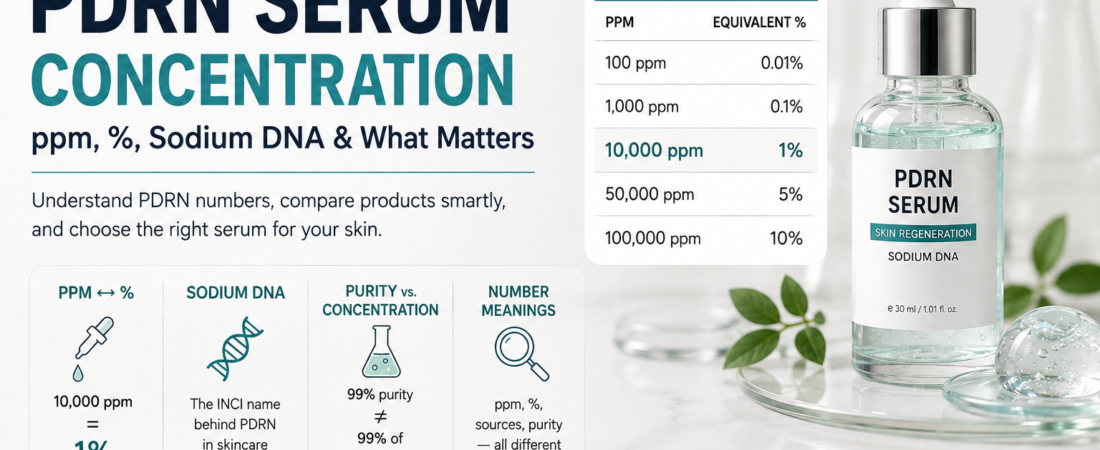
PDRN Serum Concentration: Quick Conversion Table
Mathematically, ppm and percent can be converted when they describe the same substance on the same measurement basis.
| PPM | Equivalent % |
|---|---|
| 1 ppm | 0.0001% |
| 10 ppm | 0.001% |
| 50 ppm | 0.005% |
| 100 ppm | 0.01% |
| 500 ppm | 0.05% |
| 1,000 ppm | 0.1% |
| 2,000 ppm | 0.2% |
| 5,000 ppm | 0.5% |
| 10,000 ppm | 1% |
| 50,000 ppm | 5% |
| 100,000 ppm | 10% |
So mathematically:
10,000 ppm = 1%
and:
100,000 ppm = 10%.
But this conversion is useful only if the manufacturer is talking about the same actual ingredient.
That qualification changes everything.
1. What Does ppm Mean in PDRN Skincare?
PPM means:
parts per million.
It is simply another way of expressing concentration.
For example:
100 ppm = 100 parts of a substance per 1,000,000 parts of the mixture.
In cosmetic marketing, ppm is attractive because numbers such as:
2,000 ppm
or
100,000 ppm
look much larger than:
0.2%
or
10%.
The mathematics is straightforward.
The marketing interpretation often is not.
A headline stating:
100,000 ppm PDRN
could potentially describe pure PDRN in the finished product.
But it could also describe 100,000 ppm of a proprietary raw-material complex that itself contains PDRN.
Unless the brand clearly explains the measurement basis, those two statements are not equivalent.
2. 100,000 ppm Does Not Automatically Mean 10% Pure PDRN
VT provides a useful real-world example of why PDRN numbers need context.
Its current PDRN Essence 100 official page promotes:
Vegan 100,000 PPM PDRN
and identifies its technology as PHYTO PDRN® sourced from Korean ginseng.
Mathematically, 100,000 ppm equals 10%.
However, the same official ingredient list includes Panax Ginseng Root Extract near the beginning of the formula and Sodium DNA at the end.
That does not prove the marketing claim is wrong.
Instead, it illustrates an important limitation:
From the public product page alone, consumers cannot determine whether the 100,000 ppm refers to pure Sodium DNA, a PHYTO PDRN® raw-material mixture, the ginseng-derived complex as a whole, or another internally defined basis.
In other words:
100,000 ppm of a PDRN-containing complex is not necessarily the same as 100,000 ppm of purified Sodium DNA.
When a brand uses a proprietary ingredient name, the most important question becomes:
What percentage of that complex is the actual DNA material?
Without that breakdown, comparing headline ppm numbers across brands can be misleading.
3. “99% Pure PDRN” Is Not the Same as “99% PDRN Serum”
This distinction is even more important.
Medicube’s current PDRN Pink One Day Serum describes itself as containing high-purity Salmon PDRN 99%. The official page separately notes that information about PDRN characteristics pertains to the raw material.
Consumers should therefore avoid interpreting:
99% purity
as:
99% of this serum bottle is PDRN.
Those are completely different concepts.
Concentration
Concentration asks:
How much of this ingredient is in the finished formula?
Purity
Purity asks:
Of the material identified as PDRN, how much of that raw material is actually the intended substance rather than impurities or other components?
A cosmetic could theoretically use:
a small amount of a 99%-pure raw material
or:
a large amount of a lower-purity complex.
Both could display very impressive numbers for entirely different reasons.
This is why purity and concentration should never be compared as if they were the same metric.
4. “5 PDRN” Does Not Mean 5% PDRN
COSRX provides another excellent example.
Its current product is called:
COSRX 5 PDRN Collagen Intense Vitalizing Serum.
A shopper could easily assume:
5 PDRN = 5% PDRN.
But that is not what COSRX means.
The official product page explains that 5 PDRN refers to five PDRN sources:
salmon, Centella asiatica, rice, Lactobacillus and sea grapes.
The ingredient list contains both Sodium DNA and Hydrolyzed DNA, but the official page does not state that the finished serum contains 5% PDRN.
This gives us another important rule:
Never assume a number next to “PDRN” is a concentration unless the brand actually identifies the unit as %, ppm or another concentration measurement.
A number can describe:
number of sources
rather than:
amount of ingredient.
5. What Does Sodium DNA Mean on the Ingredient List?
This is one of the most searched questions in modern PDRN skincare.
A consumer may see:
PDRN Serum
on the front of a product.
Then turn the bottle around and find:
Sodium DNA
instead of:
PDRN.
The European Commission’s CosIng database identifies Sodium DNA/RNA as the sodium salt of DNA and RNA.
At the same time, scientific literature defines PDRN more specifically as mixtures of DNA fragments with particular molecular characteristics rather than simply using “DNA” as a generic term. Traditional medically studied PDRN has historically been derived through controlled purification of salmonid DNA, and recent research continues to distinguish PDRN from related polynucleotide materials based partly on molecular size and biological behavior.
That means the INCI term Sodium DNA alone does not tell consumers everything they may want to know about a PDRN-marketed raw material.
It does not automatically disclose:
- Molecular-weight distribution
- DNA fragment length
- Biological source
- Purification process
- Raw-material concentration
- Finished-product concentration
This is why more transparent PDRN products increasingly disclose additional information beyond the INCI name.
6. Can You Estimate PDRN Concentration From the Ingredient List?
Sometimes you can make broad observations.
But you usually cannot calculate an exact percentage.
Under U.S. FDA cosmetic labeling rules, ingredients are generally listed in descending order of predominance. However, ingredients present at 1% or less may be listed in any order after ingredients present above 1%.
That creates an important limitation.
If Sodium DNA appears near the bottom of an ingredient list, you cannot conclude:
It must contain exactly 0.01%.
Nor can you reliably distinguish:
0.9%
from
0.09%
from
0.009%.
Once ingredients fall within the ≤1% group, position alone no longer gives a reliable concentration ranking under the U.S. labeling framework.
Therefore:
ingredient position is a clue, not a concentration certificate.
7. Why 100 ppm Can Still Be a Real Product Claim
Not every PDRN formula competes by using the largest possible number.
Anua currently sells products with explicitly disclosed PDRN figures at very different levels.
Its PDRN 100 Hyaluronic Acid Glow Pad is marketed with 100 ppm PDRN, while its PDRN Collagen Glow Facial Serum Spray is marketed with 2,000 ppm PDRN.
Converted mathematically:
100 ppm = 0.01%
2,000 ppm = 0.2%.
Does that automatically make the 2,000 ppm product twenty times “better”?
No.
They are different product formats with different intended roles and formulas.
A toner pad may use the ingredient differently from a leave-on serum mist.
This is why PDRN serum concentration should be interpreted within the full formulation, not in isolation.
Does Higher PDRN Concentration Mean Better Results?
There is currently no universally established concentration threshold that proves:
X ppm is the ideal topical PDRN concentration for every cosmetic product.
Much of the historical PDRN evidence comes from regenerative medicine rather than ordinary over-the-counter topical cosmetics. Scientific reviews describe PDRN’s regenerative and anti-inflammatory mechanisms, while newer research is beginning to examine topical and plant-derived PDRN materials.
For example, a 2025 study of low-molecular-weight peony-derived PDRN reported improvements in barrier recovery and elasticity in small human evaluations, showing that topical PDRN research is advancing. But this does not establish a universal ppm rule that can be applied to every commercial serum.
So there is currently no scientifically defensible formula such as:
10,000 ppm = good
50,000 ppm = better
100,000 ppm = best
The formulation matters too much.
What Matters More Than the Biggest PPM Number?
When comparing PDRN products, Beauty Seller Lab would rank the following information above a giant unexplained front-label number.
| Question | Why It Matters |
|---|---|
| What does the number measure? | Pure active, raw-material complex, source count or purity can all be different |
| Is it ppm, %, or purity? | These are different metrics |
| What is the PDRN source? | Salmon, plant and microbial materials are increasingly entering the category |
| What appears in the ingredient list? | Sodium DNA, Hydrolyzed DNA and supporting extracts can provide context |
| Is molecular information provided? | PDRN is defined partly by DNA-fragment characteristics |
| Is there finished-product testing? | Raw-material research is not automatically proof of final serum performance |
| What is the total formulation? | Peptides, niacinamide, ceramides, collagen and delivery systems may significantly affect the product experience |
This is also why our earlier comparison of salmon PDRN vs vegan PDRN matters: PDRN source is becoming another major point of differentiation rather than concentration alone.
The Four Numbers Consumers Should Never Confuse
The modern PDRN category now uses at least four very different types of numbers.
| Label Example | What It May Mean |
|---|---|
10,000 ppm PDRN | Concentration claim, if clearly defined |
1% PDRN | Percentage concentration claim, if clearly defined |
99% pure PDRN | Purity of PDRN raw material |
5 PDRN | May describe five types/sources, as with COSRX |
And there is a fifth category appearing in treatment-inspired skincare:
delivery-system intensity numbers.
Medicube and spicule-style products may use large numbers to describe shot or delivery concepts rather than the actual PDRN percentage. That is another reason consumers should always identify the unit before comparing numbers.
A Better Way to Read a PDRN Product Page
Imagine two products.
Product A
100,000 ppm PHYTO PDRN Complex
Product B
1% Sodium DNA
At first glance:
100,000 ppm = 10%.
So Product A looks ten times stronger.
But suppose Product A’s 100,000 ppm refers to a complex that contains multiple ingredients and only a small fraction of the complex is Sodium DNA.
Then the comparison changes completely.
Unless the brands disclose:
the concentration of the complex
and
the active fraction inside the complex,
you cannot make a true apples-to-apples comparison.
That is exactly why ingredient transparency may become the next competitive phase of PDRN skincare.
What PDRN Brands Should Disclose in 2027
The PDRN market is becoming mature enough that:
Contains PDRN
will eventually stop being sufficient differentiation.
A stronger product page would clearly identify:
| Disclosure | Example |
|---|---|
| PDRN source | Salmon / ginseng / peony / microbial |
| Finished-product concentration | 1,000 ppm in finished formula |
| Measurement basis | Pure Sodium DNA vs proprietary complex |
| Raw-material purity | 99% purity of PDRN raw material |
| Molecular information | Molecular-weight range if relevant |
| Supporting actives | Peptides, ceramide, niacinamide, collagen |
| Product-specific testing | Hydration, barrier, elasticity, etc. |
From a seller’s perspective, this is important.
The market will become harder to differentiate once every brand uses:
PDRN
100
1000
10K
and
99%.
Clear measurement language could eventually be more valuable than the largest number.
Current PDRN Products Show How Complicated the Market Has Become
Here are four current examples checked in August 2026.
| Product | Headline Number | What It Actually Communicates |
|---|---|---|
| VT PDRN Essence 100 | 100,000 ppm | VT’s vegan PHYTO PDRN® positioning from Korean ginseng |
| Anua PDRN Glow Pad | 100 ppm | Explicit PDRN ppm disclosure |
| Anua PDRN Serum Spray | 2,000 ppm | Explicit PDRN ppm disclosure |
| COSRX 5 PDRN Serum | 5 PDRN | Five PDRN sources, not stated as 5% |
| Medicube PDRN One Day Serum | 99% purity | High-purity Salmon PDRN raw-material positioning |
VT currently states 100,000 ppm for its ginseng-derived PDRN essence; Anua publishes 100 ppm and 2,000 ppm claims for different PDRN products; COSRX defines its “5 PDRN” as five PDRN sources; and Medicube uses a 99% high-purity Salmon PDRN claim for its One Day Serum.
The numbers look comparable.
They are not.
What This Means for Beauty Sellers
PDRN concentration is becoming a marketing battleground.
But chasing the largest number creates a problem.
If consumers begin learning the difference between:
ppm
purity
proprietary complex concentration
and
actual Sodium DNA content,
ambiguous claims may become less persuasive.
For new products, a more credible approach would be:
1,000 ppm PDRN raw material in finished formula — standardized to X% Sodium DNA
rather than simply:
1,000,000 PDRN POWER
The first is harder to market in one giant number.
But it is much easier to understand.
And transparency becomes increasingly important as the PDRN category expands into salmon, plant and microbial sources. Research published in 2025 has already demonstrated emerging microbial-derived PDRN and plant-derived materials, showing that “PDRN” itself is becoming a broader technology category.
Should You Buy the Highest-PDRN Serum?
Not necessarily.
A useful buying decision should combine:
- clear concentration disclosure
- source transparency
- credible formulation
- supporting ingredients
- finished-product evidence
rather than relying on the largest ppm number.
For people comparing currently available formulas, our Best PDRN Serums for 2027 guide looks at products based on formulation, positioning, price and available brand data rather than PDRN number alone.
The Bottom Line
The biggest mistake when comparing PDRN serum concentration is assuming every number on the package measures the same thing.
It does not.
100,000 ppm
may describe a proprietary PDRN-containing complex.
99%
may describe raw-material purity.
5 PDRN
may describe five ingredient sources.
And Sodium DNA on an ingredient list tells you that a DNA-derived cosmetic ingredient is present, but by itself does not reveal the finished-product concentration, molecular-weight distribution or complete raw-material specification.
The simple ppm-to-percent math still matters:
10,000 ppm = 1%.
But the more important question is:
1% of what?
Going into 2027, the PDRN products that communicate that answer most clearly may have the strongest credibility.
For consumers, that means looking beyond the biggest number.
For beauty sellers, it means that ingredient transparency may become a stronger competitive advantage than concentration marketing alone.
FAQ
What does 10,000 ppm PDRN mean?
If the claim refers to pure PDRN on the same measurement basis, 10,000 ppm mathematically equals 1%. However, consumers should verify whether the ppm figure refers to pure PDRN or to a PDRN-containing proprietary complex.
Is 100,000 ppm PDRN equal to 10%?
Mathematically, yes: 100,000 ppm = 10%. But a commercial claim of “100,000 ppm PDRN complex” does not necessarily mean that 10% of the finished bottle is pure Sodium DNA. VT’s current PDRN Essence 100, for example, markets 100,000 ppm PHYTO PDRN® while separately listing Panax Ginseng Root Extract and Sodium DNA in its ingredients.
Is 99% pure PDRN stronger than 10,000 ppm PDRN?
You cannot compare those numbers directly. 99% purity describes the purity of a raw material, while 10,000 ppm can describe the amount of an ingredient or mixture in the finished formula. Medicube currently uses a 99%-purity positioning for its Salmon PDRN One Day Serum.
Is Sodium DNA the same as PDRN?
Sodium DNA is an ingredient name referring to the sodium salt of DNA, while scientific PDRN is characterized more specifically as fragmented DNA material with defined molecular characteristics. Therefore, the label term Sodium DNA alone does not provide the complete specification of a PDRN raw material.
Does ingredient order tell me how much PDRN is in a serum?
Not exactly. FDA rules generally require descending concentration order, but ingredients at 1% or less may be listed in any order after those present above 1%. This means exact concentration cannot reliably be determined from ingredient position alone.
Does higher PDRN concentration always work better?
There is no universal topical concentration threshold proving that a higher ppm automatically produces better cosmetic results. PDRN formulations differ by source, molecular characteristics, delivery, supporting ingredients and product-specific testing.
What does COSRX “5 PDRN” mean?
COSRX states that its current 5 PDRN serum combines five PDRN sources: salmon, Centella asiatica, rice, Lactobacillus and sea grapes. It should not be interpreted as a 5% PDRN concentration claim.