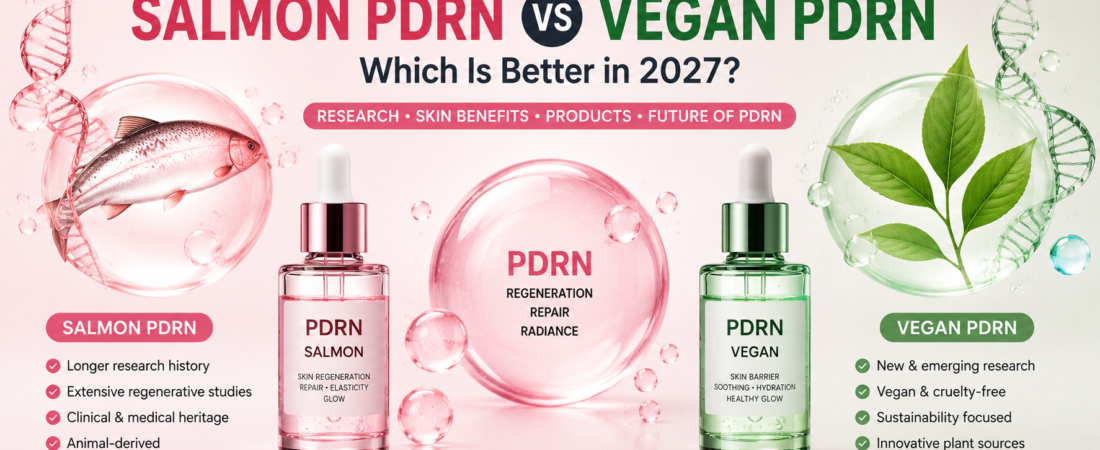
For years, PDRN had one dominant origin story:
salmon DNA.
Traditional PDRN used in medical and regenerative research has commonly been purified from salmonid DNA, including salmon and trout sources. Scientific reviews describe PDRN as mixtures of DNA fragments investigated for tissue repair, inflammation regulation and wound healing.
But the skincare market is changing.
Korean beauty brands are now introducing plant-derived, vegan and alternative PDRN concepts, including rose PDRN, green tea PDRN and other botanical sources. Medicube currently gives shoppers a choice between Salmon DNA PDRN and Rose PDRN (Vegan), while Innisfree markets Green Tea PDRN™ as a vegan alternative to salmon-derived PDRN.
That raises an increasingly important question:
When comparing salmon PDRN vs vegan PDRN, which one is actually better?
The short answer is:
Salmon-derived PDRN currently has the deeper historical research base.
Plant-derived PDRN has newer but increasingly interesting research and a powerful sustainability and vegan-positioning advantage.
But the full answer depends on what kind of product you are buying.
For a broader introduction to the ingredient, read our PDRN Skincare in 2027 Guide.
Salmon PDRN vs Vegan PDRN: Quick Comparison
| Factor | Salmon PDRN | Vegan / Plant-Derived PDRN |
|---|---|---|
| Traditional PDRN source | Salmonid DNA | Plant or other non-animal sources |
| Research history | More established | Newer |
| Regenerative research | Extensive | Emerging |
| Cosmetic positioning | Clinical / regenerative | Vegan / innovation / sustainability |
| Consumer novelty | High | Very high |
| Animal-derived | Yes | No, when genuinely plant-derived |
| Source transparency | Increasingly important | Extremely important |
| Product availability | Broad | Rapidly growing |
| 2027 market potential | Strong | Very strong growth potential |
| Main limitation | Animal origin | Less mature evidence base |
The biggest difference between salmon PDRN vs vegan PDRN is not simply performance.
It is evidence maturity versus innovation.
What Is Salmon-Derived PDRN?
Traditional PDRN is produced from purified DNA fragments.
A major pharmacological review describes medical PDRN as being derived through purification and sterilization of DNA originating from Oncorhynchus mykiss or Oncorhynchus keta — trout and salmon species.
Research on PDRN has explored mechanisms involving the adenosine A2A receptor and nucleotide salvage pathways, with applications investigated in wound healing and regenerative medicine.
This history explains why salmon PDRN became commercially powerful in skincare.
It already had a scientific story before becoming a cosmetic trend.
Consumers were not simply being introduced to another moisturizing botanical extract.
They were being introduced to an ingredient associated with:
regenerative medicine
tissue repair
skin recovery
Korean aesthetic treatments
That gave salmon PDRN a level of clinical-inspired positioning that many traditional cosmetic ingredients do not have.
What Is Vegan PDRN?
This is where things become more complicated.
The term “vegan PDRN” is increasingly used commercially for PDRN or PDRN-inspired materials obtained without salmon-derived DNA.
Current products use different source and manufacturing concepts.
Medicube markets a Rose PDRN (Vegan) option alongside its Salmon DNA PDRN serum.
Innisfree markets Green Tea PDRN™, sourced from Jeju green tea and produced through a fermentation-based process, as a vegan alternative to salmon-derived PDRN.
IOPE markets plant-based Bio-PDRN™, including a serum formulated with 38% of the proprietary ingredient.
So “vegan PDRN” should not automatically be treated as one standardized ingredient.
Different brands may use different:
- botanical sources
- extraction methods
- fermentation technologies
- molecular characteristics
- concentrations
- proprietary names
That makes source transparency especially important.
Does Plant-Derived PDRN Actually Have Scientific Evidence?
Yes — but the evidence base is newer.
One of the most important studies in this area examined PDRN isolated from Panax ginseng.
Researchers reported that purified Panax-derived PDRN promoted keratinocyte and fibroblast activity and improved experimental markers related to skin regeneration and barrier function. The authors concluded that plant-derived Panax PDRN showed physiological activity similar to salmon-derived PDRN in their experimental models.
That is significant.
It suggests that the biological activity associated with PDRN may not necessarily depend entirely on salmon as the source.
More recently, research on low-molecular-weight peony-derived PDRN reported improvements in barrier recovery in a small topical human study and improvements in periorbital elasticity after several weeks of use.
Research has also examined rose-derived PDRN in experimental models related to oxidative stress and skin longevity.
Together, these studies make plant-derived PDRN scientifically more interesting than simply calling it a marketing substitute.
But there is an important limitation:
the evidence is still much smaller and newer than the historical body of research surrounding traditional salmon-derived PDRN.
Round 1: Which Has More Scientific History?
Winner: Salmon PDRN
From a research perspective, the salmon PDRN vs vegan PDRN comparison currently favors salmon-derived PDRN because of its longer scientific history.
If the question is purely:
Which form has been studied for longer?
salmon-derived PDRN wins.
Much of the established pharmacological literature on PDRN involves material produced from salmonid DNA and investigates regenerative, anti-inflammatory and tissue-repair applications.
Plant-derived PDRN research is much newer.
The Panax ginseng study was published in 2023, while several other alternative-source studies appeared in 2025 and 2026.
So from an evidence-history perspective:
Salmon PDRN = established foundation
Plant PDRN = developing foundation
That does not automatically mean salmon products work better topically.
It simply means more historical research exists.
Round 2: Which Has the Stronger Vegan and Sustainability Story?
Winner: Vegan PDRN
This one is straightforward.
Salmon-derived PDRN originates from animal material.
Plant-derived PDRN can offer brands a way to participate in the PDRN category without relying on salmon DNA.
Innisfree explicitly positions its Green Tea PDRN™ as a vegan alternative sourced from Jeju Island green tea.
Medicube offers Rose PDRN (Vegan) as an alternative selection to Salmon DNA PDRN in the same serum.
This creates a powerful commercial message:
PDRN benefits without the salmon-derived ingredient story.
For consumers who prioritize animal-free cosmetics, that difference may become a deciding factor.
Round 3: Which Has the Better Marketing Story?
Result: Tie — but for Different Reasons
Salmon PDRN has an unusually memorable origin story.
Salmon DNA skincare immediately creates curiosity.
It connects skincare to Korean aesthetic medicine and regenerative treatments.
That makes it highly clickable.
But plant PDRN can be equally marketable for different reasons:
Green Tea PDRN
Rose PDRN
Vegan PDRN
Plant Bio-PDRN
These names are less shocking, but they combine several consumer trends at once:
K-beauty + biotechnology + vegan beauty + botanical ingredients.
Medicube’s product strategy demonstrates this perfectly because consumers can literally select between Salmon DNA PDRN and Rose PDRN (Vegan) within the same PDRN Pink Peptide Serum.
The brand is effectively allowing two different consumers to enter the same product category through different stories.
Round 4: Which Is Better for Sensitive Consumers?
No Clear Winner
Source alone is not enough to answer this question.
A skincare product is not just PDRN.
It also contains:
- preservatives
- humectants
- peptides
- niacinamide
- retinoids
- fragrance
- botanical extracts
- emulsifiers
- delivery systems
For example, Innisfree’s Green Tea PDRN Firming Serum combines Green Tea PDRN™ with a 1% Triple Retinol Complex, low-molecular-weight hyaluronic acid and green tea peptides.
That means someone sensitive to retinoids cannot assume the product is automatically gentler simply because the PDRN itself is plant-derived.
Similarly, a salmon-derived PDRN product should be judged on the full formulation rather than its PDRN source alone.
The correct question is:
Is the complete formula suitable for my skin?
not simply:
Is the PDRN vegan?
Round 5: Which Has More Product Innovation Potential?
Winner: Vegan / Alternative PDRN
This is where the market becomes especially interesting.
Traditional salmon PDRN has a relatively fixed source story.
Alternative PDRN can potentially come from multiple biological sources.
Research and commercial development already include:
- Panax ginseng-derived PDRN
- peony-derived PDRN
- rose-derived PDRN
- green-tea-based proprietary PDRN concepts
- microbial-derived PDRN
A 2025 study even reported microbial-derived PDRN, showing that alternative production technologies may eventually expand the category beyond both fish and plants.
This matters for the future of skincare.
PDRN may eventually stop being defined by one source.
Instead, brands may compete over:
source
molecular weight
purification
delivery system
concentration
fermentation technology
clinical evidence
This would make PDRN much more like peptides or hyaluronic acid — a broad technology category rather than one ingredient story.
Real Product Example 1: Medicube Salmon PDRN vs Rose PDRN
Medicube offers one of the clearest real-world comparisons.
Its PDRN Pink Peptide Serum currently allows consumers to select:
Salmon DNA PDRN
or
Rose PDRN (Vegan)
within the same product line. The serum is listed at $26 on the brand’s U.S. store and is positioned around peptides, niacinamide, hydration, firm-looking skin and glass glow.
This is commercially important.
The consumer does not have to choose between two completely different brands.
They choose the PDRN source.
That suggests PDRN source itself is becoming a product attribute similar to:
mineral vs chemical sunscreen
or
retinol vs retinal
The ingredient’s origin is becoming part of purchase decision-making.
Real Product Example 2: Innisfree Green Tea PDRN™
Innisfree has taken a more proprietary approach.
Its Retinol Green Tea PDRN™ Firming Serum contains 56% Green Tea PDRN™, according to the brand, alongside a Triple Retinol Complex and low-molecular-weight hyaluronic acid.
Innisfree explicitly describes Green Tea PDRN™ as a vegan alternative to salmon-derived PDRN sourced from Jeju green tea.
The company also states that its Green Tea PDRN™ showed comparable or better moisture-barrier results than salmon-derived PDRN in ingredient-specific in-vitro testing. That claim should be interpreted as brand-reported ingredient testing, not independent evidence that all plant-derived PDRN outperforms salmon PDRN.
That distinction is important.
One proprietary ingredient test cannot establish superiority across the entire category.
Real Product Example 3: IOPE Plant Bio-PDRN™
IOPE provides another example of plant-derived PDRN moving into premium skincare.
Its Expert PDRN Caffeine Shot Serum contains 38% plant-based Bio-PDRN™ and 20,000 ppm caffeine, according to the official product page.
The formula is positioned around firmness, vitality and more refined-looking skin texture.
This demonstrates another likely future direction:
Plant PDRN + familiar active ingredient
Instead of selling Bio-PDRN alone, IOPE combines it with caffeine.
The PDRN provides technological novelty.
The caffeine gives consumers another recognizable benefit story.
Salmon PDRN vs Vegan PDRN: Which Should Consumers Choose?
The decision can be simplified.
Choose Salmon PDRN if:
You prefer the source with the longer research history.
You are specifically interested in traditional Korean regenerative PDRN positioning.
Animal-derived ingredients are not a concern for you.
You prefer products that closely follow the original PDRN story.
Choose Vegan or Plant PDRN if:
You want to avoid animal-derived PDRN.
You prefer vegan-positioned skincare.
You are interested in newer biotechnology and botanical-source innovation.
You value source transparency and alternative manufacturing technologies.
Neither choice is automatically superior.
The full formulation still matters more than the source name alone.
The Biggest Mistake: Assuming All “Vegan PDRN” Is the Same
This may become increasingly important in 2027.
Consumers will likely encounter products labeled:
Rose PDRN
Green Tea PDRN
Phyto PDRN
Bio-PDRN
Vegan PDRN
These names should not automatically be considered chemically or biologically identical.
Research on Panax-derived PDRN cannot automatically validate a commercial rose-derived product.
Likewise, evidence for one proprietary Green Tea PDRN™ material cannot automatically be applied to every plant-derived DNA ingredient.
The better questions are:
What is the source?
How is the material produced?
What concentration is used?
Has the ingredient been characterized?
Is there ingredient-specific testing?
Is the evidence in vitro, animal, topical human or injectable clinical research?
Those distinctions will become increasingly valuable as consumers become more sophisticated.
What This Means for Beauty Sellers
For sellers, the salmon PDRN vs vegan PDRN divide creates opportunity.
The early stage of the PDRN trend focused on one message:
Contains PDRN.
The next stage is already more complex:
What kind of PDRN?
That creates multiple product niches.
Traditional PDRN positioning
Salmon PDRN + peptides
Vegan positioning
Plant PDRN + barrier care
Slow-aging positioning
Plant PDRN + retinol
Firming positioning
Bio-PDRN + caffeine
Premium biotechnology positioning
Proprietary PDRN + delivery technology
This makes PDRN source an additional differentiation tool.
For a new product entering the market, simply using PDRN may no longer be enough.
A stronger concept may be:
source + concentration + complementary active + consumer problem
For example:
3% Plant PDRN + Ceramide Barrier Serum
is a more complete story than:
PDRN Serum.
Could Vegan PDRN Eventually Replace Salmon PDRN?
Possibly — but replacement is not the most likely near-term scenario.
A more likely outcome is segmentation.
Salmon PDRN may remain attractive to consumers who want:
traditional PDRN
clinical heritage
regenerative positioning
Plant-derived PDRN may appeal more strongly to consumers looking for:
vegan cosmetics
biotechnology
sustainability
new botanical sources
The two categories can coexist.
Medicube’s strategy of selling both Salmon DNA PDRN and Rose PDRN (Vegan) already illustrates this possibility.
Instead of one replacing the other, consumers may simply begin selecting PDRN based on source preference.
What Could Come After Plant PDRN?
Plant-derived PDRN may not be the final stage.
Alternative production technologies are already being investigated.
A 2025 study described PDRN derived from Lactobacillus rhamnosus, comparing its biological properties with traditional salmon-derived PDRN in laboratory assays.
This opens a larger possibility:
fermentation-derived or microbial PDRN.
If these technologies become commercially scalable, future consumers may see:
salmon PDRN
plant PDRN
microbial PDRN
all competing within the same skincare category.
That would fundamentally change how PDRN products are marketed.
So Which Is Better in 2027?
There is no universal winner.
For research history:
Salmon PDRN wins.
For vegan positioning:
Plant PDRN wins.
For current innovation:
Plant and alternative PDRN have the advantage.
For proven superiority in topical cosmetics:
There is not enough evidence to declare one universal winner.
The most scientifically responsible conclusion is that source matters, but formulation, molecular characteristics, concentration, delivery and product-specific evidence matter too.
The Bottom Line
The salmon PDRN vs vegan PDRN debate is likely to become more important as alternative PDRN sources enter mainstream skincare.
The salmon PDRN vs vegan PDRN debate represents something bigger than a choice between fish and plants.
It shows that PDRN is evolving from a single trendy ingredient into a broader skincare technology category.
Salmon-derived PDRN has the advantage of history.
It is closely connected with the medical and regenerative research that originally made PDRN famous.
Plant-derived PDRN has a different advantage.
It opens PDRN to vegan positioning, new botanical sources, proprietary technologies and potentially new manufacturing methods. Research on Panax, peony and rose-derived materials suggests that this area deserves serious attention rather than being dismissed as marketing alone.
Going into 2027, the question may therefore change from:
Does this product contain PDRN?
to:
Where does the PDRN come from, how is it made, and why is this version different?
That is exactly the kind of question that creates the next stage of a skincare category.
FAQ
Is salmon PDRN better than vegan PDRN?
Salmon-derived PDRN has a longer research history, but current evidence does not prove that every salmon-derived topical cosmetic is superior to every plant-derived product. Product formulation and evidence should be evaluated individually.
Is vegan PDRN real PDRN?
Plant-derived PDRN materials have been isolated and investigated scientifically, including PDRN derived from Panax ginseng and peony. However, commercial terms such as Green Tea PDRN™, Rose PDRN and Bio-PDRN may refer to different proprietary materials and should not automatically be treated as identical.
What plants can PDRN come from?
Published research has investigated PDRN or related polynucleotide materials from sources including Panax ginseng, peony and rose. Commercial skincare brands are also using proprietary green-tea and rose-based concepts.
Is Medicube PDRN vegan?
Medicube currently sells its PDRN Pink Peptide Serum in two selectable variants: Salmon DNA PDRN and Rose PDRN (Vegan). Consumers need to choose the vegan version specifically if that is their preference.
Is Innisfree Green Tea PDRN vegan?
Innisfree describes its Green Tea PDRN™ formulas as vegan alternatives to salmon-derived PDRN and says its material is based on Jeju green tea.
Will vegan PDRN become more popular in 2027?
It is plausible based on current product launches and research activity, but future popularity cannot be guaranteed. The expansion of Medicube, Innisfree and IOPE into alternative PDRN sources indicates that brands are actively investing in this category.
Can salmon and vegan PDRN produce exactly the same results?
That cannot currently be assumed. Different sources, molecular characteristics, concentrations and formulations may produce different results. Research on specific plant-derived PDRN materials is promising, but it should not automatically be generalized to all vegan PDRN cosmetics.