K-beauty has become increasingly interested in one question:
How can skincare ingredients get past the skin barrier more effectively?
That question has helped drive interest in PDRN, exosomes, delivery systems and now another unusual technology:
spicule skincare.
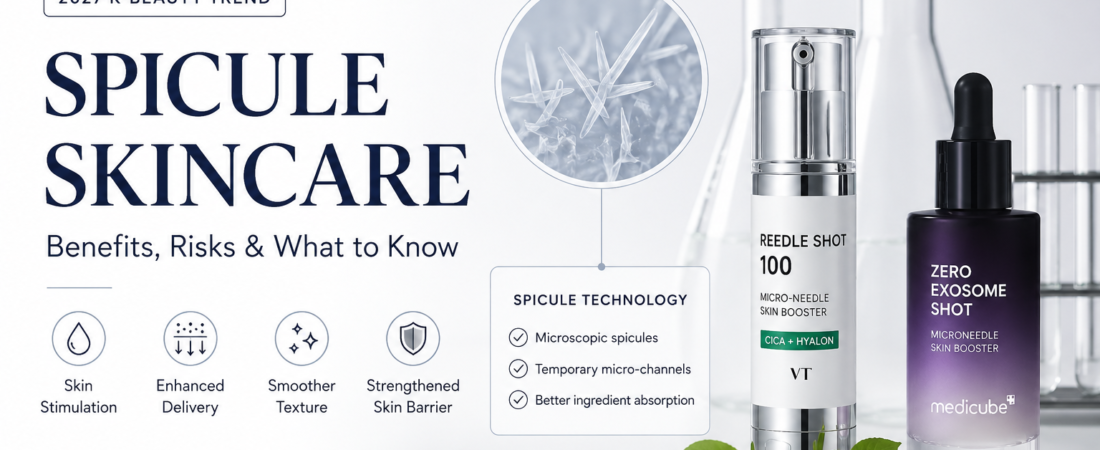
Sometimes marketed as “reedles,” “micro-needles” or even “liquid microneedling,” spicules are microscopic needle-like structures that can create temporary pathways in the outer layers of skin.
That sounds similar to microneedling.
But the two are not the same thing.
Scientific studies have investigated sponge-derived spicules as a way to improve skin delivery of large molecules, including hyaluronic acid, peptides and other biomaterials.
At the same time, products from Korean brands such as VT Cosmetics and Medicube are turning the technology into an increasingly mainstream at-home skincare category. VT alone currently offers a broad Reedle Shot collection spanning different strengths and combinations with ingredients such as PDRN, retinoids, collagen and hyaluronic acid.
So what exactly is spicule skincare, what can it realistically do, and why could it become an even bigger K-beauty category in 2027?
Spicule Skincare: Quick Overview
| Factor | Spicule Skincare |
|---|---|
| Basic technology | Microscopic needle-like structures |
| Common cosmetic source | Sponge-derived mineral spicules |
| Main purpose | Temporary skin-barrier disruption / enhanced delivery |
| Typical sensation | Tingling or prickling |
| Common formats | Serums, boosters, ampoules, masks |
| Popular K-beauty positioning | Pores, texture, glow, ingredient delivery |
| Same as professional microneedling? | No |
| Major advantage | At-home treatment-inspired experience |
| Major limitation | Irritation and lack of uniform product standards |
| 2027 potential | High |
The most useful way to understand the category is:
Spicules are primarily a delivery and skin-stimulation technology — not one single active ingredient.
What Are Spicules in Skincare?
Spicules in skincare are microscopic needle-like structures, often derived from marine sponges, that are used in some topical formulas to create a distinctive physical sensation and interact with the outer skin barrier. They are mainly discussed as a cosmetic delivery technology rather than as a skincare ingredient with one single biological effect.
In research on skincare delivery, marine sponge-derived spicules have been studied as natural microstructures capable of penetrating the stratum corneum, the outermost barrier layer of skin. One widely cited study using Haliclona sponge spicules described rod-shaped siliceous structures around 120 micrometers long and approximately 7 micrometers in diameter.
Applied through massage, these structures can physically create microscopic pathways in the skin.
That is what makes them interesting for cosmetic delivery.
The skin barrier normally does an excellent job of preventing large molecules from penetrating deeply.
Unfortunately for skincare formulators, that means many interesting cosmetic ingredients also struggle to cross it efficiently.
Spicules provide one possible way around that limitation.
For product examples, see our guide to the Best Spicule Skincare Products for 2027
How Does Spicule Skincare Work?
The basic mechanism is mechanical.
Instead of chemically dissolving part of the skin barrier like an exfoliating acid, microscopic spicules can physically disrupt the outer layer and create temporary microchannels.
Research using sponge spicules has demonstrated increased delivery of hydrophilic macromolecules through the skin.
A 2019 study combining sponge spicules with flexible liposomes reported increased penetration and deposition of hyaluronic acid, with large numbers of temporary microchannels created in the skin model.
Other studies have explored sponge-spicule systems for delivering peptides, proteins, siRNA and regenerative materials.
This gives spicule products two commercial stories:
skin stimulation
and
enhanced ingredient delivery.
The second may ultimately be the more important one.
Why Does Spicule Skincare Tingle?
That prickling sensation is not accidental.
The microscopic structures are physically interacting with the outer skin.
VT Cosmetics describes its Reedle products as microneedle-style skin boosters, while its ingredient technology includes Cica Reedle™, which the brand identifies with silica and Centella asiatica extract.
Medicube similarly uses hydrolyzed sponge spicules in its Zero Exosome Shot, where the spicule technology is combined with Lactobacillus extracellular-vesicle positioning, exfoliating acids, niacinamide and panthenol.
A stronger tingling sensation should not automatically be interpreted as evidence that a product is “working better.”
Different products use different concentrations, materials and formulations.
Comfort and barrier tolerance matter too.
Spicule Skincare vs Microneedling
This distinction is extremely important.
Professional microneedling uses controlled needles to mechanically penetrate skin at specified depths.
It is used in dermatology and aesthetic medicine for indications including scars and skin rejuvenation, and professional devices can reach substantially deeper tissue than typical topical cosmetic spicules.
Spicule skincare is different.
It uses microscopic particles applied topically, usually through rubbing or massage.
Dermatologists discussing the trend in 2026 emphasized that topical spicules act much more superficially and should not be considered a replacement for professional microneedling, particularly for treating significant scarring or deeper age-related changes.
So the comparison is useful for explaining the concept.
But:
Spicule skincare ≠ professional microneedling.
“Liquid microneedling” is better understood as a marketing shorthand than a literal equivalence.
Potential Benefit 1: Improved Ingredient Delivery
This has some of the clearest mechanistic research behind it.
Sponge spicules have been investigated as skin-delivery systems for a range of materials that otherwise penetrate the stratum corneum poorly.
Research has demonstrated improved skin delivery of hydrophilic biomacromolecules, hyaluronic acid and therapeutic peptides using spicule-based systems.
This explains why many commercial formulas do not sell spicules alone.
Instead, the spicules are paired with another active ingredient.
The commercial formula increasingly looks like:
Spicule + Active Ingredient
rather than:
Spicule only.
Potential Benefit 2: Skin Texture
Texture is probably the easiest consumer benefit to connect with the technology.
VT currently positions Reedle Shot 100 around smoother and more refined-looking skin texture, while its broader product line offers different strengths for daily use, every-three-day application and more intensive weekly routines. These are brand positioning and usage recommendations rather than independent evidence that every consumer will experience the same results.
A 2025 study of a nano-encapsulated marine-spicule delivery system also reported improvements in several skin measurements after treatment, including pores, wrinkles and pigmentation. Importantly, this was a specific delivery system involving a mesenchymal-stem-cell secretome and should not be generalized to every spicule cosmetic.
That distinction matters.
Evidence for one sophisticated experimental formulation does not prove that every “reedle serum” produces identical effects.
Potential Benefit 3: A More Treatment-Like At-Home Experience
This is where K-beauty marketing becomes especially effective.
Consumers increasingly want skincare that feels more active than:
Apply moisturizer and wait.
Spicule products create an experience.
There is:
a visible technology
a physical sensation
different intensity levels
a treatment schedule
and
supporting active ingredients.
VT currently sells Mild Reedle Shot 50 for gentler use, Reedle Shot 100 as a daily booster, Reedle Shot 300 with an every-three-day positioning and Reedle Shot 700 as a more intensive treatment.
That creates a skincare system that feels closer to an at-home treatment protocol than a conventional serum.
Commercially, that is extremely powerful.
The VT Reedle Shot Effect
No discussion of modern spicule skincare is complete without VT Cosmetics.
Its current Reedle Shot category has expanded far beyond one hero product.
The official collection includes multiple intensity levels as well as specialized versions incorporating PDRN, collagen, retinoid positioning, hyaluronic acid, cica and vitamin-focused formulas.
Reedle Shot 100 is currently positioned as a daily booster, while Reedle Shot 300 is recommended by the brand every three days and Reedle Shot 700 is positioned as a more intensive weekly treatment.
This is an important market signal.
The category is evolving from:
one unusual spicule serum
into:
an entire platform of spicule-based skincare.
The Next Stage: Spicules + PDRN
One of the most predictable combinations is already happening.
VT currently markets a PDRN Reedle Shot 100, combining its Reedle platform with vegan PDRN positioning.
This follows the same pattern we have already seen across regenerative skincare:
PDRN alone becomes popular.
Then brands combine PDRN with peptides.
Then exosomes.
Then delivery technologies.
Spicules make sense as part of that progression because their commercial role is not necessarily to replace the active ingredient.
Their role can be to help create a stronger delivery story around it.
For more on the PDRN category, read our PDRN Skincare in 2027 Guide.
Spicules + Exosomes Are Already Here
Medicube provides another example.
Its Zero Exosome Shot combines exosome-coated hydrolyzed sponge spicules with Lactobacillus extracellular-vesicle positioning and other skincare actives.
Medicube’s PDRN Pink Collagen Exosome Shot also contains hydrolyzed sponge alongside PDRN- and exosome-related ingredients.
This suggests an increasingly clear direction:
active ingredient + biotechnology + delivery system.
Instead of competing as:
PDRN vs exosomes vs spicules,
future products may simply combine all three technologies into one regenerative-skincare concept.
For the broader comparison, see our PDRN vs Exosomes 2027 Guide.
The Biggest Risk: Irritation
The same mechanism that makes spicules interesting also creates their main disadvantage.
They physically interact with the skin barrier.
That means temporary tingling or prickling is common in this category, and overuse or aggressive combinations may increase irritation. Dermatologists discussing at-home spicule skincare recommend caution with sensitive or already-compromised skin and warn against treating the products as equivalent to professional procedures.
VT’s own instructions for Reedle Shot 100 say to avoid use on wounded areas and advise against using Reedle Shot 100 together with stronger Reedle Shot 300 or 700 products at the same time.
That gives consumers an important rule:
More intensity is not automatically better.
What Should You Avoid Combining With Spicule Skincare?
This depends on the specific product, but caution is sensible when layering multiple potentially irritating treatments.
Dermatologists and skincare experts discussing the category recommend beginning with lower-intensity spicule products and being cautious about simultaneously using strong exfoliating acids or retinoids, particularly while learning how the skin tolerates the technology.
That does not mean every acid or retinoid is universally incompatible with every spicule formula.
In fact, brands sell formulations that deliberately combine spicule technology with these actives.
VT, for example, sells a Reti-A Reedle Shot combining Reedle technology with retinoid positioning.
The important distinction is:
professionally formulated combination
versus
randomly stacking multiple strong products at home.
Who Should Be Careful?
Spicule skincare may not be appropriate for everyone.
People with very reactive skin, an impaired skin barrier, active irritation or recent skin procedures should be particularly cautious, and dermatologists quoted in recent coverage specifically flag conditions such as eczema or rosacea as reasons to avoid or seek professional guidance before using these products.
Any product causing severe burning, persistent redness, swelling or other concerning symptoms should be discontinued.
The goal is controlled cosmetic stimulation.
Not skin damage.
Are Stronger Reedle Numbers Better?
Not necessarily.
Numbers such as:
50
100
300
700
create an easy progression system for consumers, but they should not be interpreted as a universal scientific standard shared across the entire industry.
VT uses them within its own product system to distinguish gentler daily products from less-frequent, higher-intensity options.
Different brands may use different spicule materials, particle sizes, concentrations and formulations.
So comparing:
Brand A 300
with
Brand B 300
may be meaningless unless the brands explain what the number actually represents.
This transparency issue is likely to become more important as the category grows.
What Should Consumers Look For?
A useful spicule product should answer four questions:
What are the spicules made from?
How strong is the formula?
What active ingredient is being delivered?
How frequently is the product intended to be used?
The ingredient list may use terms such as Hydrolyzed Sponge, while some proprietary systems also describe silica-based spicule technologies. Medicube’s Zero Exosome Shot, for example, identifies Hydrolyzed Sponge, while VT identifies its Cica Reedle™ technology with silica and Centella asiatica extract.
The clearer the brand is about those details, the easier the product is to evaluate.
Why Spicule Skincare Could Grow in 2027
There are several reasons to watch this category.
First, K-beauty’s current direction increasingly emphasizes skin texture, pore appearance and treatment-inspired homecare rather than glow alone. Vogue’s 2026 K-beauty trend coverage specifically highlighted microneedle essences, ampoule shots and VT’s Reedle technology within this shift.
Second, spicule technology is highly compatible with other trending ingredients.
Current products already combine spicules with:
PDRN, exosome positioning, retinoids, hyaluronic acid, collagen, cica and vitamins.
Third, the format is easy to differentiate by strength.
A brand can create:
beginner
daily
advanced
weekly
versions using the same overall technology concept.
That can create repeat purchases and product ladders more easily than a single hero serum.
What Spicule Skincare Means for Beauty Sellers
For sellers, the main opportunity is no longer simply:
Launch a spicule serum.
VT already demonstrates how quickly that idea can become crowded.
The stronger strategy is:
Spicule Technology + Clear Skin Problem + Supporting Active + Defined Intensity
For example:
Mild Spicule + Ceramide Barrier Booster
or:
Spicule + PDRN Firming Serum
or:
Exosome-Coated Spicule Pore Booster
This gives the consumer four things to understand:
technology
benefit
hero ingredient
usage level.
That is a stronger product story than simply placing the word “MICRONEEDLE” on the package.
Spicule Skincare vs PDRN vs Exosomes
These technologies actually play different roles.
| Technology | Main Consumer Story |
|---|---|
| PDRN | Regeneration / recovery |
| Exosomes | Biological communication / biotech |
| Spicules | Delivery / skin stimulation |
That is why combinations between them make commercial sense.
The strongest regenerative formulas of the next few years may not ask consumers to choose between these categories.
They may combine:
PDRN + Exosomes + Spicule Delivery
into one treatment-inspired product.
For more detail on the first two technologies, read our PDRN vs Exosomes 2027 Guide.
Is Spicule Skincare Just Hype?
No — but some of the marketing can go beyond the evidence.
The physical delivery concept has legitimate scientific support.
Research has repeatedly demonstrated that sponge-derived spicules can disrupt the stratum corneum and improve delivery of difficult-to-penetrate molecules.
What is less certain is whether every commercial spicule serum produces major anti-aging, collagen or pore-reduction results simply because it contains spicules.
Those outcomes depend on:
the spicule material, concentration, supporting ingredients, formulation, usage pattern and actual product-specific testing.
Therefore the strongest claim is not:
Spicules transform your skin like professional microneedling.
It is:
Spicules are a scientifically interesting topical delivery technology that can alter skin permeability and create a treatment-inspired skincare experience.
That distinction matters.
The Bottom Line
Spicule skincare may be one of K-beauty’s most commercially interesting delivery technologies going into 2027.
Unlike many trend ingredients, spicules are not primarily valuable because of one biochemical effect.
Their importance comes from what they can potentially help other ingredients do.
Scientific research has demonstrated that sponge-derived microspicules can create temporary pathways through the outer skin barrier and improve delivery of large molecules.
Korean brands are now commercializing that concept through increasingly sophisticated product systems.
VT has expanded Reedle Shot across multiple strengths and active-ingredient combinations. Medicube combines hydrolyzed sponge technology with exosome and PDRN positioning.
But consumers should understand the limitation:
spicule skincare is not professional microneedling.
And stronger stimulation does not automatically mean better skincare.
For consumers, the smartest approach is to evaluate the complete formula, intensity and usage instructions.
For beauty sellers, the opportunity is even clearer.
The future probably isn’t:
Spicule Serum.
It is:
Spicule Delivery + Hero Ingredient + Specific Skin Problem + Controlled Intensity.
That is how a niche technology becomes a complete beauty category.
FAQ
What is spicule skincare?
Spicule skincare uses microscopic needle-like structures, often derived from sponge material, to physically interact with the outer skin barrier. Research has explored sponge spicules as topical delivery systems capable of increasing skin permeability.
Are spicules the same as microneedling?
No. Professional microneedling uses controlled needles at defined depths, while cosmetic spicules are applied topically and generally act much more superficially. Dermatologists do not consider topical spicule products equivalent replacements for professional microneedling.
Why does spicule skincare tingle?
The sensation occurs because microscopic spicules physically interact with the skin surface. Tingling intensity varies depending on the product, spicule concentration and individual tolerance.
Do spicules help skincare absorb better?
Research using sponge-derived spicules has demonstrated improved delivery of materials including hydrophilic macromolecules, hyaluronic acid and peptides through the skin.
Can beginners use spicule skincare?
Lower-intensity products are generally positioned as the starting point. VT, for example, markets Mild Reedle Shot 50 for gentler use and Reedle Shot 100 as a beginner/daily product within its own system.
Can spicules be combined with PDRN?
Yes. Commercial products already combine these technologies. VT currently markets PDRN Reedle Shot 100, while Medicube sells PDRN/exosome products containing hydrolyzed sponge.
Is spicule skincare safe for sensitive skin?
Tolerance varies. Recent dermatologist guidance recommends caution for very sensitive, compromised or actively irritated skin, and VT itself advises avoiding wounded areas when using Reedle Shot 100.
Will spicule skincare be a major trend in 2027?
Future demand cannot be guaranteed, but current K-beauty coverage, expanding commercial product lines and combinations with PDRN, exosomes and other active ingredients indicate that the category is continuing to develop rather than remaining a single viral product.