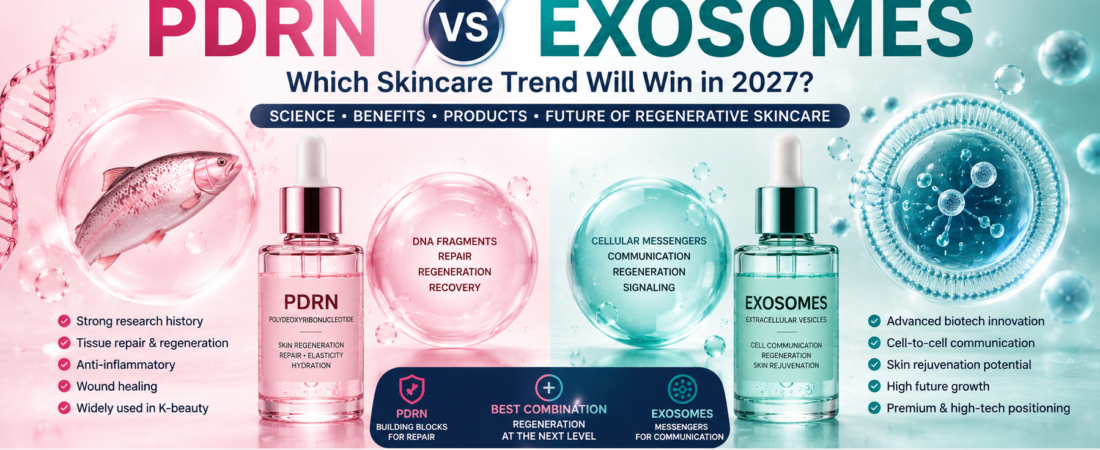
K-beauty’s next generation is increasingly being defined by one idea:
regenerative skincare.
Instead of focusing only on hydration, brightening or traditional anti-aging, brands are borrowing language and concepts from biotechnology, aesthetic medicine and skin-recovery research.
Two ingredients sit at the center of that shift:
PDRN and exosomes.
PDRN has already moved rapidly from Korean aesthetic treatments into serums, creams, masks and other everyday skincare formats.
Exosomes are following a similar path, appearing in both professional aesthetic applications and increasingly sophisticated at-home products.
So when comparing PDRN vs exosomes, which technology has the stronger skincare opportunity in 2027?
The answer depends on whether we are talking about scientific maturity, consumer understanding, product differentiation or future innovation.
And increasingly, brands are asking a different question:
Why choose one when you can combine both?
For more background on PDRN itself, read our PDRN Skincare in 2027 Guide.
PDRN vs Exosomes: Quick Comparison
| Factor | PDRN | Exosomes |
|---|---|---|
| Basic concept | DNA fragments | Extracellular communication vesicles |
| Traditional research area | Tissue repair / regeneration | Cell-to-cell communication / regeneration |
| Consumer awareness | Rapidly growing | Emerging |
| Topical evidence | Developing | Developing |
| Research complexity | Moderate | Very high |
| Ingredient standardization | More understandable | Major challenge |
| Marketing power | Very high | Very high |
| Clinical-inspired positioning | Strong | Extremely strong |
| Source differentiation | Salmon / plant / microbial | Cell, plant, microbial and EV-derived concepts |
| 2027 innovation potential | High | Very high |
| Hybrid-product potential | Very high | Very high |
The simplest way to understand PDRN vs exosomes is this:
PDRN provides regenerative building blocks and signaling-related biological effects.
Exosomes act more like biological communication packages.
That difference gives each technology a very different skincare story.
What Is PDRN?
PDRN stands for polydeoxyribonucleotide.
Traditional medical PDRN consists of purified DNA fragments commonly obtained from salmonid sources. Research has investigated PDRN in tissue repair, wound healing and inflammatory processes, including mechanisms involving adenosine A2A receptor signaling and nucleotide salvage pathways.
That medical history helped create PDRN’s skincare appeal.
The ingredient already carried associations with:
regeneration, recovery, wound repair and Korean aesthetic treatments.
However, there is an important distinction between established research on medically delivered PDRN and the rapidly expanding market for topical PDRN cosmetics.
Evidence for ordinary topical PDRN serums is still substantially less mature than the evidence surrounding medical and injectable applications.
That does not mean topical PDRN does nothing.
It means the strength of a product should be judged by its complete formulation and product-specific evidence, not by the word PDRN alone.
What Are Exosomes?
Exosomes are a subtype of extracellular vesicle, generally described as tiny membrane-bound particles roughly 30–150 nanometers in size.
They participate in cell-to-cell communication by transporting biological materials such as proteins, lipids and nucleic acids between cells.
This creates a compelling skincare analogy:
If PDRN is a set of regenerative biological materials, exosomes can be thought of more like messengers carrying biological instructions.
That concept is one reason exosomes have attracted so much attention in regenerative aesthetics.
Recent reviews have investigated exosome or extracellular-vesicle approaches for skin rejuvenation, wound healing, pigmentation, hydration, elasticity and other dermatological applications.
But there is a major complication.
The term “exosome” does not guarantee that every cosmetic product contains the same type, purity, source or concentration of material.
The Biggest Exosome Problem: Standardization
This may be the single most important difference when comparing PDRN vs exosomes.
PDRN itself can vary by source, molecular characteristics and concentration.
But exosomes introduce another level of complexity.
Their biological characteristics can depend on:
the source material, cell type, production conditions, isolation method, purification process, storage conditions and characterization techniques.
Dermatology reviews repeatedly identify the lack of standardized sourcing, isolation and characterization as a major challenge for exosome-based products.
This means two products both labeled “exosome serum” may not necessarily contain directly comparable materials.
For consumers, that creates a transparency problem.
For sellers, it creates both a risk and an opportunity.
The brands that can clearly explain what their exosome material actually is may have a major advantage.
Round 1: Which Has the More Established Regenerative Research History?
Winner: PDRN
PDRN has a longer direct history in regenerative medicine.
Research on salmon-derived PDRN has explored tissue repair, anti-inflammatory activity, wound healing and related biological mechanisms for years.
Exosome research is scientifically broad and rapidly expanding, but the application of exosome-based products specifically for cosmetic skin rejuvenation is comparatively newer.
A 2026 systematic review of human exosome-based skin-rejuvenation studies found promising short-term improvements in areas including hydration, elasticity, texture, pigmentation and wrinkle appearance. However, the authors also highlighted the need for stronger evidence.
Another 2026 dermatology review similarly concluded that exosome approaches are promising but noted limitations including small sample sizes, short follow-up and non-randomized study designs.
So if the question is:
Which trend has the more established regenerative heritage?
PDRN currently wins.
Round 2: Which Has the More Advanced Biological Story?
Winner: Exosomes
This is where exosomes become extremely powerful from a marketing perspective.
PDRN can be explained as DNA fragments associated with regenerative pathways.
Exosomes can be explained as cellular messengers.
That creates an advanced biotech narrative:
Tiny biological packages carrying proteins, lipids and genetic information that help cells communicate.
Scientifically, the reality is more complicated than that simplified marketing description, but the underlying concept of extracellular vesicles participating in intercellular communication is well established.
For skincare marketing, that gives exosomes a futuristic positioning that even PDRN struggles to match.
PDRN sounds clinical.
Exosomes sound next-generation.
Round 3: Which Is Easier for Consumers to Understand?
Winner: PDRN
Ironically, despite the strange “salmon DNA” origin story, PDRN is actually easier to explain.
A consumer can understand:
PDRN = DNA fragments associated with regenerative research.
Exosomes require several additional questions:
What are extracellular vesicles?
Where did they come from?
Are they human-derived?
Plant-derived?
Bacterial?
Are they true exosomes or another type of extracellular vesicle?
What exactly is inside them?
How were they purified?
That creates more education work for brands.
The problem is becoming particularly relevant as commercial products use the word exosome for very different ingredient systems.
A Good Example: COSRX PDRN + Exosome
COSRX provides an unusually transparent example.
Its current PDRN EXOSOME Skinplaning Glaze Mask combines Sodium DNA with Lactobacillus extracellular vesicles, alongside ingredients including niacinamide, panthenol, collagen, hyaluronic acid and a peptide. The official ingredient list specifically identifies Lactobacillus Extracellular Vesicles.
COSRX positions the product around:
PDRN + EXOSOME
rather than forcing consumers to choose one technology.
The product is currently listed at $17 on the COSRX U.S. site and is marketed around firmness, hydration, texture and glow.
Commercially, this matters.
The formula already demonstrates where regenerative skincare may be heading:
multiple biotechnology stories inside one product.
Round 4: Which Has More Product Transparency?
Winner: PDRN — for now
A PDRN product can often tell consumers:
salmon PDRN
rose PDRN
green tea PDRN
30,000 ppm PDRN
or another relatively understandable source or concentration story.
Exosome products are harder.
The term can cover different extracellular-vesicle sources and ingredient systems, and current scientific reviews continue to emphasize variability in isolation, characterization and manufacturing.
That means a strong exosome product in 2027 may need to disclose much more than:
Contains exosomes.
Consumers may increasingly want to know:
Source?
Number or concentration?
Purification?
Stability?
Delivery technology?
Human testing?
This is likely to become a major product-development battleground.
Round 5: Which Has Greater 2027 Trend Potential?
Winner: Exosomes — but with Higher Risk
This is an inference based on current research activity and product launches rather than a certainty.
PDRN is already becoming a recognizable mainstream skincare category.
Exosomes are still at an earlier stage of consumer adoption.
That means exosomes have more novelty left to capture.
At the same time, novelty creates risk.
The science is more complex.
Product standardization is weaker.
Consumer understanding is lower.
And the gap between genuine technology and marketing language may become increasingly important.
This makes exosomes potentially higher-growth but higher-risk than PDRN.
Medicube Is Already Combining PDRN + Exosomes
Medicube’s PDRN Pink Collagen Exosome Shot is another important commercial signal.
The current U.S. product is priced at $28 and marketed with Salmon PDRN, exosome and collagen, using a spicule-style at-home booster format. Medicube offers Mild 2000 and Strong 7500 versions.
The brand states that the formula delivers 15 million exosome shots alongside salmon PDRN and positions the product around elasticity, brightening, pores and uneven tone. Those performance claims should be interpreted as brand-reported product testing, not general evidence proving that all PDRN-exosome formulas produce the same results.
This distinction matters.
As regenerative skincare expands, consumers will need to separate:
ingredient science
from
product-specific testing
from
marketing claims.
Medik8 Shows the Premium Version of the Trend
Medik8 has pushed the hybrid concept even further with Exo-PDRN Prismatic+.
The serum combines the brand’s vegan Prismatic PDRN with a Triple Exosome Complex and other proprietary technologies. It was listed at $96 on Medik8’s international store when checked in August 2026.
Medik8 reports an independent clinical study involving 60 volunteers, alongside separate ex-vivo, consumer and penetration testing. The brand reports improvements in luminosity, barrier function, firmness and wrinkles, while some of its headline claims come from ex-vivo and in-vitro testing rather than clinical endpoints.
This is commercially important because it shows where the premium end of regenerative skincare could move.
Not:
PDRN Serum.
Not:
Exosome Serum.
But:
PDRN + Exosomes + Delivery Technology + Growth-Factor-Inspired Technology.
That is a much more difficult product story for generic competitors to copy.
The Most Important Trend: PDRN + Exosomes
The most interesting conclusion from the PDRN vs exosomes debate may be that the market is already moving beyond the debate.
COSRX combines PDRN and extracellular vesicles.
Medicube combines PDRN and exosome positioning in an at-home spicule booster.
Medik8 combines proprietary PDRN with a triple-exosome complex.
Three different brands.
Three different price positions.
Three different product formats.
But the same strategic idea:
combine regenerative technologies instead of choosing only one.
That is a strong signal for 2027.
Why Hybrid Regenerative Skincare Makes Commercial Sense
PDRN and exosomes solve different marketing problems.
PDRN already has strong consumer recognition.
It gives a product a recognizable hero ingredient.
Exosomes add technological novelty.
They make the formula feel more advanced and futuristic.
Together, the story becomes:
PDRN = regeneration
Exosomes = communication
Peptides = firmness
Hyaluronic acid = hydration
Ceramides = barrier
This allows brands to turn complicated biotechnology into a simple benefit stack.
The danger, of course, is overcomplication.
If every product contains ten trendy ingredients but cannot explain what problem it solves, the story becomes weaker rather than stronger.
PDRN vs Exosomes for Beauty Sellers
From a seller’s perspective, PDRN vs exosomes should not be evaluated solely by which ingredient sounds more advanced.
The commercial questions are different.
PDRN currently offers:
stronger consumer recognition, easier education and a rapidly expanding product category.
Exosomes offer:
greater novelty, premium positioning and potentially stronger biotech differentiation.
But exosome products also require greater scrutiny around ingredient source, characterization and claims because the category is less standardized.
For a mass-market product, PDRN may currently be easier to sell.
For a premium biotech product, exosome technology may create more differentiation.
For a high-end regenerative formula, the strongest strategy may be:
PDRN + exosome technology + established supporting actives.
What Sellers Should Check Before Sourcing an Exosome Product
The word “exosome” should not be enough.
Before sourcing or developing a product, sellers should ask for documentation that clarifies the material’s source, manufacturing or isolation method, characterization, concentration or count, stability, safety testing and product-specific efficacy evidence.
This follows directly from the major limitations identified in recent exosome reviews: source variability, inconsistent isolation methods and limited standardization remain important challenges.
For PDRN, similar questions apply to:
source, purity, molecular characteristics, concentration and delivery system.
In other words:
ingredient transparency may become the real competitive advantage of regenerative skincare.
What About Safety?
This is another area where the marketing language needs care.
The 2026 systematic review of exosome-based skin-rejuvenation studies found that interventions were generally tolerable in the controlled clinical studies reviewed, but the overall evidence base remains limited and heterogeneous.
Regulatory concerns become especially serious when exosome products are marketed as medical regenerative treatments, particularly products derived from human cells or tissues.
The U.S. FDA continues to warn consumers about unapproved human-cell and tissue-derived regenerative medicine products. That warning should not be interpreted as saying that every cosmetic labeled “exosome” is the same type of product, but it reinforces why source, intended use and claims matter.
For ordinary skincare consumers, the practical message is simpler:
Do not assume “exosome” automatically means clinically proven or medically equivalent.
Could Exosomes Replace PDRN?
Probably not.
A more likely outcome is that the categories develop together.
PDRN has too much consumer momentum and an increasingly broad product ecosystem to simply disappear.
Exosomes provide a complementary story rather than an identical one.
That makes the future more likely to look like:
PDRN + exosomes
rather than:
PDRN replaced by exosomes.
Current products from COSRX, Medicube and Medik8 already support that interpretation.
Could Exosomes Become the Next PDRN?
Possibly.
PDRN followed a recognizable path:
professional treatment concept
→ consumer curiosity
→ serums and creams
→ mass-market adoption
→ ingredient combinations
Exosomes appear to be moving through a similar commercialization pathway.
However, the exosome category has a harder scientific communication problem because the term covers a much more complex group of biological materials.
Therefore, the brands that win may not simply be the brands that put EXOSOME in the largest letters on their packaging.
They may be the brands that make the technology understandable and verifiable.
So Which One Wins in 2027?
There are different winners depending on the question.
For consumer recognition: PDRN.
For established regenerative history: PDRN.
For technological novelty: Exosomes.
For product complexity and differentiation: Exosomes.
For easier mass-market communication: PDRN.
For premium biotech positioning: Exosomes.
For the most interesting product-development opportunity: PDRN + Exosomes.
That final category may ultimately matter most.
The Bottom Line
The PDRN vs exosomes debate is not really about choosing between two identical skincare ingredients.
They represent two different approaches to regenerative skincare.
PDRN has a stronger established story.
Consumers increasingly recognize it.
Brands understand how to market it.
And a growing ecosystem of PDRN serums, creams, masks and treatment-inspired products already exists.
Exosomes are more complicated.
But that complexity is also what makes them interesting.
Recent systematic reviews show meaningful potential in skin rejuvenation, while simultaneously highlighting the need for stronger trials, better standardization and longer-term evidence.
Going into 2027, PDRN may remain the easier ingredient to sell.
Exosomes may become the more exciting technology to watch.
But products from COSRX, Medicube and Medik8 suggest that the market is already discovering a third option:
use both.
For beauty sellers, that means the next major opportunity may not be finding the single hottest ingredient.
It may be finding the right combination of:
regenerative technology + understandable benefit + credible evidence + differentiated formulation.
And in 2027, PDRN + exosomes could become one of the most important combinations in that category.
FAQ
Is PDRN better than exosomes?
Neither is universally better. PDRN currently has a longer direct history in regenerative medicine and stronger consumer recognition, while exosome-based skincare has newer but promising research and greater technological complexity.
What is the main difference between PDRN and exosomes?
PDRN is composed of DNA fragments, while exosomes are small extracellular vesicles involved in cell-to-cell communication and capable of carrying proteins, lipids and nucleic acids.
Can PDRN and exosomes be used together?
Yes. Current commercial examples already combine them, including COSRX PDRN EXOSOME Skinplaning Glaze Mask, Medicube PDRN Pink Collagen Exosome Shot and Medik8 Exo-PDRN Prismatic+.
Do topical exosome skincare products really work?
Research is promising, but the evidence is not yet strong enough to treat every topical exosome product as equally effective. Recent reviews report potential improvements in skin-rejuvenation outcomes while also highlighting small studies, short follow-up and substantial variation between products and methodologies.
Are all skincare exosomes the same?
No. Exosome and extracellular-vesicle materials can differ substantially depending on source, manufacturing, isolation, purification and characterization. Product labels therefore need to be evaluated individually.
Which has more potential in 2027?
PDRN appears stronger for mainstream commercial adoption, while exosomes may have greater upside for premium biotechnology positioning. Based on current product launches, a growing hybrid PDRN + exosome category is also plausible. This is a market inference rather than a certainty.
What should beauty sellers look for in an exosome product?
The most important factors are transparency around source, characterization, concentration or count, manufacturing, stability, safety and product-specific evidence. Recent scientific reviews identify standardization as one of the category’s major unresolved challenges.