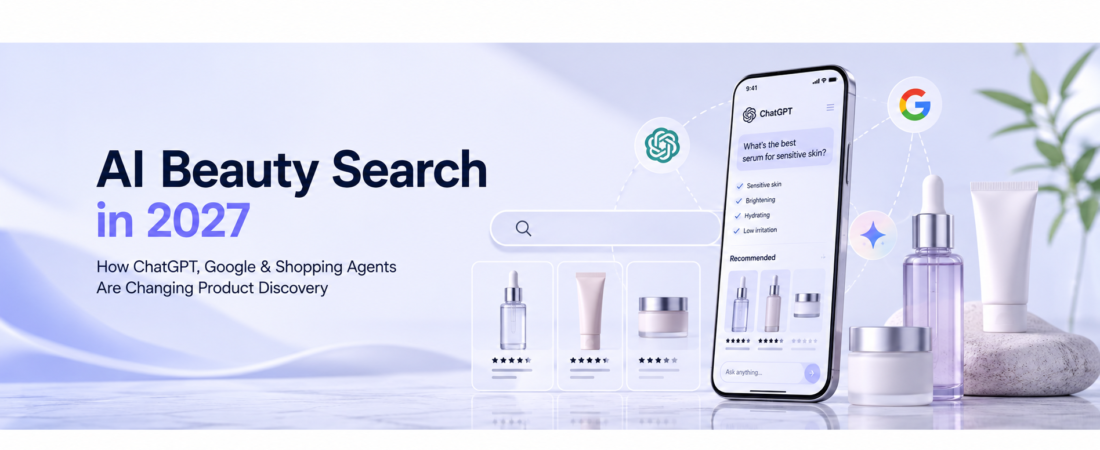
AI Beauty Search is changing one of the most important parts of the beauty industry:
how consumers decide what to buy.
For years, beauty discovery followed familiar paths.
A shopper might:
- Search Google
- Watch YouTube reviews
- Browse Sephora
- Read Reddit
- Search Amazon
- Follow TikTok creators
Those channels still matter.
But another layer is becoming increasingly important:
AI-generated product recommendations.
Instead of typing:
“best serum for dry skin”
into a traditional search engine, consumers can now ask:
“I have combination skin, use retinol three nights a week, live in a humid climate and want a Korean serum under $30 that will not feel sticky. What should I buy?”
That is a completely different kind of search.
The user is not simply looking for ten blue links.
They are asking an AI system to:
- Interpret their needs
- Compare products
- Evaluate trade-offs
- Summarize reviews
- Consider ingredients
- Match price
- Recommend a short list
This shift could change beauty SEO, e-commerce and product content at the same time.
According to NielsenIQ’s 2026 analysis of AI beauty shopping, 49% of shoppers have already received beauty product recommendations from generative AI platforms such as ChatGPT, Claude, Gemini and Copilot.
That makes AI Beauty Search more than a future prediction.
It is already part of the beauty discovery journey.
AI Beauty Search: Quick Summary
| Area | Traditional Beauty Search | AI Beauty Search |
|---|---|---|
| Query style | Keywords | Natural conversation |
| Example | “best PDRN serum” | “Best PDRN serum for sensitive skin under $30” |
| Results | Links / product grids | Personalized recommendations |
| Comparison | User compares manually | AI summarizes differences |
| Product data | Search snippets | Structured product information |
| Reviews | User reads individually | AI may synthesize patterns |
| SEO focus | Keywords + rankings | SEO + GEO + product clarity |
| Commerce path | Search → website | AI → recommendation → retailer |
| 2027 opportunity | Mature | Rapidly expanding |
The biggest change is:
Beauty brands are no longer optimizing only to be found. They may increasingly need to be understood well enough to be recommended.
What Is AI Beauty Search?
AI Beauty Search refers to product discovery through generative AI and conversational shopping systems.
Instead of searching a fixed phrase and scanning results manually, users describe:
- Skin concerns
- Hair concerns
- Budget
- Texture preferences
- Ingredient preferences
- Allergies or exclusions
- Desired benefits
- Brand preferences
The AI then tries to narrow the available market.
For example:
Traditional Search
best Korean moisturizer
AI Beauty Search
I have dehydrated combination skin and use tretinoin. I want a Korean moisturizer without fragrance that feels light enough for summer. Compare three options under $35.
That query contains multiple conditions.
A conventional search engine can return relevant webpages.
An AI shopping system can attempt to combine those conditions into one recommendation.
Why Beauty Is Especially Well Suited to AI Search
Beauty is unusually complicated.
Consumers do not shop only by:
- Brand
- Price
- Size
They also think about:
- Skin type
- Skin concern
- Ingredient compatibility
- Sensitivity
- Finish
- Texture
- Routine position
- Climate
- Product format
- Personal preference
That complexity makes beauty a strong fit for conversational search.
OpenAI describes shopping research as particularly useful for detail-heavy categories including beauty, where users need help comparing many attributes and trade-offs.
Read OpenAI’s Shopping Research announcement.
ChatGPT Is Becoming a Product Discovery Platform
ChatGPT is increasingly used for shopping research.
OpenAI says consumers can use ChatGPT to:
- Explore products
- Compare options
- Refine preferences
- Review prices
- Examine product features
- Research trade-offs
The system can use:
- Merchant product data
- Publicly available product information
- Retail sources
to help build recommendations.
See how Shopping Research works in ChatGPT.
This creates a significant change for beauty brands.
Historically, brands asked:
How do we rank on Google?
Now another question is becoming relevant:
How do we make sure AI systems correctly understand our products?
Product Discovery in ChatGPT Is Becoming More Structured
In March 2026, OpenAI expanded product discovery in ChatGPT using the Agentic Commerce Protocol.
The aim is to provide more complete and current product information directly inside the shopping experience.
Users can increasingly:
- Browse products visually
- Compare options side-by-side
- Review price
- Review ratings
- Evaluate product features
without manually opening dozens of tabs.
Read OpenAI’s 2026 Product Discovery announcement.
For beauty, this could make structured product information increasingly important.
A product page that clearly explains:
- What the product is
- Who it is for
- Ingredients
- Size
- Price
- Benefits
- Product type
- Usage instructions
- Clinical evidence
may be easier for an AI system to interpret than a page dominated by vague lifestyle copy.
AI Recommendations Are Not the Same as Ads
This distinction matters.
OpenAI states that product results in ChatGPT shopping experiences are selected independently and are not ads, while advertising is separate.
Read OpenAI’s Shopping with ChatGPT Search guidance.
That means brands cannot simply assume:
pay more = appear more.
AI product discovery depends on relevance and available product information.
This creates a different kind of competition.
Google Is Moving From Keywords Toward Conversational Shopping
Google is changing too.
Google’s Shopping Graph has become a massive real-time product database containing:
- Product listings
- Inventory
- Prices
- Reviews
Google said in early 2026 that the Shopping Graph contained more than 50 billion product listings, with more than 2 billion listings refreshed every hour.
Read Google’s 2026 NRF remarks.
By May 2026, Google said Shopping Graph had grown to more than 60 billion listings.
Read Google’s Universal Cart announcement.
The important part is not only scale.
It is how Google is using that data.
Google AI Mode Changes the Shopping Query
Traditional Google shopping relies heavily on:
keywords.
AI Mode allows consumers to ask more conversational questions.
Instead of:
Korean moisturizer sensitive skin
a consumer can ask:
What Korean moisturizer should I use if I have sensitive skin, use retinol and want something lightweight enough for Florida?
That means search behavior can become:
longer
more specific
and:
more personal.
Google itself describes this as a movement from keywords toward natural conversations.
Shopping Agents Could Move Beyond Recommendation
The next stage is even more important.
AI shopping systems may not only tell users what to buy.
They may increasingly help users:
- Monitor products
- Compare prices
- Build carts
- Choose sellers
- Complete purchases
Google’s 2026 Universal Cart was designed to let users add products across:
- Search
- Gemini
- YouTube
- Gmail
into one intelligent shopping experience.
That is part of a larger move toward agentic commerce.
Read Google’s Universal Cart announcement.
What Is Agentic Commerce?
Traditional e-commerce requires the consumer to perform most of the work.
The shopper:
- Searches
- Opens websites
- Compares products
- Checks prices
- Reads reviews
- Adds an item to the cart
- Purchases
Agentic commerce changes the role of software.
An AI agent may help perform parts of that process.
For example:
Find me a fragrance-free Korean moisturizer under $30 that ships within two days and has strong reviews.
The agent could potentially:
- Identify relevant products
- Compare attributes
- Remove unsuitable options
- Check current sellers
- Recommend the final choice
That reduces the importance of browsing hundreds of products manually.
Beauty Could Be One of the Strongest Agentic Commerce Categories
McKinsey’s State of Beauty 2026 argues that agentic commerce could become a meaningful opportunity for beauty.
McKinsey estimates that AI platforms could influence up to 35% of e-commerce transactions over the next three to five years.
In beauty specifically, AI agents could help users navigate a huge digital assortment and compare:
- Ingredients
- Efficacy claims
- Routines
- Individual needs
Read McKinsey’s State of Beauty 2026.
That creates a major question for brands:
What information will AI systems use to decide which product to recommend?
From SEO to GEO
This is where the beauty industry may need a new concept.
Traditional search optimization focuses on:
SEO — Search Engine Optimization.
McKinsey argues that brands may increasingly need:
GEO — Generative Engine Optimization.
The goal changes slightly.
SEO asks:
How do I rank for this keyword?
GEO asks:
How do I make my information clear enough to be interpreted and surfaced in an AI-generated answer?
McKinsey specifically highlights product information such as:
- Ingredients
- Benefits
- Clinical validation
- Use occasions
as information brands may need to structure clearly for AI systems.
SEO Is Not Dead
This does not mean brands should abandon SEO.
AI systems often rely on information that already exists online.
Therefore:
weak web presence can also create weak AI visibility.
SEO and GEO are likely to overlap heavily.
Useful content still needs:
- Crawlable pages
- Clear headings
- Product information
- Strong internal linking
- Reliable sources
- Structured data
- Consistent brand information
The difference is that content may increasingly serve two audiences:
human shoppers
and:
machine interpretation.
What AI Needs From a Beauty Product Page
Imagine an AI system trying to recommend a serum.
Product Page A
Says:
“Unlock your ultimate glow with the power of nature.”
Product Page B
Clearly states:
- Niacinamide serum
- 5% niacinamide
- 30 mL
- Fragrance-free
- Lightweight water-gel texture
- Designed for uneven tone and oil balance
- Patch-tested on sensitive skin
- $24
- Use morning or evening
Which one is easier for an AI system to understand?
Usually:
Product B.
This does not mean brands should remove emotion from marketing.
It means emotional storytelling should not replace factual product information.
Ingredient Transparency Becomes More Important
AI beauty search creates another reason for brands to provide clear ingredient information.
Consumers increasingly ask questions such as:
Is this fragrance-free?
Does this contain niacinamide?
Can I use this with retinol?
Is this vegan?
Does this contain PDRN?
What type of vitamin C does it use?
An AI recommendation is only as reliable as the available information.
This makes transparent ingredient labeling increasingly valuable.
For consumers, our guide to How to Read a Skincare Ingredient List explains how INCI order and the 1% rule should be interpreted.
Clinical Evidence May Become Machine-Readable Marketing
Another important change is how brands communicate evidence.
Beauty brands frequently say:
clinically tested
or:
clinically proven.
But those phrases can hide very different study designs.
AI systems may eventually compare claims across products.
That makes detailed evidence more useful than generic clinical language.
Brands should clearly explain:
- Number of participants
- Study duration
- What was measured
- Instrumental vs perception study
- Finished product vs ingredient study
- Control group
- Result magnitude
For a deeper explanation, read our guide to Clinically Tested Skincare.
Why AI Could Reward Better Product Information
There is a commercial reason to care.
NIQ reports that 49% of shoppers have already received beauty recommendations from generative AI.
More than half are interested in using AI-powered tools across the shopping journey.
Read NIQ’s AI Beauty Advisor analysis.
If AI becomes another product-discovery gatekeeper, brands with weak or inconsistent information could become harder to recommend confidently.
Beauty and Personal Care Is Already Leading AI Product Discovery
Euromonitor reported in May 2026 that Beauty and Personal Care ranked first among FMCG categories for AI-driven product searches globally in 2025.
It also reported that global skincare e-commerce penetration had reached approximately 37% in 2026, with nearly 40% projected by 2030.
Read Euromonitor’s Digital Beauty report.
That combination matters:
- high online penetration
- high information complexity
= high AI search usage
a category particularly exposed to AI-driven discovery.
AI Referral Traffic Is Growing Rapidly
The shift is also visible in web traffic.
Euromonitor reported that AI-driven referrals to retail websites increased 304% between January and December 2025, compared with 40% growth from other referral sources.
It also reported that ChatGPT referrals to U.S. websites increased 367% during 2025.
Read Euromonitor’s AI referral report.
These percentages come from a small and fast-growing base.
But the direction is important.
AI is beginning to create measurable referral traffic.
The Consumer Journey Is Becoming Less Linear
The old beauty funnel might look like:
Google → Website → Purchase.
The current journey may look more like:
TikTok
↓
ChatGPT
↓
↓
Amazon
↓
Brand website
↓
Purchase
Or:
Google AI Mode
↓
Product comparison
↓
Sephora
↓
Purchase
Consumers move between platforms.
That means attribution becomes more complicated.
The platform that generated the purchase may not be the platform that created the original demand.
AI Beauty Search and Social Commerce Will Work Together
Generative AI is not replacing TikTok.
The two systems solve different problems.
TikTok
Excellent for:
- Discovery
- Trends
- Visual demonstrations
- Creator influence
AI Search
Excellent for:
- Comparison
- Research
- Personalized questions
- Decision support
NIQ’s 2026 State of Beauty data shows both trends accelerating simultaneously.
It reported:
- 49% receiving beauty recommendations from GenAI
- 53% purchasing through social platforms
- 22% buying directly through TikTok Shop
Read NIQ’s 2026 global beauty market report.
The future beauty funnel may therefore be:
social discovery → AI validation → commerce.
Why K-Beauty May Be Well Positioned for AI Discovery
K-beauty has several characteristics that fit AI search particularly well.
1. Clear Ingredient Stories
Korean products frequently lead with:
- Centella
- PDRN
- Peptides
- Ceramides
- Spicules
- Snail mucin
These are highly searchable concepts.
2. Specific Product Functions
Products are often positioned around:
- Barrier support
- Hydration
- Brightening
- Pore appearance
- Sensitive skin
- Repair
These create clear problem-solution relationships.
3. Accessible Pricing
AI recommendations often include budget constraints.
K-beauty frequently competes in the:
$15–$40 skincare range
which can make products easy to include in comparison recommendations.
4. Strong Online Distribution
Korean brands increasingly sell through:
- Amazon
- TikTok Shop
- Sephora
- Olive Young Global
- Brand websites
Our analysis of K-Beauty in the U.S. 2026 explains how these channels are reshaping Korean beauty distribution.
PDRN Is a Good Example of AI-Friendly Beauty Search
Consider a consumer asking:
What is the best Korean PDRN serum?
Traditional SEO may return several ranking pages.
AI can instead ask:
Are you prioritizing concentration, sensitive skin, price or clinical evidence?
Then compare products.
This makes product attributes more valuable.
For example:
- PDRN concentration
- DNA source
- Product format
- Supporting ingredients
- Delivery system
- Price
Our PDRN Skincare 2027 and PDRN Delivery Technology guides show how much context can exist behind one apparently simple ingredient.
AI systems are especially useful when the consumer needs that context summarized.
Better AI Discovery Requires Better Claims
There is also a risk.
AI systems may repeat product claims that appear online.
If inaccurate claims become widely copied across:
- Retail pages
- Blogs
- Social media
- Affiliate sites
they can become difficult to correct.
This makes evidence quality increasingly important.
Brands should clearly separate:
Ingredient Evidence
Research on a raw material or ingredient.
Finished-Product Evidence
Testing on the actual commercial formula.
Marketing Interpretation
The wording used to communicate the result.
Those are not interchangeable.
The Risk of AI Hallucinations in Beauty
AI systems can make mistakes.
Possible problems include:
- Incorrect product ingredients
- Outdated prices
- Discontinued products
- Wrong concentration
- Misinterpreted studies
- Incorrect compatibility claims
OpenAI itself notes that shopping research can occasionally make mistakes involving information such as price and availability, and users should verify retailer information before purchasing.
Read OpenAI’s Shopping Research limitations.
This means brands should make authoritative information easy to find.
Product Data Consistency Could Become a Competitive Advantage
Imagine a product has:
Brand Website
30 mL / $29 / 5% niacinamide.
Amazon
30 mL / $25 / percentage not listed.
Retailer B
30 mL / $32 / says 10% niacinamide.
Affiliate Blog
Claims 12%.
That creates uncertainty.
AI systems may encounter conflicting information.
Brands should aim for consistent product data across:
- Brand site
- Amazon
- Retail partners
- Social commerce
- Merchant feeds
Consistency supports both customers and machine interpretation.
Reviews May Become More Important, Not Less
AI can summarize reviews.
That changes the usefulness of large review datasets.
A shopper may ask:
What do people with sensitive skin say about this moisturizer?
Instead of manually reading 300 reviews, AI may summarize recurring themes.
That means review quality and authenticity become even more important.
Brands cannot only optimize the product page.
They also need:
a strong post-purchase experience.
Structured Data Still Matters
Machine-readable information can help search systems understand products.
Relevant structured product information may include:
- Product name
- Price
- Availability
- Reviews
- Ratings
- Brand
- SKU
Google already uses structured data and merchant feeds in shopping experiences.
AI-driven commerce gives brands another reason to keep product data clean.
AI Search Could Change Beauty Content Sites Too
This shift does not only affect brands.
Publishers and beauty content sites may also need to adapt.
Traditional content strategies often relied on:
Best X Products
and:
X vs Y.
Those formats still have value.
But if AI can directly compare products, publishers need to add something AI summaries cannot easily replace.
Examples include:
- Original analysis
- Evidence interpretation
- Market context
- Transparent methodology
- Expert commentary
- Comparative frameworks
- Unique datasets
This is one reason Beauty Seller Lab increasingly focuses on combining:
beauty science + market analysis + commerce context.
Content Should Answer Real Questions
GEO does not necessarily mean writing strange AI-optimized text.
It may mean answering questions more clearly.
Instead of:
“Our revolutionary cream transforms your skin.”
say:
“This fragrance-free moisturizer contains ceramides and panthenol and is designed for dry or barrier-compromised skin.”
That sentence is better for:
- Humans
- Search engines
- AI systems
because the information is explicit.
AI Beauty Search Could Make Niche Brands More Discoverable
There is a potential upside for smaller brands.
Traditional retail favors:
- Distribution
- Shelf space
- Brand awareness
Traditional search favors:
- Domain authority
- Backlinks
- Established rankings
AI recommendation systems may create new opportunities when users ask highly specific questions.
For example:
Korean moisturizer under $25 without fragrance for dry skin.
A smaller product that fits the criteria well could potentially appear alongside larger brands.
That makes product fit more important.
But Large Brands Still Have Major Advantages
AI does not automatically democratize commerce.
Large brands often have:
- More product reviews
- More retailer listings
- More authoritative mentions
- Better product feeds
- Larger content ecosystems
- Higher brand awareness
Those signals create more information for AI systems to use.
Smaller brands therefore need exceptional clarity.
What Beauty Brands Should Do Now
Brands do not need to redesign their entire strategy around AI tomorrow.
But several actions already make sense.
1. Standardize Product Information
Ensure important attributes are consistent across channels.
2. Make Ingredient Information Clear
Avoid hiding useful product facts inside images only.
3. Explain Who the Product Is For
Use explicit language around:
- Skin concern
- Texture
- Product type
- Routine position
4. Publish Evidence Transparently
If clinical testing exists, explain:
- Participants
- Duration
- Measurement
- Result
5. Build Searchable Educational Content
Help users understand the category.
6. Maintain Accurate Retail Listings
Price and availability matter.
7. Monitor AI Recommendations
Brands should periodically test queries such as:
best serum for X
best moisturizer for Y
compare Brand A vs Brand B
to understand how AI platforms describe the market.
What Beauty Sellers Should Do
Retailers face a similar challenge.
A product listing should not only contain:
title + image + price.
Better listings may include:
- Skin concern
- Key ingredients
- Product format
- Texture
- Size
- Routine step
- Claims
- Evidence
- Compatibility information
This makes products easier to compare.
Will GEO Replace SEO?
Probably not.
A better model is:
SEO + GEO + Commerce Data.
SEO
Helps content get discovered on search engines.
GEO
Helps AI systems understand and potentially cite or recommend information.
Commerce Data
Helps shopping systems identify:
- Price
- Availability
- Product attributes
All three may increasingly work together.
What About Traditional Google Rankings?
They still matter enormously.
AI systems do not exist in an information vacuum.
High-quality web content remains part of the information ecosystem.
The long-term strategy is therefore not:
stop doing SEO.
It is:
make SEO content more useful, structured and evidence-aware.
The 2027 Beauty Discovery Funnel
A plausible consumer journey in 2027 could look like this:
Discovery
TikTok or Instagram introduces a product.
Research
ChatGPT or Gemini explains:
- Ingredients
- Pros
- Cons
- Alternatives
Validation
The consumer checks:
- Reviews
- Clinical evidence
Commerce
The consumer chooses:
- Amazon
- Sephora
- TikTok Shop
- Brand website
Repeat Purchase
An AI assistant may eventually remember preferences and simplify repeat decisions.
This is not a distant science-fiction scenario.
Many pieces already exist.
Beauty Seller Lab View
AI Beauty Search changes the competitive question.
The old question was:
Can consumers find your product?
The new question may increasingly become:
Can an AI system understand why your product is relevant to this particular consumer?
That requires better information.
Not more hype.
Brands that provide:
clear ingredients
specific benefits
transparent evidence
consistent product data
accurate pricing
and:
useful educational content
may be better prepared for an AI-mediated shopping environment.
The beauty industry has spent years optimizing:
shelf placement
then:
Google rankings
then:
social feeds.
The next shelf may be:
the AI-generated recommendation.
FAQ
What is AI Beauty Search?
AI Beauty Search refers to using generative AI and conversational shopping tools to discover, research and compare beauty products.
Are consumers already using AI for beauty recommendations?
Yes. NIQ reported that 49% of shoppers had already received beauty recommendations from generative AI platforms.
How does ChatGPT recommend products?
ChatGPT shopping tools can use user intent, public product information, merchant data and retail sources to identify relevant options.
Is ChatGPT shopping advertising?
OpenAI states that product results are selected independently and are separate from advertisements.
What is GEO?
GEO stands for Generative Engine Optimization. It refers to structuring information so generative AI systems can more easily understand and surface it.
Will GEO replace SEO?
Probably not. SEO and GEO are likely to complement each other because AI systems still depend on information available on the web.
Why is beauty suited to AI shopping?
Beauty products involve many variables including skin type, ingredients, concerns, texture, price and routine compatibility, making conversational comparison useful.
Can AI give incorrect beauty recommendations?
Yes. AI systems may produce incorrect or outdated information, so users should verify important product details with reliable sources.
How can beauty brands prepare for AI search?
Brands should provide consistent product data, clear ingredient information, specific benefits, transparent evidence and accurate retailer listings.
Is K-beauty well positioned for AI discovery?
Potentially. K-beauty often uses ingredient-led product stories, clear skin-concern positioning and strong online distribution, all of which are compatible with conversational product discovery.
The Bottom Line
AI Beauty Search is becoming a new layer of beauty commerce.
Consumers are moving from:
typing short keywords
toward:
asking detailed shopping questions.
ChatGPT is expanding conversational product discovery.
Google is integrating AI with one of the world’s largest product databases.
Beauty shoppers are already using generative AI for recommendations.
And major industry researchers are beginning to discuss:
Generative Engine Optimization.
For beauty brands, that means product content can no longer exist only to look attractive.
It also needs to be:
clear
structured
credible
and:
easy to interpret.
The future beauty winner may not simply be the product with the best SEO.
It may be the product that both:
people understand
and:
AI can confidently recommend.